
Table of Contents
InPage files are not like ordinary Word documents. If someone sends you an .inp file, you usually need Urdu InPage installed just to open it. That creates a problem when you want to send the document to a printer, share it with a client, archive it, or let someone review it on a phone. The simplest fix is to convert InPage to PDF.
A PDF preserves the page layout much better than copying Urdu text into another editor. It also avoids the common problem of missing Nastaliq fonts on another computer. The catch is that most PDF tools cannot open a native InPage .inp file directly. In practice, the best “InPage to PDF converter” is often a print-to-PDF workflow inside InPage itself, followed by a PDF editor if you need to revise, annotate, compress, or sign the file. Here are four options:
- PDFelement: Opens the InPage file, prints it through PDFelement instead of a physical printer, and saves it as a PDF that you can also review, edit, compress, annotate, or reorganize afterward.
- Microsoft Print to PDF: This Windows' built-in tool can print the InPage document directly into a PDF file, making it the easiest free choice for simple viewing and sharing.
- XPS: Print a InPage document to an XPS file first, then uploads that XPS file to an online converter to create a PDF when direct PDF export is unavailable.
- Export the InPage Page as an Image: This method exports the InPage page as an image file and then converts that image into a PDF, which is useful for preserving layout but usually limits text quality and editability.


 G2 Rating: 4.5/5 |
 100% Secure
What Is an InPage File and Why Convert It to PDF?
InPage is a desktop publishing and word processing program widely used for Urdu, Arabic, Persian, and related right-to-left text layouts. Its native file format is usually .inp. InPage became popular because it handles Nastaliq typography, especially Urdu Noorinastaliq-style text, in ways that older general-purpose word processors often struggled with.
That strength is also the reason .inp files can be awkward outside the InPage environment. A recipient who does not have the correct version of InPage may not be able to open the file. Even if they can open it, fonts, page size, and text flow can vary depending on the system.
PDF is better for distribution because it is designed to preserve layout. Once you convert an InPage file to PDF, the recipient can open it in a browser, a PDF reader, or a PDF editor without installing InPage. This is useful for:
- sending Urdu articles, forms, notices, books, advertisements, or certificates for review;
- printing a file without giving the printer the original editable InPage document;
- archiving a document in a more universal format;
- adding comments, signatures, stamps, page numbers, or OCR after conversion.
The main thing to understand is this: a search for an inpage file convert to pdf tool may bring up many converter websites, but native .inp support is rare. You usually need to open the file in InPage first, then print, export, or save it into a format that PDF tools can process.
Best Ways To Convert InPage to PDF
There are several reliable ways to convert InPage to PDF. The right method depends on what you have installed, whether you need to edit the PDF afterward, and whether you are comfortable uploading document files to an online service.
Method 1: Convert InPage to PDF with PDFelement as a PDF Printer
If you already use InPage and want a clean PDF that you can edit afterward, printing the document to Wondershare PDFelement is one of the most practical workflows. PDFelement does not need to directly open the .inp file. Instead, it acts as a PDF printer: InPage sends the page output to PDFelement, and PDFelement creates the PDF.
This method is useful when your next step is not just viewing the PDF. For example, after conversion you may want to fix a typo in a text box, add a watermark, combine the file with other PDFs, compress it before emailing, or add comments for review. A basic print-to-PDF tool can create the file, but it will not give you the same editing and document management options afterward.

G2 Rating: 4.5/5 |100% Secure
Steps to convert InPage to PDF with PDFelement
First, open the .inp file in Urdu InPage. Check the page size, margins, and visible text before printing. This is worth doing because the PDF will reflect the layout that InPage sends to the printer.
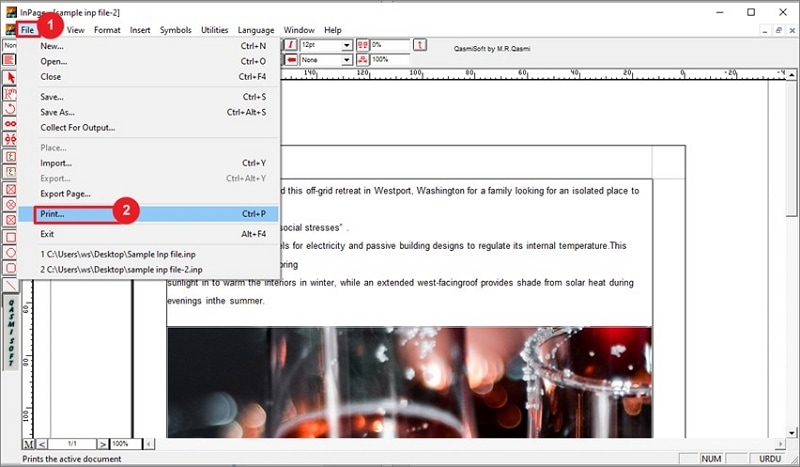
Next, open the print dialog in InPage. In most versions, you can go to File > Print or press Ctrl + P.
In the printer list, choose Wondershare PDFelement. If you do not see it, make sure PDFelement is installed correctly and that the PDF printer component is available on your system.
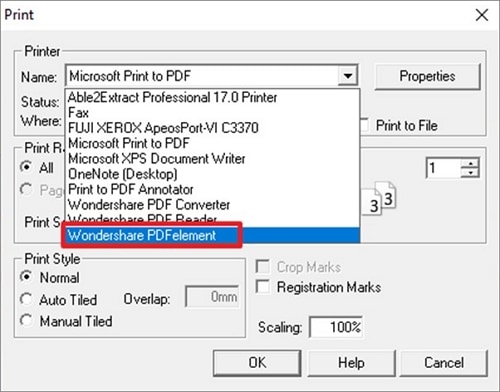
Click OK or Print. InPage will send the document output to PDFelement instead of a physical printer. PDFelement will then create and open the PDF.
Once the PDF opens, review it carefully. Look at Urdu joins, line breaks, page edges, images, and headers or footers. If everything looks correct, save the PDF to the folder you want. If the document needs changes, you can use PDFelement to edit, annotate, organize pages, compress the file, or prepare it for sharing.
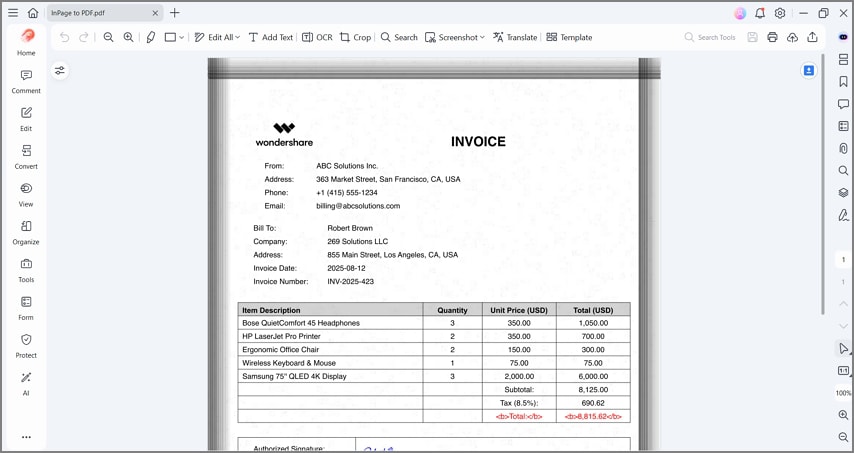
This approach is a good fit for office documents, educational material, publishing drafts, and client files where the PDF may need more work after conversion.
Method 2: Convert InPage to PDF Free with Microsoft Print to PDF
If you only need a PDF and do not need advanced editing, the built-in Windows printer can be enough. Windows includes Microsoft Print to PDF, which lets many desktop programs save printable content as a PDF file. Microsoft also provides general information about printing to PDF through Windows support resources, such as its guidance on printing to PDF in Windows.
Open your .inp document in InPage, then go to File > Print. In the printer dropdown, choose Microsoft Print to PDF. Click Print or OK, choose a file name, and save the PDF.
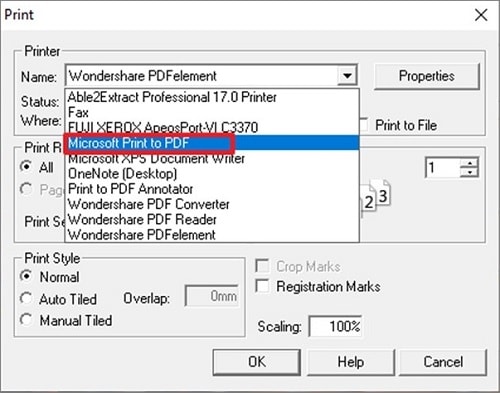
After saving, open the PDF in your usual PDF reader and inspect the pages. Pay special attention to the Urdu text shape and page boundaries. If the layout is cut off, return to InPage and check the paper size in both the document settings and print settings. A mismatch between A4, Letter, Legal, or custom page sizes is a common reason for clipped output.

This is the simplest free method for many Windows users. Its limitation is that the resulting PDF is usually treated like a printed page. You may not be able to edit text easily, especially if the original InPage output is rendered in a way that the PDF editor sees as shapes or image-like content. If you need editing, OCR, comments, or compression, open the generated PDF in a dedicated PDF editor afterward.
Method 3: Use XPS as a Bridge, Then Convert Online
Some people search for an inpage to pdf converter online because they do not want to install another PDF program. The difficulty is that most online PDF converters do not accept .inp files directly. One workaround is to create an XPS file from InPage, then convert the XPS file to PDF online.
XPS is Microsoft’s fixed-layout document format. It is not as universally used as PDF, but it can serve as a bridge when direct PDF output is inconvenient. Microsoft has documentation about the XPS document format if you need background on how it works.
Open the InPage file and choose File > Print. In the printer list, select Microsoft XPS Document Writer. Save the file as an .xps document.
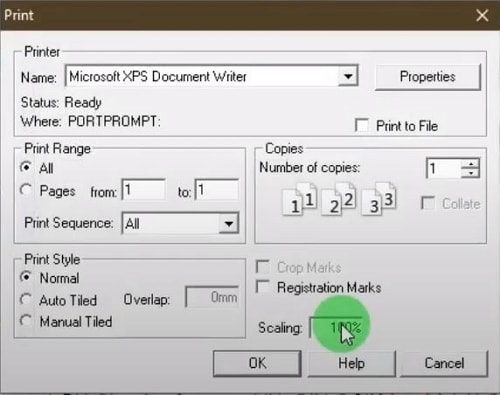
Then open a browser and use an online converter that supports XPS to PDF conversion. Upload the XPS file, start the conversion, and download the PDF when finished.
This method can work, but it is less direct than printing to PDF. It also has privacy considerations. If the document contains confidential business information, student records, legal text, identity details, or unpublished material, avoid uploading it to a third-party website unless you have checked the service’s privacy policy and file deletion practices. For sensitive documents, an offline method is safer.
Method 4: Export the InPage Page as an Image, Then Convert the Image to PDF
Another online workaround is to export the InPage page as an image, such as GIF or another supported image format, then convert that image into a PDF. This is sometimes useful for posters, single-page notices, banners, or designs where visual appearance matters more than selectable text.
In InPage, open the file and look for an export option such as File > Export Page. Save the page as an image file. Then use an image-to-PDF tool to create the PDF.
The downside is quality and editability. An image-based PDF is usually not text-editable. If you zoom in too far, text may look blurry depending on export resolution. For a single flyer or proof, that may be fine. For a multi-page Urdu book, form, or academic file, this workflow is rarely the best choice unless you later apply OCR.
If you use this method, export at the highest practical resolution and check the PDF at 100% and 200% zoom before sending it. A PDF can look acceptable on your screen but print poorly if the image resolution is too low.
Which InPage to PDF Converter Method Should You Use?
The best in page to pdf converter workflow depends less on the name of the tool and more on what you need after conversion. A one-page notice for printing has different requirements from a confidential office file or a long Urdu manuscript.
| Method | Best For | Internet Required | Extra Software Required | Main Limitation |
|---|---|---|---|---|
| PDFelement PDF printer | Converting, reviewing, editing, annotating, compressing, and managing the PDF | No | Yes | Requires installation |
| Microsoft Print to PDF | Quick free conversion on Windows | No | No, if available in Windows | Limited editing after conversion |
| XPS to online PDF converter | Users who cannot print directly to PDF | Yes | No extra PDF app, but uses XPS | Less direct; privacy depends on online tool |
| Image export to PDF | Visual layouts, flyers, single-page designs | Usually yes, if using an online image-to-PDF tool | No extra PDF app if using a website | Text is usually not editable or searchable |
G2 Rating: 4.5/5 |100% Secure
For most users, start with Microsoft Print to PDF if you only need a simple PDF. It is free and already available on many Windows systems.
Choose PDFelement if you expect to do anything with the converted PDF after creating it. For example, a school administrator may need to convert an Urdu circular, add an approval stamp, compress it, and email it. A publisher may need to combine several converted pages into one PDF and add comments. In those cases, creating the PDF and managing it in the same application saves time.
Use an inpage to pdf converter online workflow only when offline options are not available or when the file is not sensitive. Online tools can be convenient, but they are not always transparent about how uploaded files are handled. They also may fail if the intermediate file is too large or if the layout uses unusual page dimensions.
The image export method should be treated as a fallback or special-purpose option. It preserves appearance, but it sacrifices text search and easy editing unless OCR is applied later.
How To Edit, OCR, Compress, or Share the Converted PDF
The conversion step is only part of the workflow. Once you have the PDF, the next question is what you need to do with it.
A converted InPage PDF may contain selectable text, image-like text, or a mixture of both. This depends on the InPage version, fonts, printer driver, and conversion method. If you can select the Urdu text inside the PDF, editing and copying may be easier. If the page behaves like an image, you may need OCR before the text becomes searchable.
This is where PDFelement fits naturally into the process. After you convert InPage to PDF, you can open the PDF in PDFelement and handle common follow-up tasks:
- use OCR to make scanned or image-based pages searchable where supported;
- add comments, highlights, stamps, or signatures for review and approval;
- compress the PDF before sending it by email or uploading it to a portal;
- combine multiple converted InPage PDFs into one document;
- reorder, delete, crop, or rotate pages when the print output needs cleanup.
The benefit is not that PDFelement magically opens every .inp file directly. The useful workflow is more practical: open the file in InPage, print it to PDF, then use PDFelement to turn the output into a document you can actually manage.
For example, if you convert a multi-page Urdu newsletter and notice that the file is too large to email, you can compress it. If the pages need approval, you can add a signature field or stamp. If the document is built from several InPage files, you can merge them into one PDF and organize the page order.
That is often the difference between “I made a PDF” and “I made a PDF that is ready to send.”
G2 Rating: 4.5/5 |100% Secure
Troubleshooting InPage to PDF Conversion Problems
Even a simple InPage file convert to PDF workflow can run into issues. Most problems come from printer settings, fonts, page size, or choosing the wrong conversion route.
The Urdu text looks wrong after conversion
If characters appear broken, missing, or oddly spaced, return to InPage and confirm that the file displays correctly there first. If the original file already has font problems in InPage, the PDF will inherit them.
If the file looks correct in InPage but wrong in the PDF, try a different print method. For example, if Microsoft Print to PDF creates poor output, try PDFelement as the PDF printer. You can also check whether the PDF viewer itself is the problem by opening the file in another reader.
The page is cut off or margins are wrong
This usually means the document page size and printer page size do not match. InPage may be set to A4 while the print dialog uses Letter, or the document may use a custom newspaper or book layout size.
Before printing, check the page setup in InPage. Then check the print settings and choose the same page size. If available, avoid scaling unless you intentionally want the page reduced. “Fit to page” can solve clipping, but it may also shrink the design and change the intended layout.
The PDF is blank
A blank PDF can happen when the selected printer driver does not handle the InPage output correctly. Try printing a single page first. If that works, the full file may be too complex or too large for the driver. If even one page is blank, switch to another PDF printer or export route.
Also check that the content is not placed outside the printable area. Some older desktop publishing files contain objects near the edge of the page that may not print as expected.
The PDF is too large
Image-heavy InPage documents can create large PDFs. If the file is too big, compress it after conversion. Be careful with aggressive compression, though. Urdu text with fine strokes can become fuzzy if the PDF is heavily downsampled.
A sensible workflow is to save the original high-quality PDF first, then create a compressed copy for email or web upload. Keep both versions if the document is important.
The online converter will not accept the file
Most online converters will not accept .inp directly. If a website claims to be an InPage to PDF converter, check the supported file list before uploading. If .inp is not listed, the tool probably expects another input format.
Use a bridge format instead: print to XPS and convert XPS to PDF, or export an image and convert the image to PDF. If privacy matters, do not use the online route at all.
The converted PDF is not searchable
If the PDF was created as an image or if the text is not recognized as real text, search will not work. Use OCR in a PDF editor that supports the language and document type you need. OCR accuracy can vary with Urdu Nastaliq text, so always proofread important files after OCR.
People Also Ask
-
Can I convert InPage to PDF without installing extra software?
Yes, if you have InPage and a Windows system with Microsoft Print to PDF available. Open the.inpfile in InPage, go to File > Print, select Microsoft Print to PDF, and save the output file. This is the easiest free method for many users. -
Is there a direct InPage to PDF converter online?
Direct native.inpupload support is uncommon. Many online PDF converters do not understand InPage files. To use an online tool, you usually need to create an intermediate file first, such as XPS or an exported image, then convert that file to PDF. -
What is the best InPage to PDF converter for PC?
For a quick free conversion, Microsoft Print to PDF is a good first choice. If you need to edit, annotate, compress, OCR, sign, or organize the converted PDF, use a PDF editor such as PDFelement after printing the InPage file to PDF. -
Can PDFelement open an InPage .inp file directly?
PDFelement is designed for PDF workflows, not as a native InPage editor. The practical method is to open the.inpfile in InPage, print it to PDF using the PDFelement PDF printer, and then use PDFelement to edit or manage the converted PDF. -
How do I convert InPage to Word?
A common workaround is to convert InPage to PDF first, then convert the PDF to Word. However, Urdu layout and Nastaliq text may not transfer perfectly. If the PDF is image-based, you may need OCR before converting to Word. Always review the Word file manually after conversion. -
Can I convert PDF back to InPage?
There is no perfect one-click PDF to InPage conversion for most documents. You can place a PDF page or converted image into an InPage document as a visual element, but that does not recreate the original editable InPage text layout. For editable Urdu text, you may need OCR and manual formatting. -
Why does my converted InPage PDF look like an image?
Some print or export methods render the page visually instead of preserving editable text. This is common with specialized fonts and desktop publishing layouts. The PDF may still be fine for printing and viewing, but you may need OCR if you want searchable or selectable text. -
Is it safe to use an online InPage to PDF converter?
It depends on the document and the service. Avoid uploading confidential, legal, financial, academic, or unpublished files to online converters unless you trust the service and understand its privacy policy. For sensitive files, use an offline print-to-PDF method.
Final Thoughts
The most reliable way to convert InPage to PDF is usually not a direct online upload. Open the .inp file in InPage first, then use a print-to-PDF method. Microsoft Print to PDF is enough for simple output. PDFelement is better when the PDF needs editing, OCR, compression, signatures, comments, or page management after conversion.
If you must use an online converter, create an intermediate file such as XPS or an exported image, then convert that to PDF. Just remember the trade-offs: online tools can be convenient, but they are less ideal for private documents and may not preserve editable text.
For most Urdu InPage workflows, the safest path is straightforward: check the layout in InPage, print to PDF, inspect the output, and then polish the PDF with the right editor before sharing.
![All the Methods to Convert a PDF to Black and White [2026]](https://images.wondershare.com/pdfelement/images2026/pdf-like-article-3.png)