

Table of Contents
A Base64 string can look like a meaningless wall of letters, numbers, plus signs, and slashes. If that string represents a PDF, though, it is really just the PDF’s binary data rewritten into text form. To make it usable again, you need to decode the Base64 content and save the decoded bytes as a .pdf file.
That sounds technical, but the actual process can be simple. You can use a base64 to PDF online converter for a quick one-off file, decode it offline if the document is private, or use code if you are handling Base64 PDFs inside an app, API response, or database export.
This guide explains the practical ways to convert base64 to PDF, what to check before decoding, how to avoid common errors, and how to edit the PDF with Wondershare PDFelement after conversion.


 G2 Rating: 4.5/5 |
 100% Secure
What Base64 to PDF Conversion Actually Means
Base64 is not a file format like PDF, DOCX, or JPG. It is an encoding method. It takes binary data and represents it as plain ASCII text so the data can travel through systems that are designed to handle text.
That is why Base64 often appears in email attachments, JSON API responses, web forms, database records, and HTML/CSS data URLs. A PDF may be encoded this way so it can be embedded in a text-based message or transmitted without breaking during transfer.
A typical Base64 PDF string may begin with characters like this:
JVBERi0xLjQKJc...
That JVBERi0 opening is common because many PDFs begin with %PDF in binary form, which becomes JVBERi0 after Base64 encoding. This is not a guarantee that the whole file is valid, but it is a useful clue.
Sometimes the Base64 content includes a data URL prefix:
data:application/pdf;base64,JVBERi0xLjQKJc...
If you are using a decoder that expects only the raw Base64 string, remove everything before the comma and decode only the part after it.
The basic conversion process is:
- Take the Base64 text.
- Decode it into bytes.
- Save those bytes with a
.pdfextension. - Open the PDF in a PDF viewer or editor to confirm it works.
One thing matters more than the tool you choose: the input must be the complete Base64 string. If it was copied from a log, email, JSON field, or web page, and part of it is missing, the decoded PDF may fail to open.
For background on the encoding itself, the MDN Web Docs explanation of Base64 is a useful technical reference.
How To Convert Base64 to PDF Online
Online converters are the fastest option when the document is not confidential. You paste the Base64 string, run the decoder, preview the result if available, and download the PDF.
Use this method for sample files, test strings, non-sensitive documents, and quick troubleshooting. Avoid it for contracts, IDs, tax records, medical files, financial statements, or internal company documents unless your organization has approved the tool.
Decode Base64 to PDF Using Base64 Guru
Base64 Guru is a straightforward web utility for decoding Base64 into files, including PDFs. It is useful when you want a simple paste-and-download workflow, and it can display basic file information after processing.
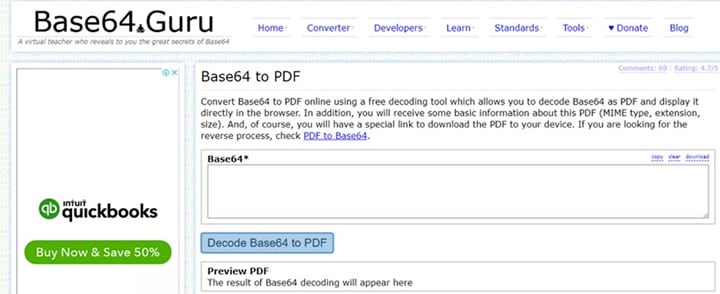
To use it, open the Base64 Guru Base64-to-PDF decoder in your browser. Paste the encoded PDF string into the input field. If your content starts with data:application/pdf;base64,, remove that prefix unless the tool specifically says it accepts data URLs.
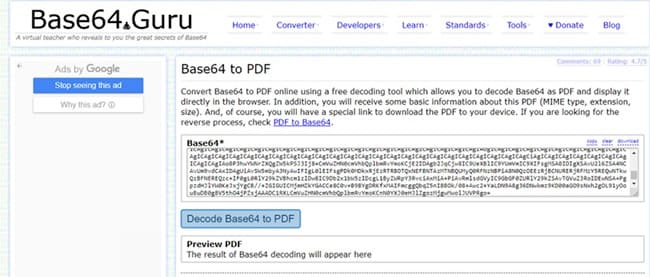
Click the button to decode the Base64 content to PDF. After processing, check the preview or file details. If the output looks correct, download the PDF file.
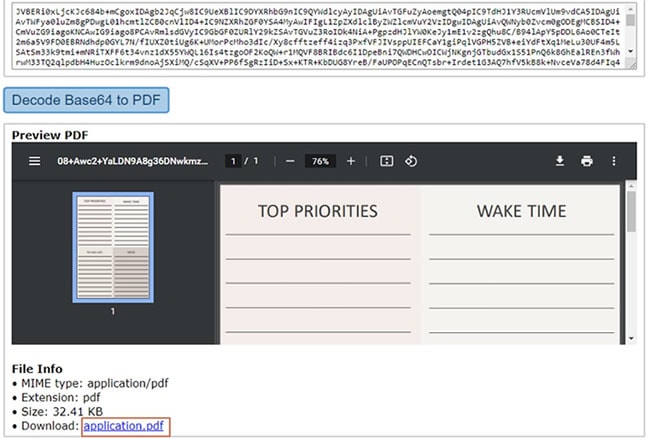
This tool is best for quick validation. For example, if an API returns a Base64 PDF and you simply need to confirm whether the response contains a real document, an online decoder can save time.
Convert Base64 to PDF Online With IPVOID
IPVOID also provides a simple Base64-to-file workflow. It is suitable for users who do not want to install software and only need to decode one string into a PDF.
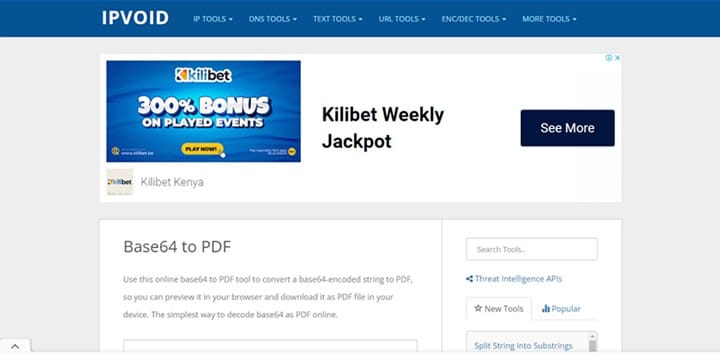
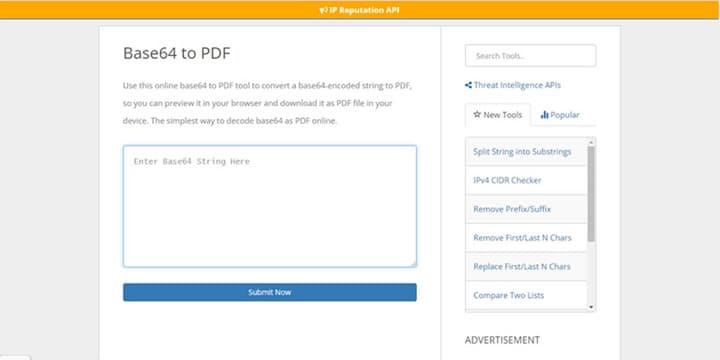
Open the IPVOID converter page, then paste the Base64 string into the field labeled for Base64 input. Make sure you paste the full string, not a shortened version copied from a collapsed preview.
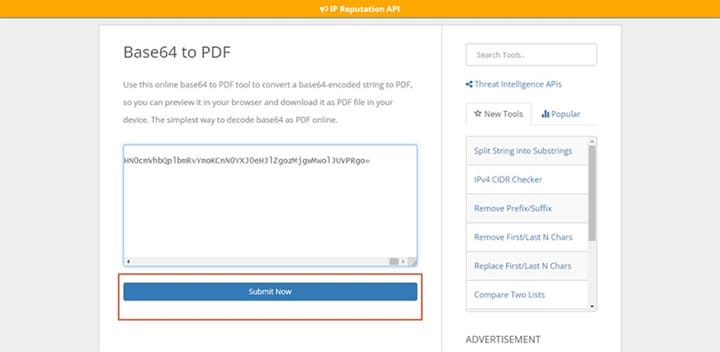
Submit the form to start decoding. When the preview appears, confirm that the file loads as a PDF. Then use the download option to save it to your device.
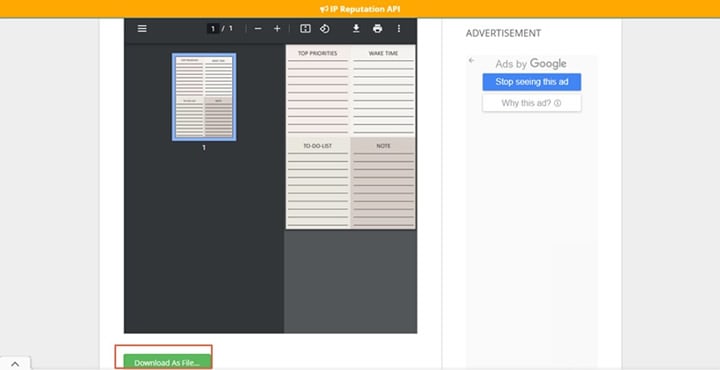
If the preview area stays blank or the downloaded file cannot open, the issue is usually the input string rather than the website. Check for missing characters, extra quotation marks, escaped slashes, or a non-PDF file encoded as Base64.
Use Base64.online for a Simple Paste-and-Download Workflow
Base64.online is another browser-based option for decoding Base64 text. It is useful when you want to paste encoded content, decode it, and download the output file quickly.
The general steps are similar: paste the Base64 content into the input field, choose the decode option, then download the result. If the tool asks you to specify an output type or filename, choose PDF or name the file with a .pdf extension.
This option is convenient for non-sensitive content, but the same privacy rule applies. If the Base64 string contains a confidential PDF, use an offline method instead.
Online Converter Safety Notes
Before you use any convert base64 to pdf online service, pause for a few seconds and ask what the document contains. Base64 is readable by anyone who decodes it. It does not hide the PDF’s contents.
Online tools are fine for test documents, public PDFs, dummy invoices, sample API responses, and non-private files. They are not the best choice for signed agreements, HR files, personal identity documents, bank records, unreleased reports, or customer data.
If you are working inside a company, follow your internal security policy. A local script or offline decoder is usually safer and more repeatable.
How To Decode Base64 to PDF Offline
Offline conversion is the better choice when privacy matters or when you need to process many files. You avoid uploading the Base64 content to a third-party website, and you can repeat the same process whenever needed.
There are two common offline approaches: use a desktop utility or run a command/script.
Use a Desktop Base64 File Converter
Some lightweight desktop utilities can decode Base64 files back into their original binary format. The old article referenced tools such as Base64 File Converter and Base64 Encoder/Decoder, which are typically small Windows utilities designed for encoding and decoding files.
The exact interface differs by tool, but the workflow usually looks like this:
- Save the Base64 content as a text file, such as
encoded.txt. - Open the desktop decoder.
- Choose the option that decodes Base64 to normal bytes or file output.
- Select the input text file.
- Set the output filename, such as
decoded.pdf. - Run the conversion and open the result.
This method is practical if you do not write code and cannot use an online service. Be careful with unknown utilities, though. Download software only from trustworthy sources, scan it if required by your workplace, and avoid abandoned tools that have no clear publisher or documentation.
Decode Base64 to PDF With the Command Line
If you are comfortable with a terminal, command-line tools are fast and private.
On macOS or Linux, you can often use:
base64 --decode encoded.txt > output.pdf
On some macOS systems, the syntax may be:
base64 -D -i encoded.txt -o output.pdf
On Windows PowerShell, you can decode a Base64 text file like this:
$b64 = Get-Content .\encoded.txt -Raw
[IO.File]::WriteAllBytes("output.pdf", [Convert]::FromBase64String($b64))
If your Base64 string includes a data URL prefix, remove it first. For example, keep only the part after the comma:
JVBERi0xLjQKJc...
This method is especially helpful when you receive a Base64 PDF in a log or exported JSON field and want to decode it without sending it anywhere.
When Offline Conversion Is Better
Choose an offline method if the PDF contains personal, legal, financial, or internal business information. Offline decoding is also better for bulk work because you can script the process instead of pasting strings manually into a browser.
It is also easier to debug. If the command fails, you know the issue is probably the Base64 content, file path, or syntax. With an online converter, it can be harder to tell whether the input failed or the website had a limitation.
How To Convert Base64 to PDF With Code
Developers often encounter Base64 PDFs in API responses, database fields, message queues, or JSON payloads. In those cases, manual conversion is not enough. You need to decode the string programmatically and write the bytes to a PDF file.
The key rule is the same in every language: decode Base64 to bytes, not to a normal text string. A PDF is binary data. If you treat it as ordinary text after decoding, the file may become corrupted.
Convert Base64 to PDF in Java
Java includes a built-in Base64 decoder in java.util.Base64. The example below decodes a Base64 string and writes the bytes to output.pdf.
import java.nio.file.Files;
import java.nio.file.Paths;
import java.util.Base64;

public class Base64ToPdf {
    public static void main(String[] args) throws Exception {
        String base64Pdf = "JVBERi0xLjQKJc..."; // your Base64 PDF string

        // If using a data URL, remove the prefix before decoding.
        if (base64Pdf.contains(",")) {
            base64Pdf = base64Pdf.substring(base64Pdf.indexOf(",") + 1);
        }

        byte[] pdfBytes = Base64.getDecoder().decode(base64Pdf);
        Files.write(Paths.get("output.pdf"), pdfBytes);

        System.out.println("PDF saved as output.pdf");
    }
}
If your input contains line breaks, Base64.getMimeDecoder() can be more forgiving:
byte[] pdfBytes = Base64.getMimeDecoder().decode(base64Pdf);
Use that when Base64 content is formatted across multiple lines, such as in email-style output.
Decode Base64 to PDF in JavaScript or Node.js
In Node.js, use Buffer.from() with the base64 encoding option, then write the buffer to a file.
const fs = require("fs");

let base64Pdf = "JVBERi0xLjQKJc..."; // your Base64 PDF string

if (base64Pdf.includes(",")) {
  base64Pdf = base64Pdf.split(",")[1];
}

const pdfBuffer = Buffer.from(base64Pdf, "base64");
fs.writeFileSync("output.pdf", pdfBuffer);

console.log("PDF saved as output.pdf");
This is a common approach when an API returns a PDF as a Base64 field, for example:
{
  "fileName": "invoice.pdf",
  "contentBase64": "JVBERi0xLjQKJc..."
}
In that case, decode only the contentBase64 value, not the whole JSON object.
Convert Base64 to PDF in Python
Python’s base64 module can decode the string and write the result as binary data.
import base64

base64_pdf = "JVBERi0xLjQKJc..." # your Base64 PDF string

if "," in base64_pdf:
    base64_pdf = base64_pdf.split(",", 1)[1]

pdf_bytes = base64.b64decode(base64_pdf)

with open("output.pdf", "wb") as f:
    f.write(pdf_bytes)

print("PDF saved as output.pdf")
The "wb" mode matters. It writes bytes instead of text. If you use normal text-writing mode, the PDF may not open correctly.
For stricter validation, Python can reject malformed Base64:
pdf_bytes = base64.b64decode(base64_pdf, validate=True)
That is useful if you want your script to fail clearly when the input contains invalid characters.
What To Do After You Convert Base64 to PDF
After conversion, open the PDF before sending it onward. A successful decode does not always mean the document is complete or useful. Check that all pages load, text is readable, images are present, and the file is not just a blank or error page saved as PDF.
If the PDF came from an API, compare it with the expected document type. For instance, an invoice should have the right customer, date, amount, and page count. If the decoded file opens but contains the wrong content, the issue is upstream, not the decoder.
Edit, OCR, Compress, or Sign the Output PDF With PDFelement
Base64 decoders usually stop once the PDF is created. They do not help much if the decoded document needs cleanup. That is where Wondershare PDFelement fits naturally into the workflow.
G2 Rating: 4.5/5 |100% Secure
After you base64 convert to PDF, open the file in PDFelement to review and manage it like a normal document. If the PDF was generated from scanned content, use OCR to make text searchable and editable. If the decoded file is too large to email or upload, compress it before sharing. If it is an agreement, add comments, fill form fields, apply a signature, or organize pages before sending it back to a client or team.
This is especially useful for documents received from APIs or business systems. A decoded PDF may technically open, but still needs page rotation, redaction, annotation, merging with attachments, or conversion to Word/Excel for review. PDFelement does not decode Base64 directly, but it is a practical next step once the PDF exists as a file.
Troubleshooting Base64 Decode PDF Errors
A failed base64 decode pdf attempt usually comes down to the input string. The decoder may be working correctly, but the text you pasted or saved is not clean Base64 PDF data.
The String Includes a Data URL Prefix
Many web apps store PDFs like this:
data:application/pdf;base64,JVBERi0xLjQKJc...
Some decoders accept the full data URL. Others do not. If conversion fails, remove this part:
data:application/pdf;base64,
Then decode only the remaining Base64 string.
The Base64 Text Is Wrapped in JSON
If the PDF comes from an API response, you may see something like this:
{
  "document": "JVBERi0xLjQKJc..."
}
Do not paste the full JSON into a Base64 decoder. Copy only the value inside the quotation marks. Also watch for escaped characters, especially if the string has been copied from logs.
The Output Is Not Actually a PDF
Not every Base64 string represents a PDF. It could be an image, ZIP file, plain text, or another file type. A PDF usually starts with %PDF after decoding. In Base64, that commonly appears as JVBERi0.
If your decoded file does not open as a PDF, try identifying the file type. On Linux or macOS, the file command can help:
file output.pdf
If it reports a PNG image, ZIP archive, or text file, rename the extension accordingly or check the source system.
Line Breaks or Spaces Are Breaking the Decode
Many Base64 decoders tolerate line breaks. Some do not. Extra spaces, tabs, hidden characters, or copied UI labels can cause errors.
If your string came from an email or web page, paste it into a plain text editor first. Remove labels, quotation marks, and accidental spaces before and after the string. Do not remove valid Base64 characters inside the content unless you know they are formatting artifacts.
The Base64 String Is Incomplete
This is the most frustrating problem because the string may still look valid. If content was truncated by a log viewer, spreadsheet cell, database export, chat message, or browser console, the decoded PDF may be corrupted.
Try getting the original value again from the source system. If possible, export it as a text file rather than copying it from a shortened preview.
The PDF Opens but Looks Damaged
If the file opens with missing pages or broken images, the Base64 may have been generated from an already damaged PDF. Decoding cannot repair missing source data. In that case, ask for the original PDF or regenerate the Base64 from the source application.
If the file opens but has minor usability issues, such as wrong page orientation, oversized file size, or scanned pages that are not searchable, use a PDF editor such as PDFelement to fix the document after decoding.
People Also Ask
-
Is Base64 the same as PDF?
No. PDF is a document format. Base64 is an encoding method that can represent binary data as text. A PDF can be encoded into Base64, then decoded back into a PDF file later. -
How do I convert Base64 to PDF?
Paste the Base64 string into a trusted online decoder or decode it offline with a command, script, or desktop utility. The decoder turns the Base64 text back into bytes, and you save those bytes with a.pdfextension. -
Can I convert Base64 to PDF online for free?
Yes. Several web tools let you convert base64 to pdf online for free. They are convenient for test files and non-sensitive documents. For confidential PDFs, use an offline method instead. -
Is Base64 encryption?
No. Base64 is encoding, not encryption. Anyone with the Base64 string can decode it. Do not treat Base64 as a way to protect private documents. -
Why does my decoded PDF not open?
The most common causes are an incomplete Base64 string, extra characters, a data URL prefix that the decoder did not accept, or content that is not actually a PDF. Check whether the Base64 begins with a PDF-like pattern such asJVBERi0, remove unnecessary prefixes, and confirm the source string is complete. -
Do I need to remove data:application/pdf;base64, before decoding?
Sometimes. If your decoder accepts data URLs, you can leave it. If the conversion fails, remove everything up to and including the comma, then decode only the Base64 portion. -
How can I decode Base64 to PDF in Java?
UseBase64.getDecoder().decode()orBase64.getMimeDecoder().decode()to turn the Base64 string into a byte array, then write the bytes to a file usingFiles.write(). Do not treat the decoded PDF as a normal text string. -
Can PDFelement convert Base64 directly to PDF?
PDFelement is not a Base64 decoder. Use an online tool, offline command, or code to decode the Base64 string first. After the PDF is created, PDFelement can help you edit, OCR, compress, annotate, sign, convert, and organize the document.
![All the Methods to Convert a PDF to Black and White [2026]](https://images.wondershare.com/pdfelement/images2026/pdf-like-article-2.png)