
Table of Contents
Hyperlinks are useful until they are everywhere. A pasted source list, copied web article, email address, table of contents, or imported report can quickly leave a Word document full of blue underlined text. If you are preparing a clean handout, academic paper, contract draft, résumé, or print-ready document, those links can look distracting or unprofessional.
The good news: it is easy to remove a hyperlink in Word on Mac without deleting the text itself. You can remove one link at a time, clear every hyperlink in the document with a shortcut, or stop Word from automatically creating links in the first place. The best method depends on whether you are cleaning a single URL, a selected section, or an entire document.


 G2 Rating: 4.5/5 |
 100% Secure
Why Word Adds Hyperlinks on Mac
Microsoft Word automatically turns certain text into hyperlinks because it assumes they are meant to be clickable. If you type or paste a web address such as https://example.com, Word may convert it into a link. The same can happen with email addresses, internal document references, and copied text from web pages.
This behavior is controlled by Word’s AutoCorrect and AutoFormat settings. It is convenient when you are drafting a digital document, but it can be annoying when the final file is meant to be printed or shared as plain text.
A hyperlink in Word usually has two parts:
Display text: the words visible in the document.
Link destination: the URL, email address, file path, heading, bookmark, or other target behind that text.
Removing the hyperlink normally removes only the destination. The visible words stay in place unless you delete them manually. That distinction matters because many users worry that “Remove Hyperlink” will erase the text. It will not.
How to Remove One Hyperlink in Word on Mac
If your document only has a few links, removing them one by one is the cleanest approach. You can check each link before deleting it, which is safer for documents that still need some clickable references.
Use Right-Click or Control-Click
This is the fastest method for one link.
- Open the document in Microsoft Word for Mac.
- Find the linked text.
- Right-click the hyperlink. If you do not use right-click on your Mac, hold Control and click the link.
- Choose Hyperlink or Link, depending on your Word version.
- Select Remove Hyperlink.
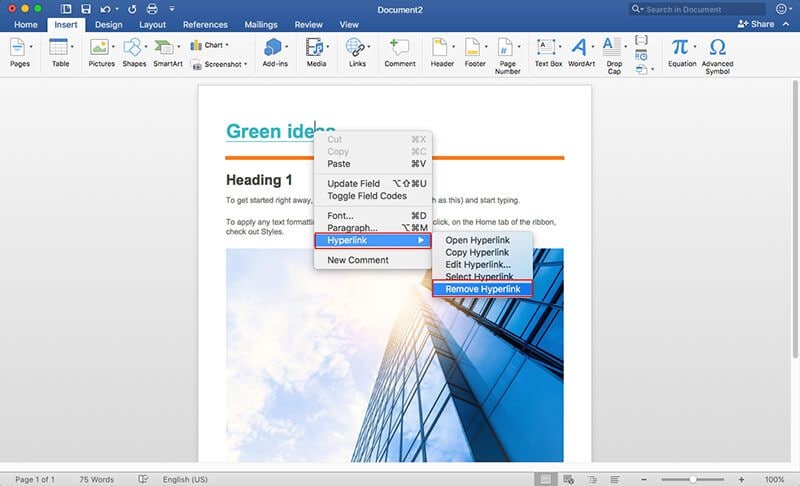
After you remove the hyperlink, the text remains. In many cases, Word also removes the blue underline styling. If the text still looks blue or underlined, that may be regular formatting rather than an active hyperlink. You can select the text and use the font color and underline controls to restyle it.
Use the Insert Link Dialog
Some versions of Word for Mac show link controls through the ribbon rather than the same right-click menu labels. If the context menu looks different on your Mac, use the ribbon method.
- Select the linked text.
- Go to Insert in the top ribbon.
- Choose Link or Hyperlink.
- In the dialog box, click Remove Link or clear the address field, depending on the interface.
This route is useful when you want to inspect the destination before removing it. For example, if the display text says “download report,” the link dialog lets you see where that phrase actually points.
Keep the Text but Remove the Clickable Link
Most people searching for how to remove hyperlink in Word on Mac want to keep the words and remove only the click action. Both methods above do that.
For example, if your document contains:
Visit our help center
and the phrase links to a URL, removing the hyperlink leaves:
Visit our help center
The words stay in the document. Only the hidden link destination is removed.
If you want to remove the link and also change the appearance, select the text after removing the hyperlink and apply your preferred style. For long documents, it is better to use Word styles such as Normal, Body Text, or your own custom style instead of manually changing every linked phrase.
How to Remove All Hyperlinks Word Mac
If the document is full of links, removing them one at a time is slow. Word for Mac has a keyboard shortcut that can remove all hyperlinks at once. This is the method most readers need when they search for remove all hyperlinks Word Mac.
Remove Every Hyperlink with a Keyboard Shortcut
Use this method when you want to clear links from the whole document.
- Open your document in Word for Mac.
- Press Command + A to select all content.
- Press Fn + Command + Shift + F9.
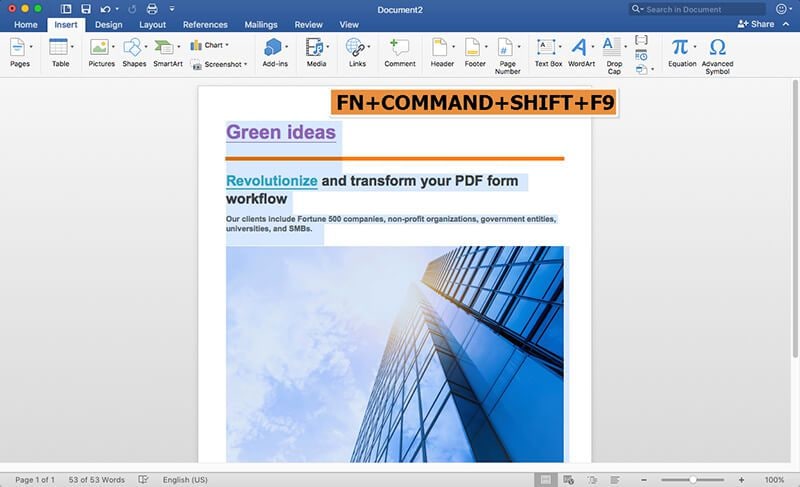
The shortcut converts hyperlink fields into regular text. In plain terms, it removes the clickable link but keeps the displayed words.
On some Mac keyboards, especially Apple keyboards with function keys assigned to brightness, volume, or system controls, the Fn key is important. Without it, your Mac may treat F9 as a system command rather than a Word command.
Remove Hyperlinks from Only Part of a Document
You do not have to remove every link. If only one section is messy, select that section first.
- Drag to highlight the paragraph, table, footnote, or section that contains unwanted links.
- Press Fn + Command + Shift + F9.
- Review the selected section to make sure the visible text remains correct.
This selective method is helpful for documents that need some links to stay active. For example, you may want to remove links from copied body text but keep hyperlinks in a references section, table of contents, or appendix.
What the Shortcut Actually Does
The shortcut does more than remove web links. It unlinks fields in the selected content. A Word field is a dynamic element, such as a hyperlink, cross-reference, citation field, date field, or table of contents element.
That means the shortcut can affect more than hyperlinks if your selected text contains other Word fields. In a simple pasted document, this is usually fine. In a heavily formatted report, legal document, academic paper, or technical manual, be careful. Save a copy before using the shortcut on the entire file.
A safe workflow is:
- Duplicate the document.
- Run the shortcut on the copy.
- Check the table of contents, citations, references, and cross-references.
- Keep the cleaned version only if nothing important was flattened.
For Microsoft’s own documentation on Word keyboard shortcuts, you can refer to Microsoft Support’s Word shortcut reference.
How to Stop Word from Creating Automatic Hyperlinks
Removing links is useful, but it is even better to prevent unwanted links from appearing again. Word’s automatic hyperlink behavior can be changed in settings.
Turn Off Automatic Hyperlinks as You Type
If Word keeps converting URLs and email addresses into links, change the AutoCorrect settings.
- Open Word on your Mac.
- Go to Word in the top menu bar.
- Choose Preferences or Settings, depending on your version.
- Select AutoCorrect.
- Open the AutoFormat As You Type tab.
- Look for the option called Internet and network paths with hyperlinks.
- Uncheck it.
- Close the settings window.
After this, Word should stop automatically turning typed URLs and email addresses into hyperlinks. Existing links will remain until you remove them manually or with the shortcut method.
The exact labels can vary slightly between Word versions, but the setting is usually under AutoCorrect or AutoFormat. Microsoft also explains AutoCorrect behavior in its official Word AutoCorrect guidance.
Paste Text Without Bringing Hyperlinks Over
Many unwanted links come from pasted web content. If you copy text from a website and paste it directly into Word, Word may preserve the original hyperlinks and formatting.
A cleaner approach is to paste as plain text.
On Word for Mac, try one of these options:
Use Edit > Paste Special > Unformatted Text.
After pasting, click the small paste options button and choose a text-only option if it appears.
Paste into a plain text editor first, then copy from there into Word.
Pasting as plain text strips most web styling, including hyperlinks, fonts, colors, and hidden formatting. You may need to reapply headings, italics, or spacing afterward, but the document will usually be easier to clean.
If you often paste research notes into Word, this habit can save more time than removing hyperlinks later.
What Happens to Hyperlinks When You Convert Word to PDF
Many Word documents eventually become PDFs. This is where the link question changes slightly. Sometimes you want hyperlinks removed before exporting. Other times, you want the PDF to keep important links clickable.
For example, a PDF brochure may need live website links. A résumé might need a clickable portfolio URL. A printed contract draft, on the other hand, may look cleaner without active links or blue underlined text.
Decide Before Exporting
Before saving or exporting your Word document as a PDF, review the purpose of the file.
If the PDF will be read on screen, keep useful links such as email addresses, website URLs, source citations, navigation links, or table of contents entries. If the PDF is for printing, submission, archiving, or legal review, you may prefer plain text with no hidden destinations.
Removing hyperlinks in Word first is usually the easiest option because Word gives you bulk tools like Fn + Command + Shift + F9. Once the file is a PDF, you need a PDF editor to inspect or remove link objects.
Use PDFelement to Manage Links After Exporting to PDF
If you already exported the file and then noticed unwanted links in the PDF, a PDF editor can help. PDFelement is useful here as a follow-up tool: it lets you open a PDF, inspect link areas, edit PDF content, annotate, organize pages, and manage the file before sharing.
G2 Rating: 4.5/5 |100% Secure
This is especially helpful when you no longer want to return to the Word version. For example, you may have a finalized PDF with signatures, comments, or page layout adjustments. Instead of rebuilding the PDF from Word, you can open it in PDFelement and remove or edit the link objects directly.
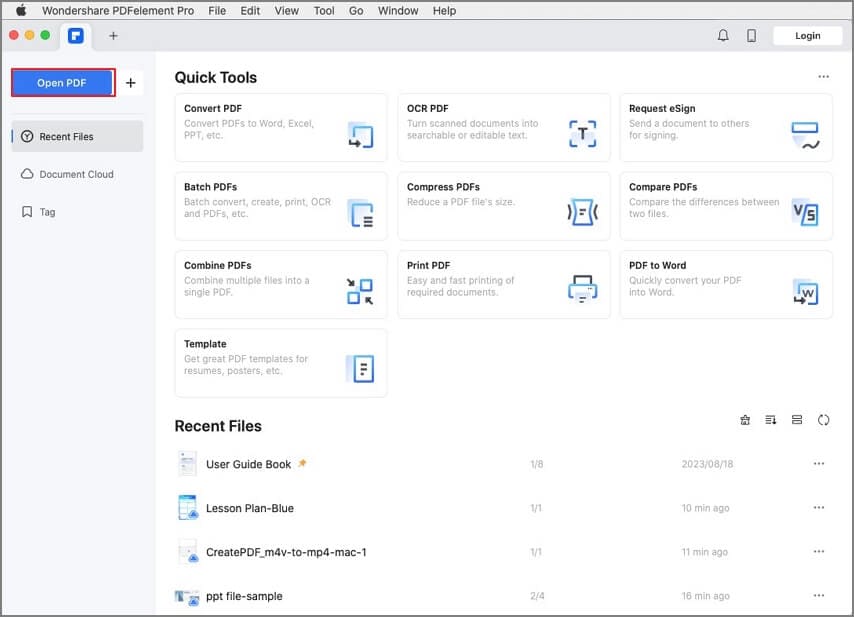
A practical workflow looks like this:
- Open the PDF in PDFelement on your Mac.
- Go to the link editing tools.
- Select the unwanted link area.
- Delete or modify the link.
- Save a new copy so you still have the original file.
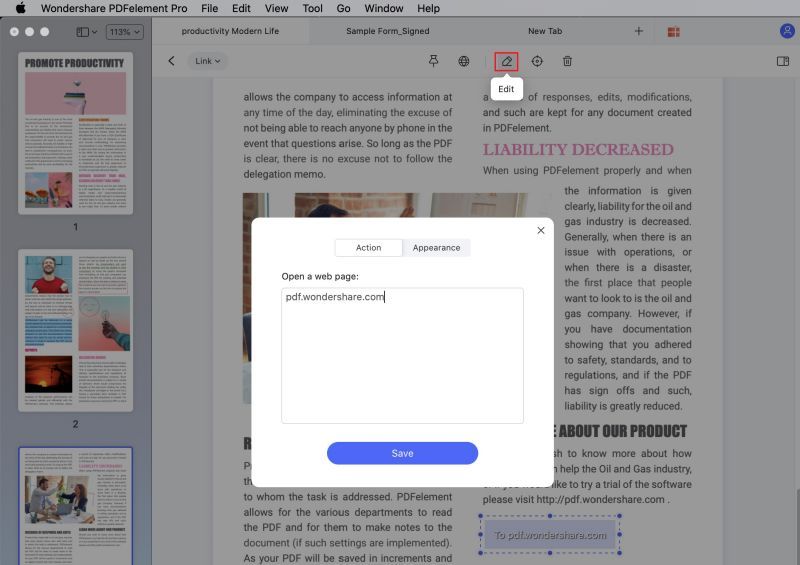
PDFelement fits best when your document cleanup goes beyond Word. If you need to convert Word files to PDF, review OCR-scanned PDFs, annotate drafts, compress large files for email, or organize pages before delivery, it gives you a single place to finish that document workflow.
Troubleshooting: Hyperlinks, Fields, and Formatting Problems
Most hyperlink removal issues on Mac come from one of three things: the shortcut is not reaching Word, the text is formatted to look like a link, or the “link” is actually another kind of field.
The Shortcut Does Not Remove Links
If Fn + Command + Shift + F9 does nothing, first make sure the document content is selected. Press Command + A once for the current document body. If your cursor is inside a text box, header, footer, footnote, or table, Word may select only that region or behave differently.
Also check your keyboard settings. On many Mac keyboards, function keys are shared with system controls. If F9 triggers a Mac feature instead of a Word command, hold Fn while pressing the shortcut.
If you use an external Windows-style keyboard with your Mac, the key layout may differ. You may need to experiment with the function key behavior in macOS keyboard settings.
The Text Still Looks Blue and Underlined
If you removed the hyperlink but the text still looks like a link, the remaining issue is formatting, not the hyperlink itself.
Select the text and remove the underline with Command + U, then change the font color to match your document. If the whole document has link-like styling, apply the correct Word style to the affected text.
A quick test: hold Command and click the text. If nothing opens and no destination appears, the hyperlink is gone.
The Link Is in a Header, Footer, Footnote, or Text Box
Command + A in the main document body may not always select content in headers, footers, text boxes, shapes, or footnotes. If links remain after running the shortcut, check these areas separately.
Double-click the header or footer and run the shortcut there. For text boxes, click inside the box, select its contents, and then use Fn + Command + Shift + F9.
Table of Contents Links May Be Affected
A clickable table of contents in Word is built with fields. If you select the entire document and unlink fields, the table of contents may turn into static text. That may be acceptable for a final print version, but it is not ideal if the document will keep changing.
If you need the table of contents to stay dynamic, remove hyperlinks selectively from body sections rather than selecting the whole document.
Hyperlinks Come Back After Editing
If links keep reappearing, AutoFormat is probably still enabled. Turn off Internet and network paths with hyperlinks in AutoCorrect settings. Also check how you paste content. Directly pasting from browsers, email clients, and PDFs can reintroduce links.
For recurring work, create a simple cleanup habit: paste as plain text, apply Word styles, then add only the links you actually want.
People Also Ask
-
How do I remove hyperlink in Word Mac without deleting the text?
Right-click or Control-click the linked text, choose Hyperlink or Link, then select Remove Hyperlink. Word removes the clickable destination but keeps the visible text in the document. -
What is the shortcut to remove all hyperlinks in Word Mac?
Select the whole document with Command + A, then press Fn + Command + Shift + F9. This removes hyperlink fields from the selected content while keeping the displayed text. -
Why does Command + Shift + F9 not work on my Mac?
On many Mac keyboards, you need to include the Fn key, so the full shortcut is Fn + Command + Shift + F9. Also make sure the document text is selected before using the shortcut. -
Can I remove hyperlinks from only one section of a Word document?
Yes. Highlight only the section you want to clean, then press Fn + Command + Shift + F9. This removes hyperlinks from the selected area only, leaving links elsewhere in the document untouched. -
How do I stop Word for Mac from automatically making hyperlinks?
Go to Word > Preferences or Word > Settings, open AutoCorrect, then check the AutoFormat As You Type options. Turn off Internet and network paths with hyperlinks. -
Will removing hyperlinks also remove blue underlined formatting?
Usually, but not always. If the text still appears blue and underlined, the hyperlink may be gone but the formatting remains. Select the text, remove underline, and change the font color manually or apply a normal Word style. -
Can I remove hyperlinks after converting Word to PDF?
Yes, but you need a PDF editor. If the file has already been exported, PDFelement can help you open the PDF, select link areas, and delete or edit unwanted links without rebuilding the document from Word. -
Is it safe to remove all hyperlinks from a long Word document?
It depends on the document. The bulk shortcut can also unlink other Word fields, such as cross-references, table of contents entries, or dynamic citations. Save a copy first if the document contains complex formatting or references.