
9 Best PDF to Image Converters in 2026: JPG, PNG & More
Compare 9 of the best PDF to image converters for JPG, PNG and TIFF, including desktop and online tools, batch conversion and image extraction.
 100% Secure |
 Powered by AI
 Home
>
Best PDF Software
> 9 Best PDF to Image Converters in 2026: JPG, PNG & More
Home
>
Best PDF Software
> 9 Best PDF to Image Converters in 2026: JPG, PNG & More
The best PDF to image converter depends on what you actually need to export. If you want every PDF page saved as a JPG or PNG, most modern converters can handle the job. If you need to extract only the original images inside a PDF, convert many files at once, control page range or resolution, or work offline with sensitive documents, the right tool is different. This updated 2026 guide compares 9 current desktop and online options for converting PDF to image formats such as JPG, PNG, TIFF, and more.
Best picks at a glance
- Best all-round desktop workflow: PDFelement for PDF-to-image conversion, batch processing, page-range controls, editing, OCR, and document preparation before export.
- Best for Adobe users: Adobe Acrobat for JPEG, PNG, TIFF, JPEG 2000, and separate embedded-image extraction.
- Best for detailed image controls: Foxit PDF Editor for page ranges, multiple image formats, and resolution controls up to 2400 DPI.
- Best browser option for page conversion vs. image extraction: Smallpdf or iLovePDF.
- Best online option for broader image formats: PDF Candy for JPG, PNG, GIF, BMP, WebP, HEIC, and TIFF.
In This Article
Quick Comparison: 9 Best PDF to Image Converters in 2026
How We Evaluated These PDF to Image Converters
Part 1. Best Desktop PDF to Image Converter Software
Part 2. Best PDF to Image Converters Online
PDF Pages vs. Extract Images: What Is the Difference?
JPG vs. PNG vs. TIFF: Which Image Format Should You Choose?
How to Batch Convert Multiple PDFs to Images
How to Convert PDF to Image for Free on Windows or Mac
Quick Comparison: 9 Best PDF to Image Converters in 2026
For occasional page-to-JPG conversion, an online tool is usually enough; for batch work, page-range controls, sensitive documents, or editing before export, a desktop converter is usually the better fit. The table below focuses on documented capabilities rather than vague ratings such as “high quality.”
| Tool | Best For | Image Formats | Batch / Multi-file | Page or Image Controls | Use Type |
|---|---|---|---|---|---|
| PDFelement | All-round desktop workflow | JPG, PNG, BMP, TIFF, GIF and more | Yes | Page range, separate pages, one long image, image settings | Desktop |
| Adobe Acrobat | Adobe ecosystem | JPEG, JPEG 2000, PNG, TIFF | Workflow-dependent | Page export, export all embedded images, image settings | Desktop |
| Foxit PDF Editor | Advanced export controls | JPEG, JPEG 2000, PNG, TIFF, BMP | Yes | Page range, merge pages, export images, resolution controls | Desktop |
| Nitro PDF Pro | Windows business workflows | Image output with downsampling controls | Yes | Choose pages, add multiple files, separate image extraction tool | Desktop |
| Adobe Acrobat Online | Simple browser conversion | JPG, PNG, TIFF | Not the main workflow | Full PDF pages to images | Online |
| Smallpdf | Page conversion or image extraction | JPG; desktop app also supports broader image workflows | Yes | Convert entire pages or extract embedded images | Online |
| iLovePDF | Quick JPG conversion | JPG | Multiple PDF upload supported | Page to JPG or Extract images; Normal/High quality | Online |
| PDF Candy | Multiple image formats online | JPEG, PNG, GIF, BMP, WebP, HEIC, TIFF | Yes | Quality controls, separate page output, selective downloads | Online |
| Nitro Online | Simple browser workflow | JPG/JPEG, PNG | Limited compared with desktop | Browser-based page conversion | Online |
How We Evaluated These PDF to Image Converters
We compared the tools by current documented capabilities that directly affect PDF-to-image work. This is not a laboratory speed benchmark, so we do not assign unsupported “quality scores” or claim one converter is universally the most accurate. Instead, the 2026 comparison focuses on output formats, batch support, page-range controls, page conversion versus embedded-image extraction, offline availability, image settings, and whether the tool is better suited to one-off or repeat workflows.
- Format support: JPG/JPEG is the most common output, but PNG and TIFF matter for text-heavy, transparent, print, or archival use cases.
- Page controls: A useful converter should let you export the pages you need instead of forcing unnecessary output.
- Batch workflows: Multi-file conversion matters for reports, forms, scans, archives, and recurring business work.
- Image extraction: Converting a whole PDF page and extracting original embedded images are different tasks, so we treat them separately.
- Freshness: We prioritize tools with current product pages or help documentation rather than relying on outdated interfaces or discontinued product names.
Part 1. Best Desktop PDF to Image Converter Software
Desktop PDF-to-image software is the better choice when you need offline processing, repeated conversions, batch files, page controls, or document editing before export. The four options below have current desktop workflows for converting PDF pages to image files.
1. PDFelement — Best for Conversion, Batch Workflows, and PDF Preparation
Wondershare PDFelement - PDF Editor Wondershare PDFelement Wondershare PDFelement is the strongest fit on this list when PDF-to-image conversion is only one step in a broader document workflow. You can convert PDF to image, choose formats such as JPG, PNG, BMP, and TIFF, set page ranges and image quality, save pages as separate images, or join pages into one long image. For recurring work, PDFelement also supports batch PDF conversion so multiple documents can be processed in one queue.


 G2 Rating: 4.5/5 |
 100% Secure
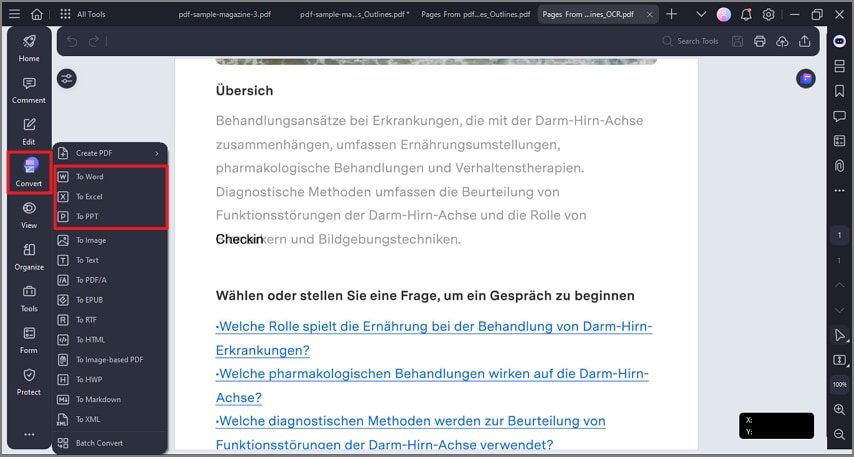
PDFelement is also useful when the PDF should be cleaned up before it becomes a static image. You can edit text and graphics, organize pages, crop content, redact sensitive information, or use OCR on scanned documents before exporting the final pages. This matters because once a page becomes a JPG, further text-level corrections are harder than editing the source PDF first.
Where PDFelement V13 adds value
For a basic one-off PDF-to-JPG conversion, you do not need AI. V13 is more useful when the source document needs preparation first: AI-assisted OCR can help with scanned content, Smart Redact can remove sensitive information before pages are shared as images, and batch workflows reduce repetitive conversion work. The practical flow is prepare the PDF → verify the content → export the final pages as images.
Best for: users who need PDF-to-image conversion plus editing, OCR, redaction, page organization, or repeated batch processing.
Watch for: if you only need to convert one simple PDF to JPG once, an online tool may be faster than installing desktop software.
G2 Rating: 4.5/5 |100% Secure
2. Adobe Acrobat — Best for Adobe Workflows and Image Export Controls
Adobe Acrobat can convert complete PDF pages to JPEG, JPEG 2000, PNG, or TIFF and can separately export the raster images embedded inside a PDF. In the current interface, the standard path is Convert > Image format, then choose the image type and conversion settings. Adobe also distinguishes between converting all PDF pages and using Export All Images, which is useful when you want only the original images rather than a rendered picture of every page.

Acrobat is especially useful when you already work in the Adobe ecosystem or need format-specific image settings. Adobe's current documentation recommends JPEG for web-friendly images, PNG when transparency matters, and TIFF for high-quality archival workflows. See Adobe's current PDF-to-image documentation for the latest export path.
Best for: Adobe users who want desktop image export and separate embedded-image extraction.
Watch for: Acrobat is broader PDF software, so it may be more than you need for occasional image conversion.
3. Foxit PDF Editor — Best for Resolution and Page-Level Export Controls
Foxit PDF Editor is a strong desktop option when you want more control over how PDF pages become image files. Current Foxit documentation supports PNG, JPEG, JPEG 2000, TIFF, and BMP output, page ranges, exporting each page as a separate image, merging pages into one image, and exporting all embedded images. Foxit's current PDF conversion page also lists resolution controls up to 2400 DPI, which is useful when image resolution matters for print, documentation, or detailed graphics.
Foxit can also OCR scanned or image-based PDFs before conversion when the document needs to become searchable or editable first. Its current PDF conversion page documents its PDF-to-image formats, page-range controls, and batch conversion capabilities.
Best for: users who want detailed image export settings, page-range control, and a business-oriented PDF editor.
Watch for: the number of available settings may be unnecessary for a simple one-page JPG conversion.
4. Nitro PDF Pro — Best for Windows Business Conversion Workflows
Nitro PDF Pro lets Windows users convert PDFs to image files, add multiple source files, choose specific pages, and control image output settings such as downsampling. The current Nitro PDF Pro workflow is Convert > To Image, where you can add files, choose pages, select the image format, set output preferences, and convert. Nitro also has a separate Extract Images function for saving images contained inside PDFs rather than rendering full pages.
Nitro's help center was updated in June 2026 and documents both the PDF-to-image and image-extraction workflows. See the current Nitro PDF-to-image guide for the latest desktop steps.
Best for: Windows teams that already use Nitro for PDF editing and Office-oriented document workflows.
Watch for: Nitro is primarily a Windows desktop choice, so browser-first or cross-platform users may prefer an online converter.
Part 2. Best PDF to Image Converters Online
Online PDF-to-image converters are best for quick jobs when you do not need to install software. They are convenient across Windows, macOS, tablets, and phones, but you should still consider file size, privacy requirements, batch limits, and whether you need full-page conversion or extraction of embedded images.
1. Adobe Acrobat Online — Best for Simple JPG, PNG, or TIFF Conversion
Adobe Acrobat Online converts PDF pages to JPG, PNG, or TIFF directly in a browser. Upload the PDF, choose the image format, run the conversion, and download the result. Adobe states that files are handled on its servers and deleted if you do not sign in to save them. The online tool is useful when you want Adobe's conversion workflow without installing the desktop app.
Best for: occasional browser-based conversion to the three most common image formats.
2. Smallpdf — Best for Converting Full Pages or Extracting Embedded Images
Smallpdf clearly separates two common PDF-to-image tasks: converting entire pages and extracting individual images. Full-page JPG conversion is available in the browser, while its image-extraction option collects embedded images separately. Smallpdf also supports batch PDF uploads and says processed files are automatically deleted after one hour.
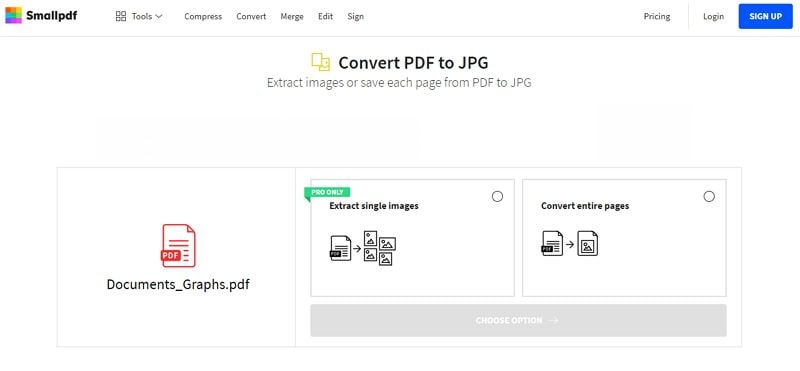
Best for: users who want a clear choice between page rendering and embedded-image extraction.
3. iLovePDF — Best for Quick JPG Output with Image Extraction
iLovePDF's PDF-to-JPG tool offers two direct modes: Page to JPG and Extract images. Page to JPG converts each PDF page into an image, while Extract images saves the embedded images found inside the PDF. The current interface also offers Normal and High image-quality options, which makes the tool easy to understand for users who do not need advanced desktop controls.
Best for: quick JPG conversion when you want a simple page-vs-image choice.
4. PDF Candy — Best for More Online Image Formats and Batch Conversion
PDF Candy is the most flexible browser option in this list when you need more than JPG. Its current PDF-to-image converter supports JPEG, PNG, GIF, BMP, WebP, HEIC, and TIFF, plus compression controls and multiple-file conversion. PDF Candy also lets you download all resulting pages together or select individual output images.
For its PDF-to-JPG tool, PDF Candy currently lists a 50 MB input limit without registration and supports batch conversion, while paid plans raise processing limits. Because limits can change, check the current tool page before processing unusually large files.
Best for: browser users who need several output formats or multi-file conversion.
5. Nitro Online — Best for a Simple Browser-Based Nitro Workflow
Nitro also provides a browser-based PDF-to-image workflow for users who do not need the full desktop editor. Its current web tools support PDF-to-JPG/JPEG and PNG conversion and work across desktop and mobile browsers. Nitro's workspace documentation lists a maximum of 100 MB or 500 pages for the web-based image conversion workflow, which is useful context for larger documents.
Best for: users who prefer Nitro but only need a straightforward online conversion.
PDF Pages vs. Extract Images: What Is the Difference?
Converting PDF pages to images and extracting images from a PDF are different operations. Page conversion renders the entire page — including text, tables, backgrounds, and graphics — as an image. Image extraction ignores the page layout and saves only the raster images embedded in the PDF.
- Convert pages to images when you need a visual copy of a flyer, invoice, chart, form, slide, receipt, or complete document page.
- Extract embedded images when you want the photos, diagrams, or graphics inside the PDF for reuse or editing.
If extraction is your real goal, use a dedicated export images from PDF workflow instead of converting every page. Acrobat, Foxit, Nitro, Smallpdf, and iLovePDF all provide some form of image extraction, although plan limits and settings differ.
JPG vs. PNG vs. TIFF: Which Image Format Should You Choose?
Choose JPG for smaller web-friendly files, PNG for sharper graphics or transparency, and TIFF when image fidelity or archival use matters more than file size. Selecting the right output format often matters more than choosing between two converters that offer similar page-rendering features.
- JPG/JPEG: best for photos, web uploads, social posts, previews, and smaller files. See the dedicated guide on how to convert PDF to JPG.
- PNG: better for screenshots, UI graphics, text-heavy pages, line art, and transparent backgrounds. See how to convert PDF to PNG.
- TIFF: useful for high-quality print, document imaging, and archival workflows where larger file sizes are acceptable.
How Do You Keep Text Sharp After PDF-to-Image Conversion?
Start with the original PDF, avoid repeatedly recompressing the output, and choose a higher resolution or quality setting when the page contains small text or fine lines. For web use, extremely high DPI usually creates unnecessarily large files; for print or archival use, higher-resolution output may be justified. Tools such as Acrobat, Foxit, Nitro, and PDFelement expose image or resolution settings that let you balance clarity and file size.
How to Batch Convert Multiple PDFs to Images
For repeated PDF-to-image work, use a converter with a true multi-file queue instead of processing documents one at a time. Batch conversion is especially useful for document archives, product sheets, reports, forms, presentations, or scanned files that need the same image format and output settings.
In PDFelement, open Batch PDF, choose Convert, add the source files, select an image output format, configure the settings, and apply the conversion. Foxit and Nitro also support multi-file desktop conversion, while Smallpdf and PDF Candy provide browser-based batch workflows. If you only need a few pages from a long PDF, first extract the required PDF pages to avoid creating unnecessary images.
How to Convert PDF to Image for Free on Windows or Mac
Windows and macOS both have built-in ways to turn visible PDF content into an image, but they are best for one-off pages rather than multi-page conversion. For several pages or consistent output settings, a dedicated converter is more efficient.
Windows: Use Snipping Tool for a Single Page or Region
- Open the PDF in your preferred PDF viewer and display the page or region you need.
- Open Windows Snipping Tool and choose a rectangular or full-window capture.
- Capture the page and save the result as an image.
This is a screenshot method, not true PDF conversion. It is suitable for one visible page or a small region, but it is inefficient for long PDFs and gives you less control over resolution.
Mac: Export from Preview
- Open the PDF in Preview.
- Select the page you need and choose File > Export.
- Choose an available image format such as JPEG or PNG, adjust quality if needed, and save the file.
For a large document, an online converter or desktop batch tool is usually faster than repeating the process page by page.
How to Choose the Best PDF to Image Converter
The best converter is the one that matches your output format, file volume, privacy needs, and whether you need whole pages or embedded images. Use these questions to narrow the list quickly:
- Do you need JPG only? A simple online tool such as iLovePDF, Smallpdf, or Adobe Online may be enough.
- Do you need PNG, TIFF, BMP, or other formats? Check PDFelement, Acrobat, Foxit, or PDF Candy.
- Are you converting many files? Prefer a tool with documented batch support such as PDFelement, Foxit, Nitro, Smallpdf, or PDF Candy.
- Do you need to correct the PDF before export? A desktop editor is more efficient than converting first and editing the flattened image later.
- Does the PDF contain sensitive information? Consider an offline workflow, and redact confidential content before converting the page into a shareable image.
- Do you need only the photos or graphics inside the PDF? Choose image extraction instead of page conversion.
If you are choosing between the two broad desktop ecosystems covered above, see the more detailed PDFelement vs. Adobe Acrobat comparison.
Conclusion
The best PDF to image converter in 2026 depends less on a generic “best” label and more on the job. PDFelement is a strong all-round desktop choice when conversion is part of a larger editing, OCR, redaction, or batch workflow. Adobe Acrobat and Foxit PDF Editor provide detailed desktop export controls, while Nitro PDF Pro fits Windows business workflows. For browser-based conversion, Smallpdf and iLovePDF make the difference between page conversion and image extraction especially clear, while PDF Candy stands out for broader image-format support.
Before choosing a tool, decide whether you need full PDF pages, embedded images, a specific image format, batch processing, or offline handling. That one decision will narrow the list faster than comparing long feature lists.
FAQs About PDF to Image Conversion
1. What is the best PDF to image converter in 2026?
PDFelement is a strong all-round desktop option for image conversion, batch processing, editing, and OCR. Adobe Acrobat and Foxit offer detailed export controls, while Smallpdf, iLovePDF, Adobe Online, PDF Candy, and Nitro Online are convenient for browser-based conversion.
2. Can I convert a PDF to JPG or PNG without losing quality?
A PDF page must be rendered into pixels when it becomes an image, so output quality depends on format, resolution, compression, and the source PDF. Use higher-quality or resolution settings for small text and detailed graphics, and avoid repeatedly recompressing JPG files.
3. What is the difference between converting PDF pages and extracting images?
Page conversion saves the complete PDF page as an image, including text, tables, and graphics. Image extraction saves only the raster images embedded inside the PDF and does not preserve the full page layout.
4. Which PDF to image converters support batch conversion?
PDFelement, Foxit PDF Editor, Nitro PDF Pro, Smallpdf, and PDF Candy provide multi-file or batch workflows. Exact limits can vary by product and plan, so check the current tool limits before processing a large archive.
5. Should I convert a PDF to JPG, PNG, or TIFF?
Use JPG for smaller web-friendly images and photo-heavy pages, PNG for sharper graphics or transparency, and TIFF for high-quality document imaging or archival work where file size is less important.
Free Download or Buy PDFelement right now!
Free Download or Buy PDFelement right now!
Try for Free right now!
Try for Free right now!
Elise Williams
chief Editor