
7 Best PDF to Word Converters with OCR for Scanned PDFs
Compare 7 PDF to Word converters with OCR for scanned PDFs. See desktop and online tools, batch OCR, layout retention, and step-by-step conversion guides.
 100% Secure |
 Powered by AI
 Home
>
Best PDF Software
> 7 Best PDF to Word Converters with OCR for Scanned PDFs
Home
>
Best PDF Software
> 7 Best PDF to Word Converters with OCR for Scanned PDFs
The best PDF to Word converter with OCR depends on whether you need desktop batch processing, layout-sensitive conversion, or a quick online tool. For regular scanned-document work, PDFelement, Adobe Acrobat, Foxit PDF Editor, and Nitro PDF Pro provide desktop OCR and Word-export workflows. For occasional browser-based conversion, HiPDF, OnlineOCR.net, and OCR2Edit can turn scanned PDFs into editable Word files without installing desktop software.
Quick Answer:
Use OCR when a PDF looks readable but its text cannot be selected, searched, or edited. A desktop OCR PDF-to-Word converter is usually better for repeated work, batch files, sensitive documents, or complex layouts, while an online converter is more convenient for occasional files. Feature availability and free-use limits can vary by product and plan; the information below was reviewed for August 2026.
- Best for OCR + broader PDF workflows: PDFelement combines searchable/editable OCR, batch OCR, PDF editing, and Word export in one app.
- Best for established Adobe workflows: Acrobat can recognize scanned text and export the result to DOC or DOCX.
- Best for quick online conversion: HiPDF, OnlineOCR.net, and OCR2Edit provide browser-based OCR-to-Word workflows with different free-use limits.
A standard PDF-to-Word converter works when a PDF already contains selectable text. OCR is needed for scanned, photographed, flattened, or image-only PDFs because the software must recognize the characters before Word can receive editable text. For these files, prioritize OCR quality, language support, layout handling, review controls, and Word export—not conversion speed alone.
- Part 1: Best Desktop PDF to Word Converters with OCR
- 1. PDFelement: Best for OCR, Batch Processing, and Word Export
- 2. Adobe Acrobat: Best for Adobe OCR and Layout Retention
- 3. Foxit PDF Editor: Best for OCR Review and Business Workflows
- 4. Nitro PDF Pro: Best for Office-Oriented PDF Conversion
- Part 2: Best Online PDF to Word Converters with OCR
- 1. HiPDF: Best for Quick Browser-Based OCR
- 2. OnlineOCR.net: Best for Free OCR of Smaller Files
- 3. OCR2Edit: Best for Custom OCR Settings
- Part 3: FAQs About OCR PDF to Word Conversion
Part 1: Best Desktop PDF to Word Converters with OCR
Desktop OCR converters are the better choice when you process scanned PDFs regularly, need batch workflows, want files to stay on your computer, or expect to edit and review the document after OCR. The four tools below all support scanned-document recognition and Word conversion, but they differ in workflow depth, OCR controls, review options, and what you can do after the document becomes machine-readable.
For this comparison, we focus on the factors that matter most for scanned PDFs: searchable or editable OCR output, language and page controls, batch processing, layout retention, review tools, and Word export. Desktop processing is also preferable when confidential files should remain on your computer.
1. PDFelement - Best for OCR, Batch Processing, and Word Export
Wondershare PDFelement - PDF Editor Wondershare PDFelement Wondershare PDFelement combines OCR, PDF editing, conversion, and batch processing in the same desktop workflow. Its current OCR workflow can turn scanned or image-based PDFs into either editable text or a searchable text layer, and you can process an entire document, a selected area, or multiple files through Batch OCR before exporting to Word.
This is useful when PDF-to-Word conversion is only one step in the job. After recognition, you can correct OCR errors, edit text and images, organize pages, redact sensitive information, sign documents, or convert the recognized file to Word, Excel, PowerPoint, and other supported formats. For repeated scanned-document work, the ability to OCR several PDFs in one batch can reduce the need to open and process files one by one.
PDFelement V13 extends OCR beyond simple text extraction. Its AI-OCR direction is designed to interpret text, tables, layout, and document structure so recognized content is easier to reuse. After OCR, the same workflow can continue into editing, summarizing, translating, multi-document Q&A, or AI Knowledge Space before the final file is exported to Word. For complex reports or table-heavy scans, this structure-aware workflow is more useful than relying on generic accuracy claims.


 G2 Rating: 4.5/5 |
 100% Secure
How to Convert a Scanned PDF to Word with OCR in PDFelement
To convert a scanned PDF to Word in PDFelement, first run OCR to make the scan searchable or editable, then export the recognized PDF to Word. Keep the original scan until you have reviewed names, numbers, tables, and other critical content in the converted file.
Step 1. Choose the OCR PDF Tool
Install and launch the latest version of Wondershare PDFelement, then open the scanned PDF. Use the OCR tool to start text recognition. If you only need part of a page, PDFelement also supports OCR on a selected area instead of the entire document.
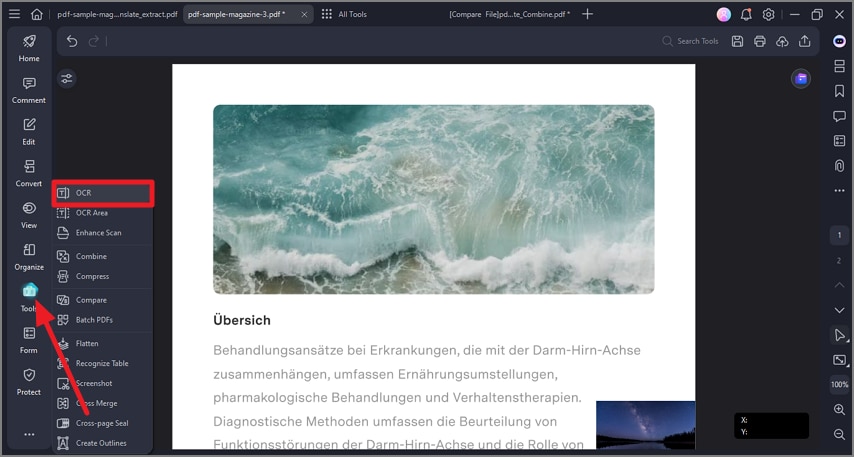
Step 2. Set OCR Language, Page Range, and Output
Choose the language that appears in the document, select the pages you want to recognize, and choose an editable-text output when you plan to revise the content. If your goal is mainly search and copy, a searchable text layer can preserve more of the original scanned-page appearance. Then click "Apply" to run OCR.
G2 Rating: 4.5/5 |100% Secure
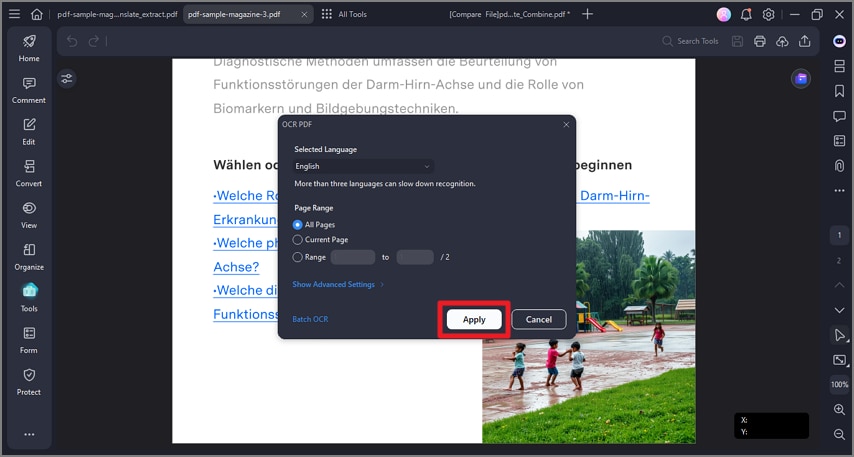
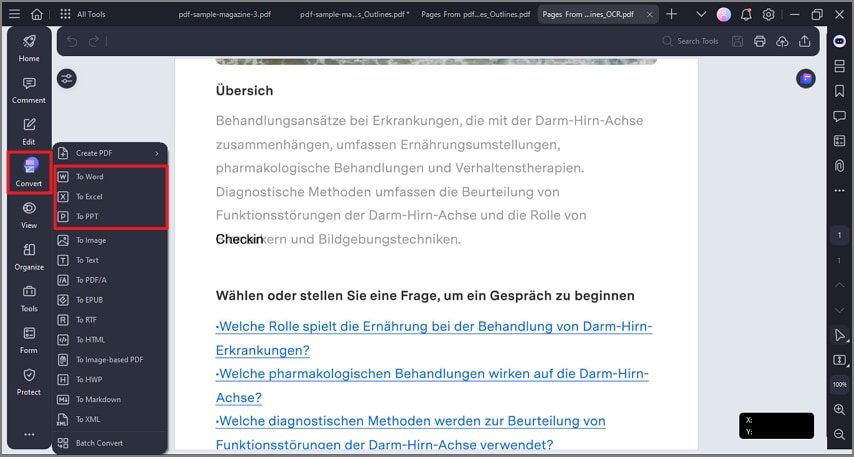
Step 3. Convert the Recognized PDF to Word
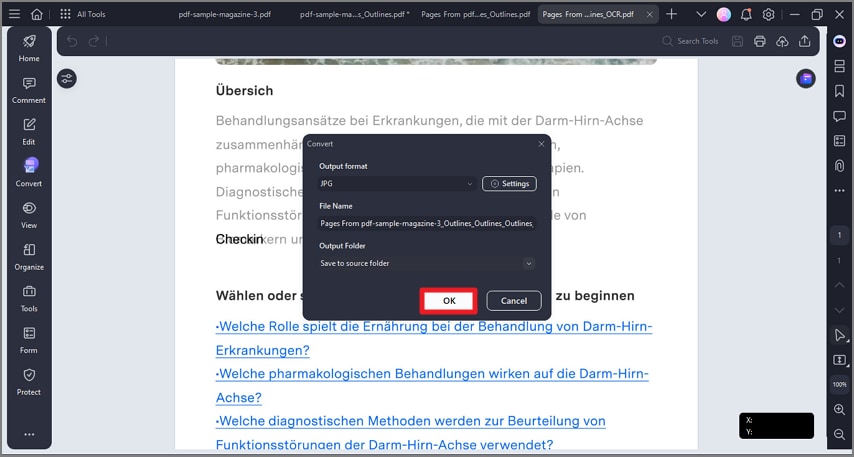
After OCR finishes, review the recognized text and correct obvious errors. Then open the conversion tools, choose Word as the output format, set the file name and output location, and save the DOC or DOCX file. Check tables, headings, page breaks, and image placement before using the Word file as a final document.
For complex layouts, use a layout-oriented conversion mode when visual structure matters most, or a recognition-oriented mode when editable text is the priority. Always compare the Word output with the original scan before using it as a final document.
Pros:
- Supports whole-document OCR, selected-area OCR, and batch OCR for multiple scanned PDFs.
- Offers searchable-text and editable-text OCR outputs for different document workflows.
- Lets you continue from OCR into editing, conversion, redaction, signing, page organization, and other PDF tasks in the same application.
- V13 connects recognized PDF content with AI-assisted workflows such as summarization, translation, multi-document Q&A, and AI Knowledge Space.
- Suitable for users who repeatedly work with scanned contracts, reports, research material, forms, and other document-heavy files.
Cons:
- Some advanced OCR, AI, export, or batch capabilities may depend on the current plan or product version.
G2 Rating: 4.5/5 |100% Secure
2. Adobe Acrobat - Best for Adobe OCR and Layout Retention
Adobe Acrobat can convert scanned PDFs to editable Word documents by recognizing image-based text and exporting the result to DOC or DOCX. In the current Acrobat experience, scanned documents can be recognized through the Scan & OCR tools, and Acrobat can also run text recognition automatically when scanned text is detected during PDF-to-Word export.
Acrobat is a strong fit for Adobe-based teams that need OCR together with editing, review, forms, redaction, accessibility, and document comparison. You can run OCR before export to review the recognized PDF first, or export directly to Word and let Acrobat recognize scanned text during conversion. For complex or high-stakes files, reviewing OCR before export gives you more control.
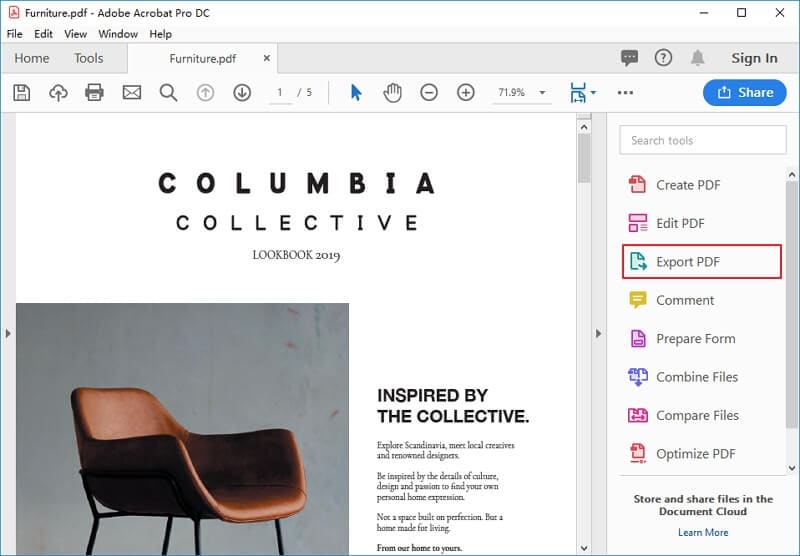
How to Convert a Scanned PDF to Word with OCR in Adobe Acrobat
In Acrobat, you can recognize the scanned text first and then export to Word, or export directly and let Acrobat run text recognition when the PDF contains scanned text. The exact labels can vary slightly by platform and Acrobat interface.
Step 1. Open the scanned PDF in Adobe Acrobat. In the current interface, open "All tools" and choose "Scan & OCR" to access text-recognition controls.

Step 2. Choose the file or current document, then use "Recognize Text" for the scanned pages. Review the recognized text if the document contains small fonts, tables, poor scans, or critical names and numbers.

Step 3. Open "Export a PDF," choose Microsoft Word, and export the document as DOC or DOCX. If Acrobat detects scanned text during export, its Word converter can run OCR automatically before the Word file is created.

Pros:
- OCR and Word export are integrated into Acrobat's broader editing and document-management workflow.
- Can automatically recognize scanned text during PDF-to-Word export.
- Suitable for users who also need advanced PDF review, forms, redaction, signing, or accessibility tools.
Cons:
- Full desktop OCR and advanced Acrobat workflows require a paid Acrobat plan.
3. Foxit PDF Editor - Best for OCR Review and Business Workflows
Foxit PDF Editor can recognize scanned or image-based PDFs, make the text searchable or editable, and then export or reuse the recognized content. Current Foxit OCR workflows use "Convert > Recognize Text" and support language selection, page ranges, and suspected-text review so users can check recognition results before relying on them.
Foxit PDF Editor, formerly Foxit PhantomPDF, is a practical business option when OCR is part of a broader editing, forms, security, signing, or scanning workflow. Current OCR tools support current-file and multiple-file recognition, language and page-range controls, searchable or editable output, and review of suspected OCR errors before Word export.
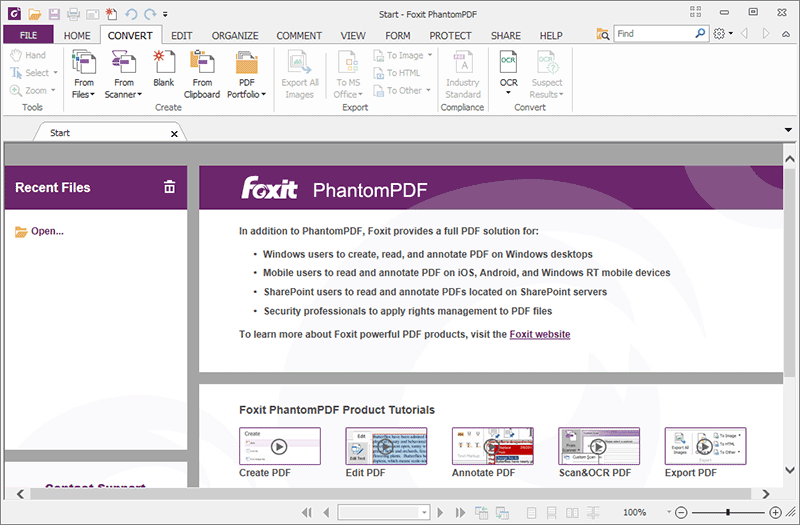
How to OCR a PDF to Word with Foxit PDF Editor
The Foxit workflow is OCR first, review the recognized text, then export the processed document to Word. Older screenshots may still show the former PhantomPDF branding, but the current product name is Foxit PDF Editor.
Step 1. Open the scanned PDF in Foxit PDF Editor. If the document is image-based, use the OCR workflow before trying to edit or export the text.

Step 2. Go to "Convert > Recognize Text," choose the current file, select the correct recognition language and page range, and run OCR. Review suspected text where accuracy matters.

Step 3. After OCR, use the export or Office conversion tools to create a Word file, then review the DOC or DOCX output for formatting, table structure, and recognition errors.

Pros:
- Supports searchable and editable OCR output for scanned documents.
- Provides language, page-range, and suspected-text review controls.
- Fits business workflows that also need editing, forms, redaction, security, scanning, or signatures.
Cons:
- Feature availability can vary by Foxit edition, plan, and platform.
- Complex tables, decorative fonts, handwriting, and poor scans still require manual verification after OCR.
4. Nitro PDF Pro - Best for Office-Oriented PDF Conversion
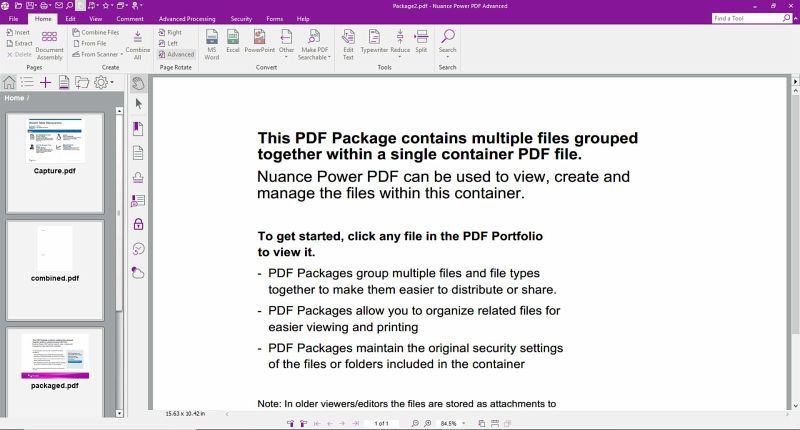
Nitro PDF Pro supports OCR for scanned PDFs and can convert recognized documents to Microsoft Word, making it a practical fit for Office-oriented document workflows. Nitro can recognize image-based text before conversion, and its Windows product includes built-in OCR languages with additional language packages available for some languages and versions.
Nitro is most relevant when Word is the main destination and the same team also needs PDF editing, conversion, review, or signing. Current Nitro documentation supports searchable or editable OCR, language and page controls, skew/orientation settings, and automatic OCR when scanned PDFs are converted to Word. For OCR-heavy use, test a representative scan before standardizing the workflow.
Pros:
- Supports OCR for scanned and image-based PDFs before Word conversion.
- Fits teams that regularly move between PDF and Microsoft Office formats.
- Provides multiple built-in OCR languages, with additional language resources available for supported versions.
- Includes broader PDF editing, conversion, signing, and document-review tools.
Cons:
- OCR language packages, product capabilities, and licensing vary by Nitro version and deployment.
Comparison of the 4 Best Desktop PDF to Word Converters with OCR
|
PDFelement
|
Adobe Acrobat
|
Foxit PDF Editor
|
Nitro PDF Pro
|
|
|---|---|---|---|---|
| OCR workflow | Whole document, selected area, or batch OCR | Scan & OCR plus automatic recognition during Word export | Recognize Text with page, language, and suspect-review controls | OCR for scanned PDFs before Office conversion |
| Best fit | OCR + editing + batch + AI-assisted PDF workflow | Adobe-centric professional PDF workflows | Business OCR, review, and desktop PDF management | Microsoft Office-oriented document conversion |
| Word export | DOC/DOCX after OCR | DOC/DOCX; OCR can run automatically for scans | Word/Office export after recognition | DOCX conversion with OCR for image-based PDFs |
| Batch / multi-file use | Batch OCR | Supported desktop workflows | Multiple-file recognition workflows | Multi-file conversion workflows |
Part 2: Best Online PDF to Word Converters with OCR
Online OCR converters are best for occasional scanned PDFs when you do not want to install desktop software. Before uploading confidential contracts, IDs, legal files, financial records, or other sensitive documents, check your organization's data-handling rules and the service's current privacy policy. Free limits, OCR availability, and sign-in requirements can change over time.
Use an online converter for short, non-sensitive files when convenience matters more than advanced review controls. Choose desktop software for confidential documents, large files, repeated batch work, or scans that need correction before export. Because online file-size, usage, language, and account limits can change, check the service's current terms before relying on it for regular work.
1. HiPDF - Best for Quick Browser-Based OCR
HiPDF provides a browser-based PDF to Word converter that can use OCR for scanned PDFs. Its current PDF-to-Word workflow lets you upload a PDF, choose OCR for image-based documents, select the document language, convert the file, and download an editable Word document. HiPDF also states that uploaded files are deleted after processing according to its current retention policy.
HiPDF is a good fit for occasional browser-based conversion when you do not need local batch processing or advanced OCR review. Select the correct document language and review tables, columns, names, and dates after conversion. For sensitive files, confirm that browser upload is permitted by your organization.
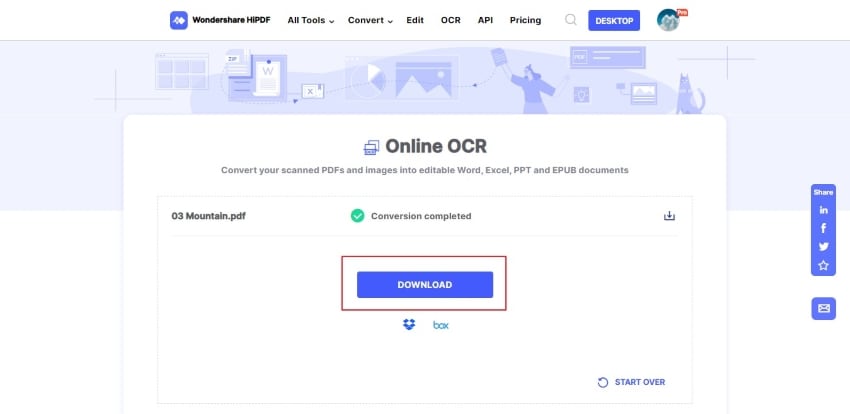
How to OCR a PDF to Word Online with HiPDF
Upload the scanned PDF to HiPDF's PDF to Word converter, enable OCR, choose the correct language, then convert and download the editable Word file. Review the output before relying on tables, names, dates, or other high-value information.
Instructions. Open the HiPDF PDF to Word tool, upload the scanned PDF, select OCR and the document language, start the conversion, then download the Word file when processing is complete.

2. OnlineOCR.net - Best for Free OCR of Smaller Files
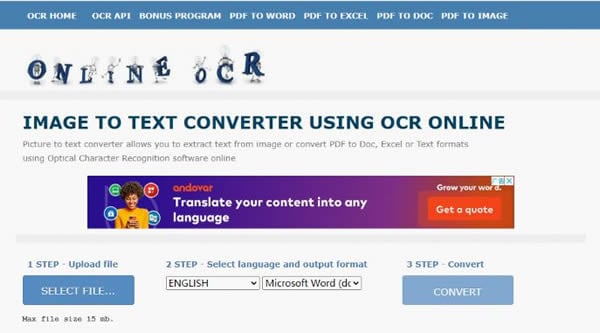
OnlineOCR.net is useful for small, occasional scanned PDFs because its guest mode supports OCR-to-Word conversion without desktop installation. The current PDF-to-Word page lists a 15 MB guest-file limit and up to 5 files per hour without registration, while registered accounts can process larger files. The tool asks you to select the recognition language before conversion and can output editable Word content with text, tables, and graphics.
This is a practical option for small, non-sensitive files that fit the current guest limits. Recognition quality still depends on scan resolution, contrast, orientation, fonts, language, and layout complexity, so verify important text after download. For skewed or faint scans, improving the source image first can matter more than changing the Word-export setting.
3. OCR2Edit - Best for Custom OCR Settings
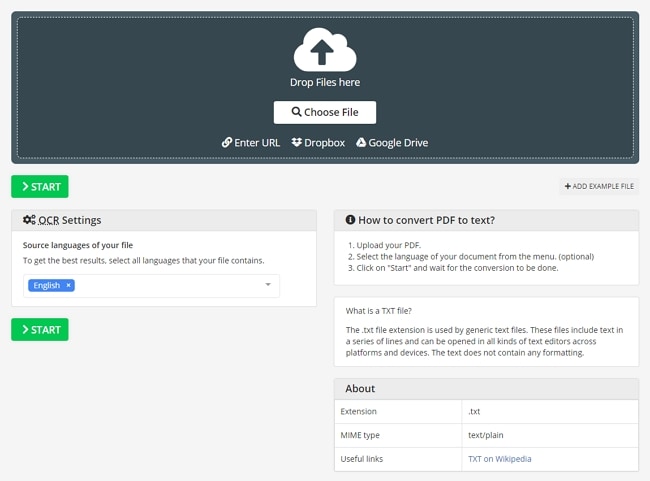
OCR2Edit is useful when you want a browser-based PDF-to-Word converter with explicit OCR controls. Its current workflow lets you choose Word as the target format, enable "Convert with OCR" for scanned pages, select an OCR method, specify the source language, and apply optional OCR-improvement settings before starting conversion.
Choose OCR2Edit when you want more control over recognition settings than a one-click converter provides. Mixed languages or dense layouts can benefit from deliberate OCR choices, but the Word output should still be checked for headings, tables, punctuation, names, and numeric values before final use.
Part 3: FAQs About OCR PDF to Word Conversion
Q1. Can OCR convert a scanned PDF to editable Word?
Yes. OCR recognizes text inside image-based or scanned PDF pages and converts it into machine-readable content that can be exported to Word. The final accuracy and formatting depend on the scan quality, language, fonts, tables, and page layout. Clean, straight scans and the correct OCR language usually produce more usable Word output than low-resolution or heavily skewed pages.
Q2. What is the best PDF to Word converter with OCR?
For regular desktop work, choose a tool that combines OCR, Word export, and the post-conversion features you actually need. PDFelement is a strong fit for OCR, batch processing, editing, and broader PDF workflows; Acrobat suits Adobe-centric teams; Foxit fits business PDF workflows; and Nitro is practical for Office-oriented conversion. For occasional non-sensitive scans, an online converter can be faster because there is nothing to install.
Q3. Can I convert a scanned PDF to Word for free?
Yes, several online services offer free or limited free OCR-to-Word conversion. HiPDF, OnlineOCR.net, and OCR2Edit all provide browser-based paths, but OCR access, file-size limits, hourly limits, sign-in requirements, and premium restrictions vary by service. Check the current service terms before relying on a free workflow for a large file or repeated conversions.
Q4. How can I preserve formatting when OCR converts PDF to Word?
Start with a clean, correctly oriented scan and select the correct recognition language. Use a converter that retains text flow, tables, images, and page structure, then review headings, columns, tables, page breaks, and fonts in Word because OCR cannot guarantee a perfect layout match on every document. When available, choose a layout-priority conversion mode for visually complex files and a recognition-priority mode when text extraction matters more than exact page design.
Q5. Can OCR convert a flattened or image-only PDF to editable Word?
Yes. If flattening leaves the visible page as image-based content, OCR can still recognize the printed text and export it to an editable Word file. Recognition quality will depend on how clearly the flattened page preserves the original text and layout. OCR cannot reconstruct information that is no longer visible in the flattened file, so hidden layers, deleted content, or lost form logic will not be recovered by recognition.
Conclusion
The right OCR PDF-to-Word converter depends on how often you convert scanned files and what you need to do after recognition. Desktop tools are usually better for repeated work, batch processing, sensitive documents, and workflows that continue into editing or review. Online converters are more convenient when you only need to process an occasional non-sensitive file.
PDFelement is a strong choice when you want OCR, batch processing, Word export, editing, and newer V13 document workflows in one environment. Acrobat is well suited to Adobe-based teams, Foxit provides detailed OCR and review controls, Nitro fits Office-oriented business workflows, and HiPDF, OnlineOCR.net, and OCR2Edit remain useful browser-based options. Whichever tool you choose, verify names, numbers, tables, and layout before using the converted Word file as a final document.
Free Download or Buy PDFelement right now!
Free Download or Buy PDFelement right now!
Try for Free right now!
Try for Free right now!

Elise Williams
chief Editor