
In this article
- Overview of ABBYY OCR Software Solutions
- How to Use ABBYY FineReader OCR (Desktop Guide)
- How to Use ABBYY Cloud OCR Online
- ABBYY OCR UiPath Integration Explained
- ABBYY OCR Pricing: How Much Does It Cost?
- Common Issues and Fixes for ABBYY OCR
- The Best Alternative to ABBYY OCR: Wondershare PDFelement
- Comparison: ABBYY OCR vs. PDFelement
- Frequently Asked Questions (FAQs)
Whether you want to use ABBYY OCR software for your university class assignments, legal document archiving, or complex professional data extraction tasks, the tool offers a powerful means to convert scanned documents into editable PDF, Word, or Excel formats.
Optical Character Recognition (OCR) is the foundational technology that allows computers to "read" text inside an image. For decades, ABBYY has been a recognized leader in this space, offering highly accurate text recognition engines. However, navigating their suite of tools—from desktop applications to cloud APIs and enterprise automation integrations—can be overwhelming for new users.
This comprehensive guide will take you through everything you need to know about the ABBYY ecosystem. We will cover how to use ABBYY OCR online and on desktop, break down its pricing structure, explain its integration with UiPath, and show you how to fix common errors. Finally, if you find ABBYY too complex or expensive, we will introduce a highly capable, user-friendly alternative.


 G2 Rating: 4.5/5 |
 100% Secure
Overview of ABBYY OCR Software Solutions
Before diving into the tutorials, it is crucial to understand that "ABBYY OCR" is not a single product. It is a technology that powers several different software solutions tailored to different user needs.
ABBYY FineReader OCR
This is the flagship desktop application for individuals and small-to-medium businesses. FineReader OCR allows you to view, edit, search, and protect PDFs, as well as perform highly accurate OCR on scanned documents directly from your Windows or Mac computer.
ABBYY Cloud OCR
Also known as ABBYY Cloud OCR SDK, this is a web-based service and API platform designed primarily for developers and businesses that want to integrate OCR capabilities into their own applications without installing heavy desktop software. There is also a consumer-facing ABBYY OCR online portal (FineReader Online) for quick, web-based document conversions.
ABBYY for Enterprise (Vantage / FlexiCapture)
For large corporations needing to process millions of documents, ABBYY offers enterprise-grade intelligent document processing (IDP) tools that use machine learning to extract specific data from unstructured documents like invoices and receipts.
How to Use ABBYY FineReader OCR (Desktop Guide)
If you have downloaded the desktop version of the ABBYY OCR software, the process of converting a physical paper document into an editable digital file is straightforward.
Here is the step-by-step process for using ABBYY FineReader OCR:
Step 1Prepare Your Hardware
If you are using a physical scanner, ensure that it is turned on, connected to your computer, and recognized by your operating system. The majority of scanners require their native drivers to be installed before FineReader can communicate with them.
Step 2Launch the Application
Open the ABBYY FineReader OCR application on your desktop. If you do not have it installed, you can download a free trial from the official ABBYY website.
Step 3Place Your Document
Place the physical document you wish to convert face-down on your scanner's glass or load it into the automatic document feeder (ADF).
Step 4Select Your Task
On the main interface, locate the "Scan" or "New Task" window. Click the downward arrow next to the primary action button to reveal your options. You will generally be provided with the following choices depending on your specific workflow needs:
- Option 1: 'Scan & Read Wizard' – This option guides you step-by-step through the entire OCR procedure, allowing you to manually adjust recognition areas before finalizing.
- Option 2: 'Scan & Read' – A quicker option that automatically scans the document and attempts to recognize images and text in one go.
- Option 3: 'Scan To PDF' – This function identifies images, scans the document, performs OCR, and immediately saves the recognized output as a searchable PDF file.
- Option 4: 'Scan To Word' – This option goes through the scanned documents, recognizes the text layout, and exports the data directly to Microsoft Word, maintaining the original formatting as closely as possible.
Step 5Review and Save
Once the OCR process is complete, FineReader will present the digitized text alongside the original image. You can correct any highlighted uncertainties (characters the engine wasn't 100% sure about) before saving the file to your hard drive.
How to Use ABBYY Cloud OCR Online
ABBYY Cloud OCR and FineReader Online allow users to perform OCR tasks entirely via their web browser. You are not required to download and install heavy desktop programs, saving time, processing power, and storage space on your device.
The online service is ideal for users who are traveling, using a shared computer, or simply need to convert a handful of pages quickly. Historically, the site lets users convert a small number of pages (up to five) for free. To convert larger volumes, a subscription plan is required.
Follow these five steps to use the ABBYY OCR online service:
Step 1Upload Your File
Navigate to the FineReader Online website. Click on the 'Upload' button to input your scanned document, image (JPEG/PNG), or non-searchable PDF file into the cloud platform.
Step 2Set the Document Language
Select the language of the text contained in your document. ABBYY supports over 190 languages, and selecting the correct one is vital for achieving high OCR accuracy. You can also select multiple languages if your document is bilingual.
Step 3Choose Output Format
Select the format into which the recognized digital text will be converted. Popular options include Searchable PDF, MS Word (.docx), MS Excel (.xlsx), or plain text (.txt).
Step 4Initiate Recognition
Click on the 'Recognize' button. The file is sent to ABBYY's secure cloud servers where the OCR engine processes the images.
Step 5Download the File
Once the processing is complete, a download link will appear. Click it to save the newly converted, editable file to your device's memory.
ABBYY OCR UiPath Integration Explained
In the world of corporate IT, automation is king. Robotic Process Automation (RPA) allows companies to build software "bots" that mimic human actions to perform repetitive tasks. UiPath is one of the world's leading RPA platforms.
Because RPA bots need to read and extract data from invoices, forms, and contracts, they require powerful OCR engines. This is where ABBYY OCR UiPath integration comes into play.
Why Integrate ABBYY with UiPath?
While UiPath comes with built-in OCR capabilities (often powered by Microsoft or Google engines), enterprise clients frequently prefer the ABBYY engine for its superior accuracy, complex layout retention, and ability to read poor-quality scans.
How to Configure ABBYY OCR in UiPath Studio
- Obtain Licenses: You must have a valid ABBYY FineReader Engine or FlexiCapture license, alongside your UiPath Studio setup.
- Install Packages: Open UiPath Studio, go to "Manage Packages," and install the
UiPath.Abbyy.Activitiespackage. - Drag and Drop Activities: In your UiPath workflow, drag the "Abbyy OCR" activity into your sequence.
- Configure Engine Path: In the properties panel of the activity, you must provide the installation path to the ABBYY engine on your local machine or server.
- Process Documents: You can now use this engine within "Read PDF With OCR" or "Get OCR Text" activities to extract data from UI elements or documents automatically.
ABBYY OCR Pricing: How Much Does It Cost?
Understanding ABBYY OCR pricing can be slightly complex because they offer different tiers for home users, businesses, and developers. Here is a general breakdown of what you can expect:
FineReader PDF for Windows / Mac
For desktop users, ABBYY has transitioned heavily toward a subscription model, though perpetual (one-time purchase) licenses are sometimes available through specific resellers.
- Standard Edition: Typically priced around $99 to $119 per year for Windows. This includes basic PDF editing and OCR capabilities. (Mac versions are similarly priced but may have feature discrepancies).
- Corporate Edition: Usually priced around $169 to $199 per year. This tier adds document comparison features and automated digitization routines (Hot Folder).
FineReader Online (Cloud)
- Free Tier: A minimal amount of pages (usually up to 5) upon registration.
- Subscription Tiers: Pricing starts at around $5/month for a small page allowance (e.g., 200 pages/month) and scales up depending on volume.
ABBYY Cloud OCR SDK (For Developers)
Developer pricing is strictly based on API calls and page volumes. Prices generally start around $29.99 for a package of 500 pages and scale down per-page as volume increases into the hundreds of thousands.

Common Issues and Fixes for ABBYY OCR
Even the best software encounters bugs. If you are using ABBYY OCR software, you might run into a few known technical hurdles. Here is how to fix them.
i. 'Fatal Error' Message While Scanning Documents
This error often occurs when ABBYY clashes with your scanner's native interface. To solve this:
- Go to the Tools menu and click on Options.
- Navigate to the Scan / Open tab.
- Under the scanning header, an interface will pop up. Select the 'Use native interface' or 'Use scanner's native interface' option.
- Click 'OK' and attempt to scan again.
ii. 'The RPC server is unavailable' Upon Launching
This issue normally occurs because the background licensing service failed to start.
- Press
Windows Key + R, typeservices.msc, and hit Enter to open the Service dialogue box. - Locate the ABBYY FineReader Licensing Service in the list.
- Right-click on it and select Restart (or Start if it is currently stopped).
iii. 'Requested member of the collection does not exist'
This is usually a registry issue related to Microsoft Office integrations.
- Go to Windows Search and type
Regedit, then press Enter. - Navigate to
HKEY_CURRENT_USER\Software\ABBYY\FineReader. - You may need to delete the registry folder for your specific version to force the software to rebuild its default settings (Proceed with caution and back up your registry first).
iv. Text Limitations and Poor Accuracy
If the OCR output is outputting gibberish:
- Ensure that the program's recognition language matches the document's actual language.
- Ensure the document is not handwritten, as standard OCR struggles with cursive (you need specialized ICR for that).
- Increase the contrast of the scanned image before running it through the OCR engine.
v. General Scanning Issues
If the software refuses to recognize the document structure properly:
- Ensure that the physical scan is aligned as straight as possible on the glass.
- Set your scanner's brightness level to 50%.
- Ensure the document is scanned at a resolution of exactly 300 DPI (Dots Per Inch), which is the optimal resolution for OCR engines.
The Best Alternative to ABBYY OCR: Wondershare PDFelement
While ABBYY is a legacy powerhouse, it has notable drawbacks: its pricing can be steep, the interface can feel outdated or overly complex for casual users, and the separation between Mac and Windows features can be frustrating.
If you are looking for an intuitive, modern, and cost-effective alternative, Wondershare PDFelement will measure up to all your PDF needs.
Other than supporting the highly accurate conversion of OCR recognition texts to MS Word, Excel, HTML, and PowerPoint, users get to edit scanned documents seamlessly just like they would in a word processor. The tool has also been integrated with extensive annotation features, personal drawing tools, text boxes, stamps, and comments. This makes teamwork, content creation, and document sharing incredibly simple.
G2 Rating: 4.5/5 |100% Secure
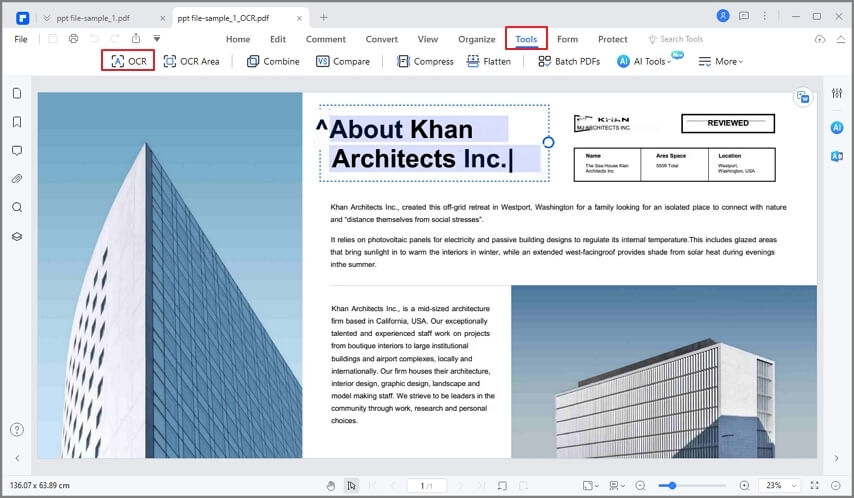
Step-by-Step: How to Perform OCR with PDFelement
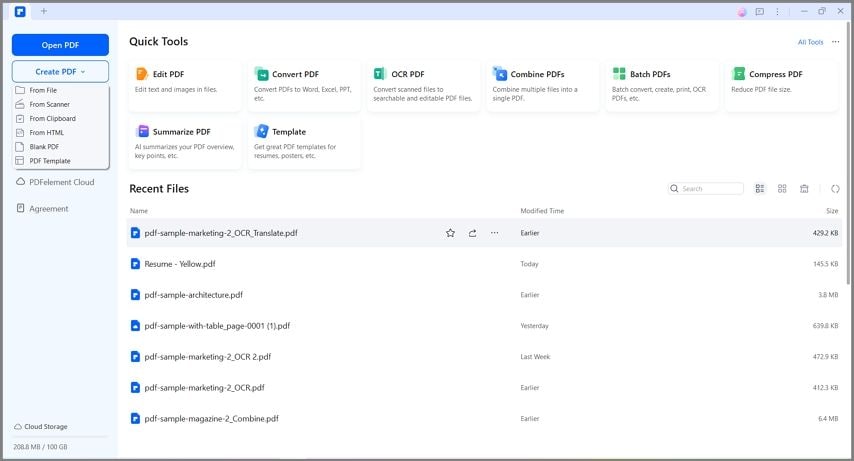
Step 1Open Your Scanned PDF File
Launch PDFelement. On the main interface, click the "Open File..." button. Navigate through your files, select the scanned document you want to digitize, and click "Open". Alternatively, you can simply drag and drop the file directly into the program window.
Step 2Perform OCR
PDFelement is equipped with smart detection. The program will automatically detect that you have opened an image-based, scanned PDF, and a blue notification ribbon will appear at the top. Click on the "Perform OCR" button on this ribbon. In the pop-up window, you will have two choices:
- Searchable Text Image: Keeps the image looking exactly the same but overlays invisible, selectable text.
- Editable Text: Converts the images of text into actual, editable font characters.
Select your preferred option, click the "Choose Language" button to ensure you select the correct language for your document, and finally, click "OK".
Step 3Edit Text after OCR
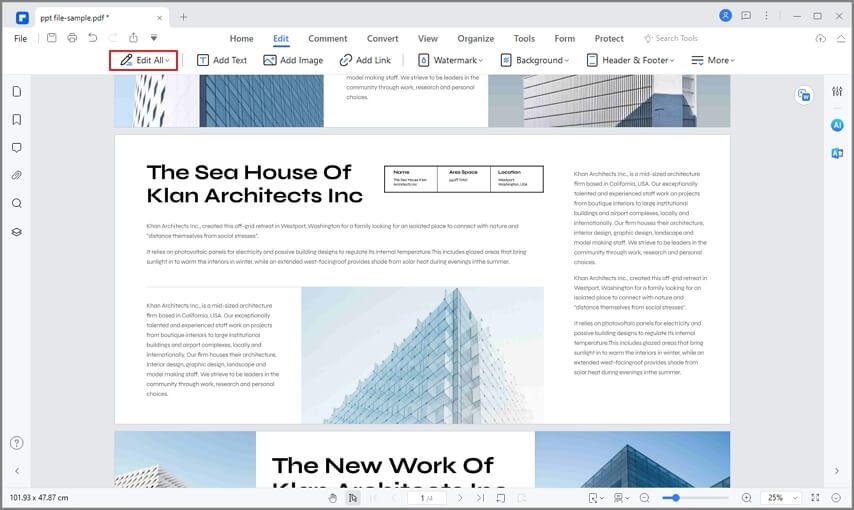
Once the OCR process finishes (usually in just a few seconds), your document is fully unlocked. You can now go to the "Edit" menu at the top. Select either "Line Mode" to edit single lines of text, or "Paragraph Mode" to edit entire blocks of text simultaneously. You can change fonts, colors, sizes, and layout instantly.
Why PDFelement is the Superior Choice
- Powerful Optical Character Recognition (OCR): Powered by an advanced engine, this tool makes it simple to recognize texts present in images and scanned documents with remarkable accuracy.
- Accommodates Searchable Files: It lets users perform crucial data extraction tasks in scanned PDFs. One can easily copy, search, or redact text in the contents of an image document.
- Supports Multiple Languages: The application is compatible with dozens of languages, including English, Spanish, Chinese, Portuguese, German, French, and more.
- Advanced UI and Speed: It boasts a robust processing speed, a beautiful, Microsoft Office-style interface, and powerful editing, annotating, converting, and protecting features.
Comparison: ABBYY OCR vs. PDFelement
To help you make the best decision for your document workflows, here is a breakdown of how ABBYY FineReader compares to Wondershare PDFelement.
| Feature / Metric | ABBYY FineReader PDF | Wondershare PDFelement |
|---|---|---|
| Primary Focus | Heavy-duty text extraction & OCR. | All-in-one PDF editing, creation & OCR. |
| User Interface | Traditional, slightly clinical interface. | Modern, ribbon-style interface (Office-like). |
| OCR Accuracy | Extremely high (industry standard). | Very high (powered by top-tier engines). |
| Pricing Model | Expensive annual subscriptions. | Highly competitive, affordable pricing. |
| PDF Editing | Good, but secondary to OCR extraction. | Exceptional (edit text, images, links smoothly). |
| Learning Curve | Moderate to High. | Very Low (Intuitive drag-and-drop). |
| Best For... | Enterprises, legal firms, developers. | Individuals, SMBs, students, daily office work. |
G2 Rating: 4.5/5 |100% Secure
Ultimately, if your sole requirement is extracting complex data via API or feeding an RPA bot via UiPath, ABBYY is the undisputed champion. However, if you are an individual or business looking to scan paper, turn it into a PDF, edit the text, add a digital signature, and email it out without breaking the bank, PDFelement is the much better overall software package.
Frequently Asked Questions (FAQs)
-
1. Is ABBYY OCR free?
No, ABBYY OCR software is not entirely free. While you can access a free trial for the FineReader desktop software, and get a small allowance of free pages via ABBYY FineReader Online, ongoing and high-volume usage requires a paid subscription or license. -
2. Does ABBYY work on Mac?
Yes, there is a version of ABBYY FineReader PDF for Mac. However, historically, the Mac version has sometimes had feature disparities compared to the more robust Windows version. Ensure you check the current feature list before purchasing for macOS. -
3. What is the difference between OCR and ICR?
OCR (Optical Character Recognition) is designed to read printed, typed text from books, invoices, and documents. ICR (Intelligent Character Recognition) is a more advanced technology designed to recognize and decipher human handwriting. -
4. How long does the OCR process take?
The speed depends on your hardware and the length of the document. For a standard 10-page document scanned at 300 DPI, modern tools like ABBYY and PDFelement can usually process the entire file in under a minute. -
5. Can OCR recognize tables and layouts?
Yes. High-end tools like ABBYY FineReader and PDFelement don't just recognize raw text; they analyze the structural layout of the image. When exported to Excel or Word, they will actively attempt to recreate columns, rows, margins, and headers to match the original scan.
![[2026] 11 Most Recommended Nanonets OCR Alternatives](https://images.wondershare.com/pdfelement/images2026/pdf-like-article-2.png)