
Table of Contents
Signing a document from an iPhone should not feel like a workaround. If the file is already in Mail, Files, Messages, or a cloud drive, the right app lets you open it, add your signature, fill missing fields, and send it back without printing a page or looking for a scanner.
The harder part is choosing the right signature app for iPhone. Some apps are built for quick PDF signing. Others are designed for formal approval workflows with signer authentication, reminders, audit trails, and team templates. An app that is perfect for signing a school form may be too limited for contracts; a full e-signature platform may be overkill if you only need to sign a PDF twice a month.
This guide compares the best options for iPhone and iPad users, explains where each one fits, and shows a practical PDF signing workflow with PDFelement for iOS.


 G2 Rating: 4.5/5 |
 100% Secure
What Makes a Good Signature App for iPhone?
A good iOS signature app should do more than place a scribble on a page. At a minimum, it should make the document easy to read, let you position the signature accurately, preserve the PDF formatting, and export a clean copy. For many people, that is enough.
For business use, the bar is higher. You may need signer identity verification, date stamps, an audit trail, cloud storage, reminders, reusable templates, or certificate-based signing. Those features matter when a document needs to prove who signed it, when it was signed, and whether the file was changed afterward.
Simple signatures vs. formal electronic signatures
People often use "digital signature", "electronic signature," and “e-signature” as if they mean the same thing. They overlap, but they are not identical.
A simple handwritten signature placed on a PDF is useful for everyday documents: permission slips, internal forms, receipts, basic agreements, HR acknowledgments, or vendor paperwork. You draw your name with a finger or Apple Pencil, place it on the document, and save the file.
A formal electronic signature workflow usually adds more context. The app may email a signing link, require the signer to verify their identity, capture IP address and timestamp data, and generate an audit certificate. This is common for sales contracts, legal agreements, real estate paperwork, finance documents, and business approvals.
A certificate-based digital signature goes further by using a digital certificate to help verify the signer’s identity and detect document tampering. If your organization asks for certificate-based signing, check the app’s security and compliance details before relying on a basic PDF markup tool.
iPhone signing vs. iPad signing
The best signature app for iPhone is usually the one that makes small-screen signing painless. You need clear zoom controls, a responsive signature pad, and an easy way to move the signature box into place. If you often review long contracts, a good search tool and page thumbnail view also help.
An iPad signature app has a different advantage: space. On an iPad, you can review more of the page at once, fill forms faster, and use Apple Pencil for a cleaner handwritten signature. If you sign dense PDFs or mark up documents before approving them, the iPad experience is usually better.
The ideal setup for many users is an app that works across both devices. You might review a contract on an iPad at your desk, then sign a short approval from your iPhone while away from your computer.
Best Signature Apps for iPhone and iPad
There is no single best mobile signature app for every situation. The right choice depends on how often you sign, whether other people also need to sign, and how much proof or workflow control you need.
1. PDFelement for iOS: Best for signing, editing, and managing PDFs on iPhone and iPad
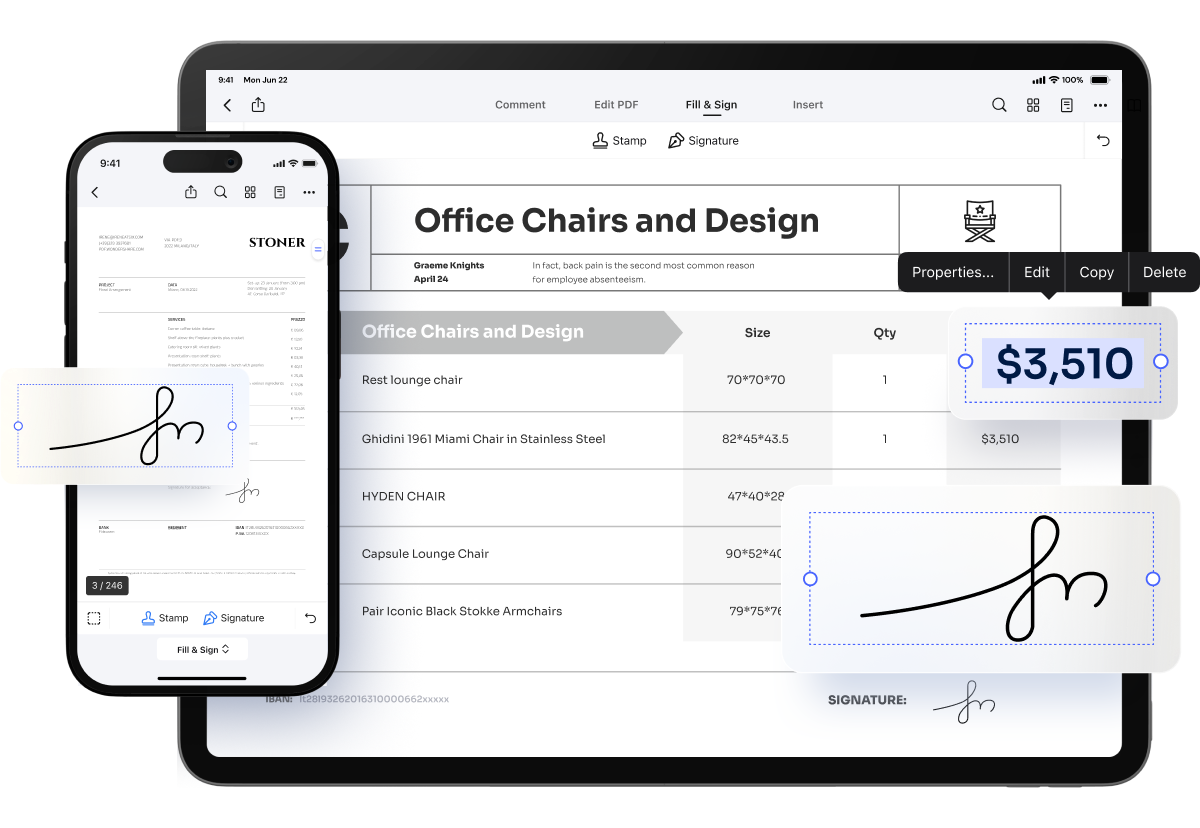
PDFelement for iOS is a strong choice if most of your signing work happens inside PDF files. It lets you open a PDF on iPhone or iPad, add a handwritten signature, fill forms, annotate pages, edit PDF content, convert files, organize pages, and save or share the finished document.
That matters because signing is often only one step. A client form may need text fields filled in before you sign it. A contract may need a highlighted clause, a comment, or a corrected date. A scanned document may need cleanup or OCR before it is easy to review. Using a PDF-focused app avoids the awkward routine of signing in one app, editing in another, and compressing the file somewhere else before sending it.
For iPhone users, PDFelement works well as a practical signature app for iPhone because it focuses on the PDF workflow around the signature: importing files, adding text, marking up pages, placing the signature, and exporting a clean PDF. On iPad, it becomes more comfortable for reviewing longer documents, especially if you prefer signing with Apple Pencil.
G2 Rating: 4.5/5 |100% Secure
PDFelement is especially useful for:
- Signing PDF forms received by email or saved in Files
- Filling in names, dates, addresses, checkboxes, and other form fields
- Annotating or highlighting terms before sending the document back
- Converting Office files or images into PDFs before signing
- Organizing, compressing, or sharing PDFs after signing
If your main need is a full multi-party signing workflow with automated reminders and audit certificates, a dedicated e-signature platform may be more appropriate. But for day-to-day PDF signing and document preparation on iOS, PDFelement is one of the most practical choices.

2. DocuSign: Best for business e-signature workflows
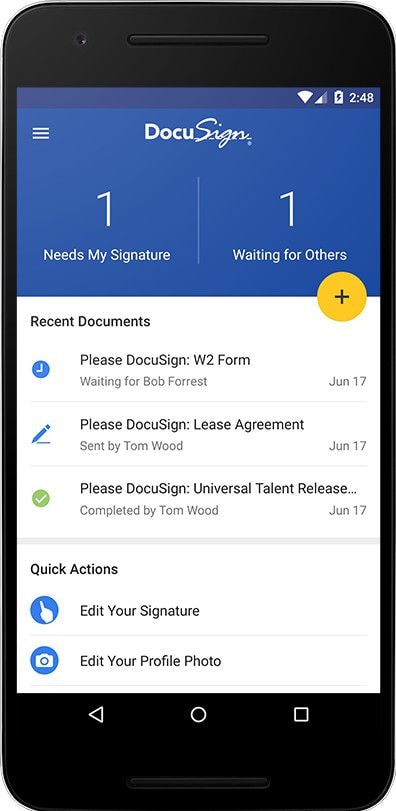
DocuSign is one of the best-known e-signature platforms and is widely used for contracts, approvals, client agreements, and sales documents. It is more than a PDF signing tool. It is built around sending documents for signature, tracking signing status, reminding recipients, and keeping records of completed agreements.
As a mobile signature app, DocuSign is helpful when several people need to sign the same document or when a business needs a repeatable approval process. You can prepare a document, assign fields to different signers, send it out, and monitor completion from your phone.
The tradeoff is that DocuSign may feel heavier than necessary for simple one-person PDF signing. If you only need to put your own signature on a file and email it back, a PDF editor may be faster. If you manage agreements with clients, vendors, or employees, DocuSign’s workflow features are the reason to consider it.
3. Adobe Acrobat Sign and Adobe Fill & Sign: Best for Adobe document ecosystems
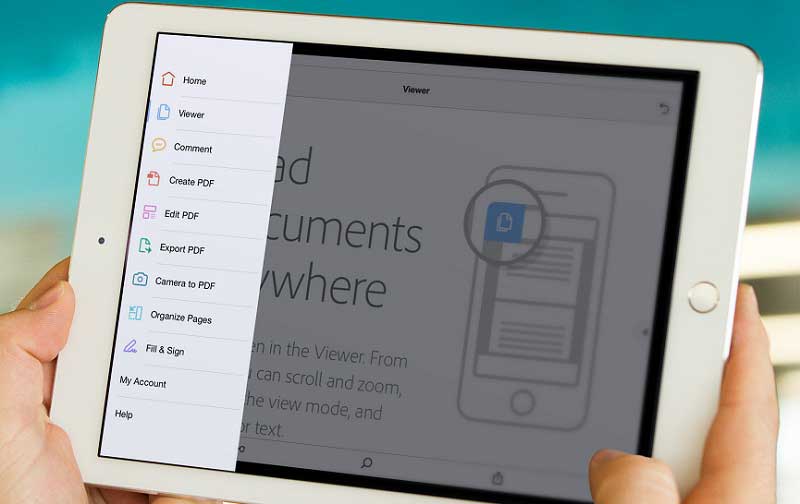
Adobe offers several ways to sign documents, depending on which app or service you use. Adobe Acrobat includes PDF tools and signing features, while Adobe Acrobat Sign is aimed at formal e-signature workflows. Adobe Fill & Sign has also been associated with quick form filling and simple signing, though Adobe’s product lineup and feature availability can change over time.
Adobe is a sensible choice if your workplace already uses Acrobat, Creative Cloud, or Adobe document services. The interface is familiar to many users, PDF compatibility is generally strong, and the broader Acrobat ecosystem includes editing, scanning, commenting, and sharing tools.
For iPhone users, Adobe can work well for both quick signing and more structured e-signature tasks, depending on the plan and app. The main thing is to check which signing features are included before committing. Some capabilities may require a paid subscription or a specific Adobe service.
4. Secured Signing: Best for identity-focused signing features
Secured Signing is designed for users and businesses that need more than a basic signature image. Its feature set may include cloud-based signing, identity verification options, video confirmation, document negotiation, and signing workflow tools.
This kind of app is worth considering when the signature process itself needs extra evidence. For example, a business may want to verify that a signer completed the process personally, or it may need a more detailed record than a flattened PDF with a signature placed on it.
For casual iPhone signing, Secured Signing may be more than you need. For organizations that care about verification and auditability, it can be a better fit than a lightweight PDF markup app.

5. OneSpan Sign: Best for regulated business use
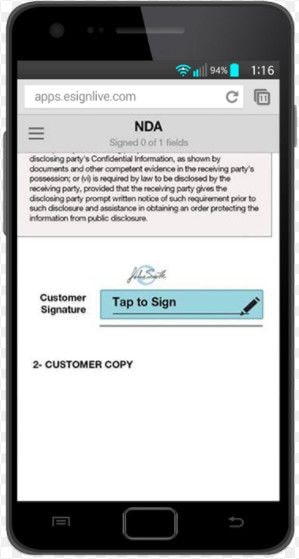
OneSpan Sign, previously known as eSignLive, is another established e-signature platform used in business and enterprise settings. It is often associated with industries that care about security, identity, and compliance, such as finance, insurance, government, and other regulated environments.
The strength of OneSpan Sign is not casual PDF markup. It is structured signing at scale: controlled workflows, signer authentication, deployment flexibility, and enterprise-grade signing processes. If your organization needs a secure iOS app signature workflow for formal agreements, it belongs on the shortlist.
For individuals and small teams, the decision depends on complexity. If you only sign your own PDFs, it may be too much. If you send sensitive agreements to customers or partners and need stronger controls, it is built for that type of work.
6. Apple Markup: Best free built-in option for quick signatures
Apple’s built-in Markup tools are easy to overlook. On iPhone and iPad, Markup lets you add a signature to PDFs and images from apps such as Mail, Files, Photos, and Preview-style document views.
It is convenient because there is nothing to install. Open the document, tap the Markup icon, create or reuse a signature, place it on the page, and save or share the file. For a one-page form or a low-risk document, it may be all you need.
The limits become clear with more serious document work. Markup is not a full PDF editor. It does not provide advanced form management, multi-party signing workflows, audit trails, or business-level signer authentication. It is best treated as a quick built-in signing option, not a replacement for a dedicated signature app for iPhone.
Apple explains the basic Markup workflow in its support resources for using Markup on iPhone and iPad.
How to Sign a PDF on iPhone or iPad with PDFelement
If your document is already a PDF, the signing process can be short. The example below uses PDFelement for iOS because it combines signing with PDF editing, form filling, annotation, and export tools.
G2 Rating: 4.5/5 |100% Secure
Step 1: Import or open the PDF
Install PDFelement for iOS, then open the PDF from your device, Files, email attachment, or cloud storage location. If the document is a photo or scan rather than a PDF, convert or scan it into PDF first so the signed copy is easier to share and preserve.
On an iPhone, zoom in before filling small fields. On an iPad, use page thumbnails to move quickly between sections of a longer file.
Step 2: Fill in the required fields before signing
Before adding a signature, complete the document. Enter your name, date, address, initials, checkboxes, or other required information. This prevents the common problem of signing first, then realizing you still need to edit the page.
If the PDF has interactive form fields, tap into each field and type. If the file is a flat PDF or scanned form, use text tools to place information manually. For scanned documents, OCR can make the file easier to search and review before signing.
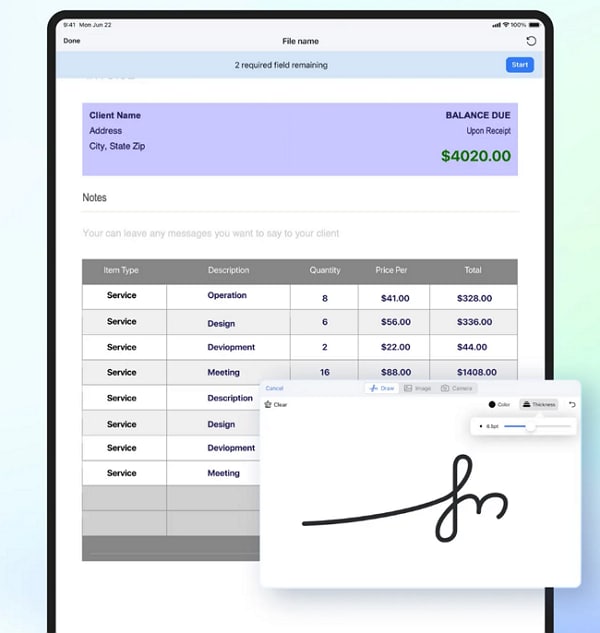
Step 3: Add your signature
Open the Fill & Sign or signature tool, then create a signature by drawing with your finger or Apple Pencil. On iPhone, a horizontal screen position may give you more room to draw. On iPad, Apple Pencil usually produces a more natural result.
Place the signature in the correct location and resize it if needed. Keep it proportional and avoid covering printed text. If the form needs initials on multiple pages, create initials separately rather than shrinking your full signature into a small box.
Step 4: Review the signed PDF
Do one final pass before sending. Check that the signature is on the right page, all required fields are filled, dates are correct, and no annotation is accidentally covering important text.
If the document contains sensitive information, confirm that you are sharing it through an appropriate channel. For example, a routine vendor form may be fine by email, while a confidential contract may need a secure portal or approved business system.
Step 5: Save and share the completed document
Save the signed copy as a PDF. If the file is large because it contains scans or images, compress it before sending. Use a clear filename such as signed-service-agreement-jane-smith.pdf rather than leaving it as scan_004_final2.pdf.
PDFelement can also help with follow-up PDF tasks after signing, such as organizing pages, converting the file to another format, or keeping an annotated copy for your records.
How to Choose the Right iOS Signature App
The phrase “best signature app for iPhone” can point to very different tools. A freelancer signing a W-9, a sales team sending contracts, and a legal department collecting approved agreements do not need the same app. Use the signing scenario to narrow the choice.
G2 Rating: 4.5/5 |100% Secure
For occasional personal PDF signing
If you sign documents only occasionally, start with a simple workflow. Apple Markup may be enough for basic forms. PDFelement is a better fit if you also need to fill fields, edit PDF text, annotate pages, convert files, or manage signed documents in one place.
The key is speed. You should be able to open the file, sign it, save it, and send it back in a few minutes. Avoid paying for an enterprise e-signature platform if you do not need multi-signer routing or audit records.
For regular business approvals
If you send documents to clients, contractors, employees, or vendors, look for workflow features. DocuSign, Adobe Acrobat Sign, OneSpan Sign, and similar platforms are built for this. They can assign signing fields, send reminders, track completion, and maintain a signing history.
A PDF editor still has a role in this workflow. Many documents need cleanup before they are sent for signature. You may need to correct text, combine attachments, remove extra pages, compress the final packet, or add comments for internal review. This is where PDFelement can support the signing process even if the final signature request is sent through a dedicated e-signature service.
For secure or regulated documents
If the signed document has legal, financial, medical, or regulatory importance, do not choose based only on convenience. Check the platform’s authentication options, encryption, audit trail, data storage practices, and compliance documentation.
For U.S. users, the federal ESIGN Act provides a legal framework for electronic signatures in many situations. You can read the law on the official Federal Trade Commission ESIGN Act page. Other countries and industries may have their own requirements, so confirm what applies before using a simple signature image for high-stakes documents.
For iPad and Apple Pencil users
If you prefer a handwritten look, an iPad signature app with Apple Pencil support is worth using. The larger screen makes it easier to sign naturally, especially for long names or initials. It also helps when reviewing dense contracts, filling tables, or marking up clauses before approval.
For many users, the best signature app for iPad is not necessarily different from the best iPhone app. The better choice is often one iOS app that works well on both devices, syncs files reliably, and does not force you to rebuild signatures or workflows on each screen.
Are iPhone Signatures Legally Valid?
Electronic signatures are commonly accepted for many personal and business documents, but validity depends on the law, the document type, the signing process, and the parties involved. A signature drawn on an iPhone can be acceptable in many routine situations, but some documents require stricter identity verification, witnesses, notarization, or a specific signing platform.
The legal question is usually not “Was it signed on an iPhone?” It is “Can the signing process show intent, consent, identity, and document integrity?” A formal e-signature platform may help answer those questions by recording timestamps, signer emails, authentication steps, IP addresses, and audit logs.
For low-risk documents, a simple signed PDF may be fine. For contracts, financial paperwork, HR agreements, real estate documents, healthcare forms, or anything that could be disputed later, ask the receiving organization what signing method they require. If a bank, court, employer, or government agency asks for a specific format, follow that requirement rather than assuming any iOS app signature will be accepted.
Also remember that some workflows still require notarization or jurisdiction-specific handling. Remote online notarization is separate from ordinary PDF signing and may require approved identity verification and notary tools.
Practical Tips Before You Send a Signed Document
A signing app saves time, but small mistakes can still create delays. Before you send the final PDF, slow down for one minute and check the details that usually cause documents to be rejected.
Make sure the signature is on every required page. Some forms require initials in addition to a final signature, especially agreements with multiple clauses. Check that the date format matches the recipient’s expectations, particularly for international documents where month/day order can cause confusion.
Use a clean version of your signature. If you draw it with your finger on an iPhone, try rotating the screen or zooming into the signature area. On iPad, Apple Pencil gives better control. Avoid signatures that look cropped, stretched, or too faint.
Keep the file format stable. PDF is usually the safest format for signed documents because it preserves layout across devices. If you sign an image or a Word file, convert it to PDF before sending unless the recipient requested a different format.
Name the file clearly. A signed document should be easy to identify later. Include the document type, party name, and date if helpful. For example: signed-nda-acme-2025-03-18.pdf.
For sensitive documents, avoid sending the file to the wrong thread or personal account. Use the approved business channel, client portal, or secure file-sharing method when required.
People Also Ask
-
What is the best signature app for iPhone?
The best signature app for iPhone depends on the job. PDFelement for iOS is a strong choice for signing, filling, editing, annotating, and managing PDFs. DocuSign and Adobe Acrobat Sign are better suited to formal business e-signature workflows with multiple signers and tracking. Apple Markup is the simplest free option for quick, low-risk signatures. -
What is the best signature app for iPad?
For PDF-focused work, PDFelement is one of the best signature app for iPad options because the larger screen works well for reading, form filling, markup, and Apple Pencil signing. If you need business routing, audit trails, and signer management, consider platforms such as DocuSign, Adobe Acrobat Sign, or OneSpan Sign. -
Can I sign a PDF on iPhone without printing it?
Yes. Open the PDF in a signature app for iPhone, add your signature, fill any required fields, save the signed copy, and send it back digitally. Apps such as PDFelement, Apple Markup, Adobe Acrobat, and DocuSign can all support this in different ways. -
Is Apple Markup enough for signing documents?
Apple Markup is enough for many simple documents, such as basic forms or informal approvals. It is not ideal when you need advanced PDF editing, form management, signer authentication, reminders, or an audit trail. For those needs, use a dedicated PDF app or e-signature platform. -
Can I use the same signature app on iPhone and iPad?
Most major iOS signature apps work on both iPhone and iPad. This is useful if you want to sign quick documents from your phone but review longer PDFs on an iPad. Before choosing an app, check whether your signatures, files, and account settings sync across devices. -
What is the difference between an electronic signature and a digital signature?
An electronic signature is a broad term for signing electronically, such as drawing your signature on a PDF or clicking to sign an agreement. A digital signature usually refers to a more technical method that uses certificates and cryptographic validation to verify identity and detect tampering. Many everyday documents only need an electronic signature, but some organizations require certificate-based digital signatures. -
Is an iOS app signature legally binding?
An iOS app signature can be legally binding in many cases if the process shows the signer’s intent and meets the requirements for that document type and jurisdiction. However, some documents may require stronger authentication, notarization, witnesses, or a specific approved platform. For high-value or regulated documents, confirm the required signing method with the recipient or a qualified professional. -
Can I sign scanned documents on iPhone?
Yes. You can scan a paper document with your iPhone, save it as a PDF, and sign it with a PDF signing app. For better results, scan in good lighting, crop the page edges, and use OCR if you need searchable text. PDFelement can help with scanning-related PDF workflows, form filling, signing, and saving the final PDF.