
Table of Contents
- Why Gmail HTML Signatures Work Differently Than Plain Text Signatures
- Before You Insert an HTML Signature in Gmail
- How To Insert HTML Signature in Gmail
- How To Test and Fix a Gmail Email Signature HTML Layout
- Best Practices for a Professional HTML Email Signature in Gmail
- Use PDFelement for Signed PDF Documents You Send Through Gmail
A Gmail signature can do more than show your name and phone number. With HTML, you can add a logo, clickable social icons, brand colors, formatted job details, legal disclaimers, and links to booking pages or documents. The catch is that Gmail does not give you a simple "upload HTML file" option.
That does not mean you cannot use a Gmail HTML signature. You just need to add it the way Gmail accepts it: by pasting the rendered signature into the signature editor, not by pasting raw HTML code into the box. Once you understand that difference, the process is fairly simple.
This guide explains how to insert an HTML signature in Gmail and how to handle related document workflows when you need to send signed PDFs through Gmail.
Why Gmail HTML Signatures Work Differently Than Plain Text Signatures
Gmail's signature editor is a rich-text editor. It lets you add text, links, images, basic formatting, and spacing, but it is not a full HTML code editor. If you paste raw code such as < table >, < a href="" >, or < img src="" > directly into the signature box, Gmail will usually treat it as text or strip parts of it.
The practical workaround is to copy the rendered version of the signature. In other words, you open the HTML signature in a browser or generator preview, select the visible signature design, copy it, and paste that into Gmail. Gmail keeps much of the formatting because you are copying the visual result, not the source code.
This is why many tutorials for an html email signature Gmail setup tell you to open the HTML file in Chrome, Safari, Edge, or Firefox first. The browser turns the code into a visible design. Then Gmail can accept that design through copy and paste.
There are limits. Gmail may simplify some CSS, remove unsupported styling, or change spacing slightly. Email clients also render HTML differently. A signature that looks perfect in Gmail desktop may appear slightly different in Outlook, Apple Mail, or the Gmail mobile app. That is normal for email HTML, which is more restrictive than web page HTML.
Before You Insert an HTML Signature in Gmail
A good Gmail signature starts before you open Gmail settings. If the HTML is too complex, uses unsupported styling, or depends on local image files, it may break after pasting. A few checks upfront can save a lot of editing later.
What Gmail Supports
Gmail works best with simple, email-safe HTML. Traditional table-based layouts often perform better than modern CSS-heavy designs because many email clients still handle tables more predictably. Inline styles are safer than external stylesheets. Small images, clear links, and basic font formatting are usually fine.
Gmail signatures can include:
- Formatted text, including bold, color, font size, and alignment
- Clickable links for websites, social profiles, email addresses, and phone numbers
- Images such as logos, headshots, banners, and icons
- Simple table-based layouts copied from a rendered HTML signature
Avoid relying on JavaScript, embedded forms, video players, background scripts, external CSS files, or advanced animations. These are commonly blocked or stripped in email for security and compatibility reasons.
For general reference on Gmail signature settings, Google's own Gmail Help page explains where signatures are managed and how signatures can be assigned to new emails and replies.
What To Prepare First
Before you add a Gmail email signature HTML design, make sure you have the final version ready. Editing a complex signature inside Gmail can be frustrating because the signature editor is not built for fine HTML control.
Prepare the basics first: your name, job title, company, phone number, website, email address, logo, and any required disclaimer. If your company uses brand guidelines, check the approved colors, logo size, and social media links.
If you are using an HTML file, save it somewhere easy to find. If you are using a generator, keep the preview page open. If a designer or marketing team gave you code, ask whether the images are already hosted online. That matters more than most people expect.
A Note About Images and Hosting
Images in an HTML signature need to be available online. If the signature code points to an image stored only on your computer, recipients will not see it. Gmail cannot send your local image path, such as C:\Users\Name\logo.png, as a working public image.
Use images hosted on a reliable public URL, your company website, your email signature platform, or another approved image host. The URL should start with https://. If an image requires login access, blocks hotlinking, or is deleted later, it may disappear from the signature.
Keep images reasonably small. Oversized banners or high-resolution logos can slow email loading and may make your signature look bulky on mobile. A clean logo and a few small icons usually work better than a large promotional graphic.
How To Insert HTML Signature in Gmail
There are three practical ways to add an HTML signature to Gmail. The best option depends on what you already have: an HTML file, a generated signature preview, or only the design details.
Method 1: Copy the Rendered HTML Signature From a Browser
This is the most common method if you already have an HTML signature file. The key is to open the file in a browser and copy the visible signature, not the code.
First, locate your HTML signature file. It may have a .html or .htm extension. Open it in a browser by double-clicking the file or dragging it into a browser window. You should see the signature displayed as it would appear in an email, with your text, logo, icons, and links.
Select the full signature design in the browser. You can usually click and drag across it, or use the browser's select-all command if the page contains only the signature. Then copy it.
Now open Gmail on desktop. Click the gear icon in the top-right corner, choose See all settings, and stay on the General tab. Scroll down to the Signature section. Click Create new if you do not already have a signature, give it a recognizable name, and paste the copied signature into the editor.
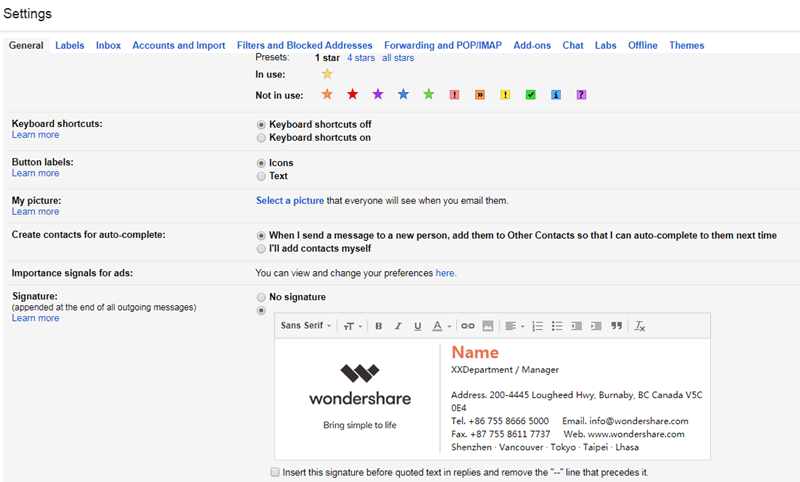
After pasting, check the layout inside the Gmail editor. Click any image once to see whether Gmail recognizes it as an image. Click links to confirm the visible text and URLs are correct. Then scroll to the bottom of the settings page and click Save Changes. Gmail will not apply the signature until you save.
To use the signature automatically, return to the same Signature settings area and check the signature defaults. Gmail lets you choose one signature for new emails and another for replies or forwards. If you leave these set to "No signature," the signature will exist but will not appear automatically.
Method 2: Copy a Signature From an Email Signature Generator
If you used a signature generator, you may not need to touch the HTML file at all. Most email signature generators provide a preview and a copy button. This can be easier because the generator usually formats the signature with email-safe HTML.
Open the generator's final preview. Look for an option such as Copy signature, Copy to clipboard, or Install in Gmail. If the tool provides Gmail-specific instructions, follow them, but the basic workflow is the same: copy the rendered signature and paste it into Gmail's signature editor.
After pasting into Gmail, send yourself a test email. Do not rely only on the preview inside Gmail settings. A signature can look acceptable in the editor but shift slightly in an actual message. Check the test email in Gmail desktop and, if possible, on your phone.
If your company uses Google Workspace, your administrator may also enforce or append organization-wide signatures. In that case, your personal Gmail signature may appear along with a company-managed footer. If the final email looks duplicated or cluttered, check with your admin before making more edits.
Method 3: Rebuild the Signature Manually Inside Gmail
If you do not have a clean HTML file or generator output, you can rebuild a simpler version directly in Gmail. This is not a true code-based method, but it may be the most stable option for many users.
Open Gmail's signature editor and add your text manually. Use Gmail's formatting toolbar to set font size, bold text, color, and links. Add your logo using the image icon in the signature editor. For social icons, insert small images one by one and link each icon to the correct profile.
This method is useful when your original HTML signature has too many formatting problems. A simpler signature made inside Gmail may render more consistently than a complicated design pasted from outside.
The tradeoff is design control. Gmail's editor does not offer the same precision as custom HTML. You may not be able to reproduce exact spacing, columns, or icon alignment. Still, for many professionals, a clean text-and-logo signature performs better than a crowded layout.
How To Test and Fix a Gmail Email Signature HTML Layout
Once you insert HTML signature in Gmail, do not assume the job is finished. Email signatures are small, but they are still HTML emails. Different apps interpret them differently, especially on mobile.
Send a test message to yourself and to another address if possible. For example, send one to a Gmail account and another to an Outlook or Apple Mail account. Open the email on desktop and mobile. Look closely at spacing, image loading, link behavior, and whether the signature feels too large in a short reply.
Images Do Not Appear
If images are missing, the most likely cause is the image source. The image may be stored locally, blocked by permissions, or hosted at a URL that is not publicly accessible.
Open the image URL in a private or incognito browser window. If it does not load without signing in, recipients may not see it either. Replace the image with one hosted on a public HTTPS URL. If you inserted the image directly through Gmail's image tool, try re-uploading it or using a web address instead.
Some recipients also block external images by default. In that situation, your signature should still make sense without the images. Do not put essential contact information only inside an image.
Formatting Changes After Pasting
If spacing, columns, or fonts change after you paste the signature, the HTML may rely on styles Gmail does not keep. Gmail often handles inline styles better than embedded CSS in a <style> block. It may also remove unsupported tags.
The quickest fix is to simplify the layout. Use fewer columns, avoid unusual fonts, and reduce nested elements. If your design uses a table, make sure the table is not too wide. A signature that looks like a mini web page is more likely to break than one designed specifically for email.
When copying from a browser, try selecting only the signature area, not the entire page. Accidentally copying hidden elements or extra spacing around the signature can create odd gaps inside Gmail.
Links Do Not Work
After pasting, click each link in the Gmail signature editor or send a test email and test links from the received message. Check website links, phone links, email links, social icons, and booking links.
Use full URLs, such as https://example.com, rather than shortened or incomplete links. For phone numbers, use a tel: link only if it is appropriate for your audience. For email links, mailto: links can work, but avoid adding too many prefilled parameters because some email clients may handle them differently.
If a linked icon is not clickable after pasting, select the icon in Gmail's editor and use the link button to add the URL again. Gmail sometimes preserves the image but drops the hyperlink attached to it.
Signature Is Too Large
A signature can become too large visually or technically. Visually, it may take up more space than the message itself, especially in replies. Technically, Gmail may clip long messages, and large signatures contribute to that problem.
Trim banners, long quotes, oversized disclaimers, and unnecessary icons. If you need a legal disclaimer, keep it concise and use smaller text. If your company requires a full disclaimer, consider whether it should be appended by your organization's email system rather than manually added to every user's signature.
A good practical test: write a two-line reply and look at the email with your signature attached. If the signature dominates the reply, it is too heavy.
Mobile Gmail Signature Issues
Gmail mobile apps can behave differently from Gmail desktop. In the Gmail app, you may see a separate mobile signature setting. If that setting is turned on, it can override or replace your desktop signature on messages sent from the app.
For the most reliable setup, configure the HTML signature in Gmail desktop first. Then open the Gmail mobile app and check the signature settings. If you want the same signature everywhere, test by sending an email from the app. If the app does not preserve the full HTML layout, you may need to use a simpler mobile signature.
Mobile screens also make wide signatures look cramped. Avoid layouts that depend on a large horizontal space. A logo, name, role, and a few compact links usually work better than a multi-column design with several images.
Best Practices for a Professional HTML Email Signature in Gmail
A professional Gmail HTML signature should be useful, readable, and restrained. The goal is not to impress people with decoration. The goal is to make it easy for recipients to identify you, contact you, and take the next logical action.
Keep the most important information near the top: name, role, company, and primary contact method. Add only the links people are likely to use. A website, LinkedIn profile, booking link, or support page may be useful. Five social networks, three banners, a quote, and a full promotional block usually create clutter.
Use brand colors carefully. One accent color is often enough. Stick with standard fonts or web-safe fallbacks because custom fonts may not display in every email client. If brand consistency matters, use the logo for visual identity rather than forcing a rare font that recipients may never see.
For accessibility, make the signature readable without images. Use real text for your name, job title, phone number, and website. Add descriptive alt text to important images when your signature tool supports it. Avoid low-contrast color combinations, such as light gray text on a white background.
Legal disclaimers deserve a separate decision. Some organizations require them, but many personal signatures do not need a long block of legal text. If a disclaimer is required, make it short and readable. Long disclaimers can distract from the actual email and may cause clipping in long threads.
Finally, update the signature when your role, phone number, website, or logo changes. Old signatures are easy to forget because they sit in settings. If you work in a team, keep a shared source file or HTML signature template so everyone uses the same approved version.
Use PDFelement for Signed PDF Documents You Send Through Gmail
A Gmail HTML signature is useful for everyday identity and contact details, but it is not the same as signing a document. If you need to send a contract, proposal, invoice, onboarding form, or approval file through Gmail, you should handle the document signature separately before attaching it.
That is where PDFelement fits naturally into the workflow. You can use PDFelement to prepare a PDF, add signatures or signature fields, annotate sections that need review, organize pages, compress a large file, and then send the finished document through Gmail. This keeps your email signature clean while the actual document carries the proper signature or approval marks.
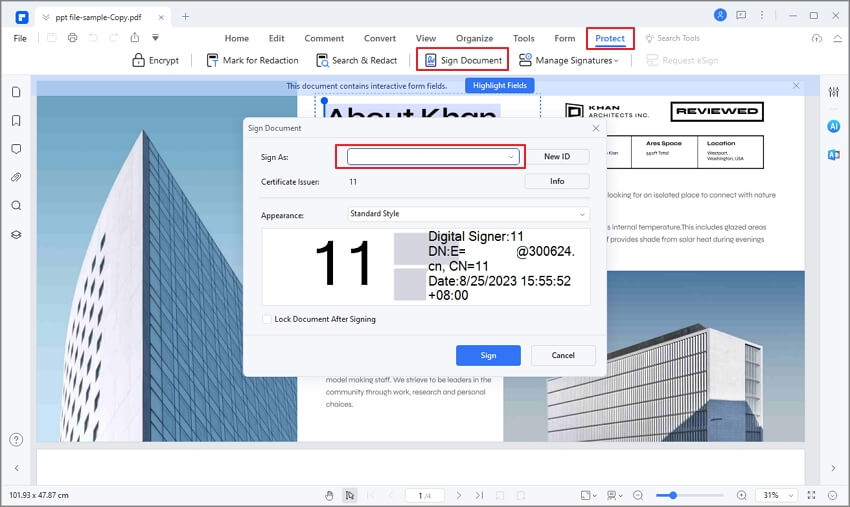
For example, if you are emailing a service agreement, your Gmail HTML signature can show who you are and how to contact you. The attached PDF can contain the actual signed agreement. Before sending, PDFelement can help you check the PDF layout, fill form fields, add comments, apply a signature, or reduce the file size if Gmail attachment limits become a problem.
This distinction matters. An email signature at the bottom of a message should not be treated as a substitute for a properly signed PDF when the document itself needs approval, acceptance, or a record of agreement. Use Gmail for communication, use your HTML signature for professional contact details, and use a PDF tool such as PDFelement when the document needs to be finalized.
People Also Ask
-
Can I paste raw HTML code directly into Gmail's signature editor?
No, Gmail's signature editor is not a raw HTML editor. If you paste HTML code directly, Gmail may show the code as text or remove parts of it. The better method is to open the HTML file in a browser, copy the rendered signature design, and paste that visible version into Gmail. -
How do I insert HTML signature in Gmail if I only have an HTML file?
Open the.htmlfile in a browser first. Select the visible signature, copy it, then go to Gmail > Settings > See all settings > General > Signature. Create or select a signature, paste the copied design into the editor, assign it to new emails or replies if needed, and click Save Changes. -
Why does my Gmail HTML signature look different after I paste it?
Gmail may remove unsupported HTML or CSS. Email clients also render HTML differently from web browsers. Complex layouts, external stylesheets, unusual fonts, and wide tables are common causes of formatting changes. Simplifying the design and using inline styles usually helps. -
Can I use images in a Gmail email signature HTML layout?
Yes, but the images should be publicly accessible online or inserted through Gmail's image tool. If the image is stored only on your computer, recipients will not see it. Use HTTPS image URLs and keep image sizes modest so the signature loads well. -
Why are my social media icons not clickable?
The image may have pasted without the original hyperlink. In Gmail's signature editor, select the icon and click the link button to add the correct URL again. Then send a test email and click the icon from the received message to confirm it works. -
Does Gmail support HTML signatures on mobile?
Gmail desktop is the best place to create and manage an HTML signature. The Gmail mobile app has its own mobile signature setting, and it may not preserve the same HTML layout. If you send many emails from your phone, test your mobile signature separately. -
How many Gmail signatures can I create?
Gmail lets you create multiple signatures and assign different defaults for new emails and replies or forwards. This is useful if you want one full signature for first-time messages and a shorter version for ongoing threads. -
Is an email signature the same as a digital signature?
No. A Gmail email signature is a contact block added to the end of an email. A digital or electronic signature for a document is a separate process used to sign or approve a file, often a PDF. If you are sending signed documents through Gmail, prepare the PDF properly before attaching it.