

In this article
- Why Chinese Character OCR is Uniquely Challenging
- Top 4 Desktop Software for Chinese OCR
- Best Free Chinese OCR Online Tools
- Comprehensive Software Comparison Table
- How to Use PDFelement for Flawless Chinese OCR
- Tips for Maximizing Chinese OCR Accuracy
- Combining Chinese OCR with Translation Workflows (Chinese OCR Translator)
- Frequently Asked Questions (FAQ)
Extracting text from scanned documents or images is a routine task in today's digital workspace, but when it comes to Chinese OCR (Optical Character Recognition), the stakes are significantly higher. Unlike the Latin alphabet, which consists of a few dozen letters, the Chinese writing system relies on thousands of intricate logograms. A single missing stroke or a slight blur in a scanned PDF can completely alter the meaning of a sentence.
Whether you are a student translating study materials, a professional digitizing international contracts, or a developer looking to build a Chinese OCR translator workflow, choosing the right tool is critical. Relying on basic or outdated software often leads to hours of manual corrections. In this comprehensive guide, we will explore the best Chinese OCR software for desktop, review reliable Chinese OCR online alternatives, and provide a detailed tutorial on how to extract Chinese characters flawlessly.


 G2 Rating: 4.5/5 |
 100% Secure
Why Chinese Character OCR is Uniquely Challenging
Before diving into the specific tools, it helps to understand why standard OCR engines often struggle with Chinese documents and what premium software does differently to overcome these hurdles.
Stroke Complexity and Character Similarity
The Chinese language contains tens of thousands of characters, with several thousand required for everyday reading. Many characters look incredibly similar to a computer's eye. For example, "己" (jǐ), "已" (yǐ), and "巳" (sì) differ only by minute stroke placements. A high-quality chinese character ocr engine utilizes advanced machine learning and contextual AI to analyze not just the visual shape, but the likelihood of a character appearing in a specific grammatical context.
Simplified vs. Traditional Chinese OCR
Chinese text generally falls into two distinct writing systems: Simplified Chinese (used primarily in Mainland China, Singapore, and Malaysia) and Traditional Chinese (used in Taiwan, Hong Kong, and Macau).
- OCR Simplified Chinese: Features characters with fewer strokes, which is sometimes easier for OCR engines to parse visually.
- Traditional Chinese OCR: Characters are much denser, requiring higher-resolution scans to prevent the strokes from bleeding together into an unrecognizable dark square.
The best Chinese OCR software allows you to explicitly select which character set the document uses, dramatically improving accuracy.
Document Orientation
While modern Chinese is typically written horizontally from left to right, historical documents, artistic texts, and materials from Taiwan or Japan (which shares Kanji) are often formatted vertically, reading from right to left. Many free OCR tools completely fail to recognize vertical text alignment, scrambling the output.
Top 4 Desktop Software for Chinese OCR
When dealing with sensitive business documents, large multi-page PDFs, or complex formatting, desktop software remains the gold standard. Here are the top contenders for the best Chinese OCR software.
1. Wondershare PDFelement (Best All-in-One Solution)
If you are looking for an optimal balance of accuracy, speed, user-friendliness, and cost-effectiveness, PDFelement stands out as the premier choice. Powered by state-of-the-art OCR technology, PDFelement can accurately recognize both Simplified and Traditional Chinese characters, maintaining the original layout of your scanned documents perfectly.
2. Adobe Acrobat Pro (Powerful but Premium)
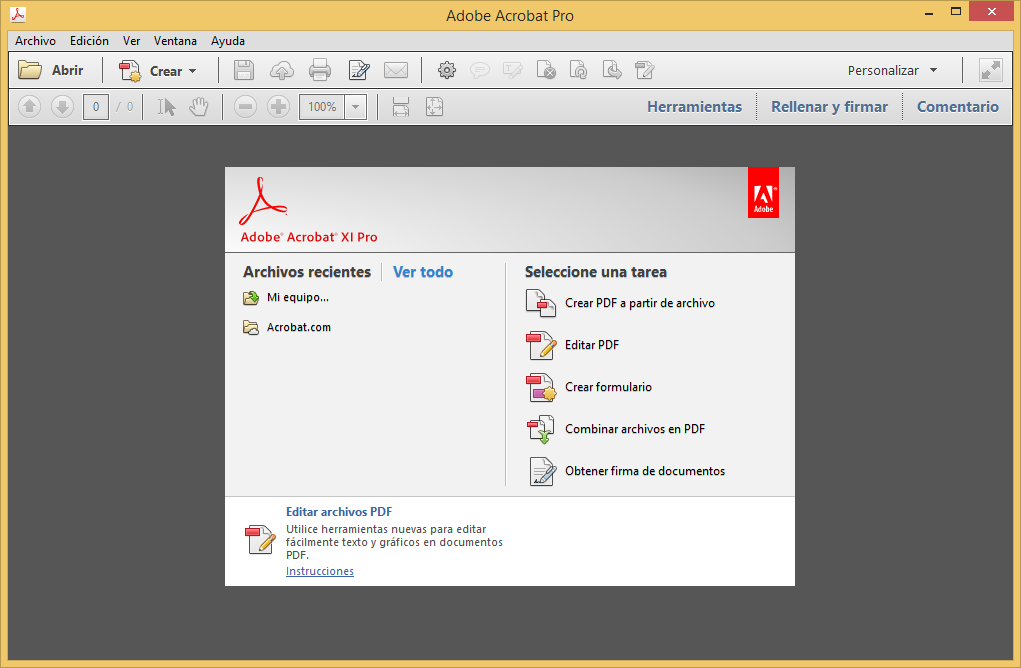
Adobe Acrobat Pro is one of the most widely installed PDF manipulators globally. It features a highly robust OCR engine that automatically detects text in scanned PDFs and converts it into editable content.
3. Foxit PDF Editor (Enterprise Alternative)
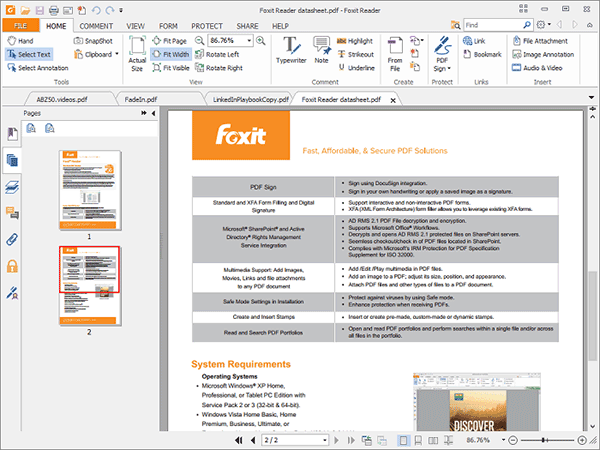
Foxit has gained significant popularity as a lightweight yet feature-rich alternative to Adobe. Its paid Editor versions include a capable OCR add-on designed to make PDF management and text extraction straightforward.
4. Sumatra PDF (Best for Lightweight Viewing, Note on OCR)


Sumatra PDF is a fantastic, open-source program known for its blazing-fast performance and minimalist interface. However, Sumatra PDF does not have built-in OCR capabilities. If you receive a scanned Chinese document, Sumatra will only let you view it as an image. You cannot search, highlight, or copy the Chinese text.
Best Free Chinese OCR Online Tools
If you only have a single image or a one-page document and prefer not to install software, a chinese ocr online tool is a practical solution. While web apps generally offer less formatting retention and privacy security than desktop apps, they are incredibly convenient.
1. Google Drive / Google Docs OCR
One of the best-kept secrets for free ocr chinese characters is Google Drive. Google’s underlying optical character recognition is powered by its massive AI infrastructure, making it surprisingly adept at reading Chinese.
- How it works: Upload a scanned PDF or image (JPG/PNG) containing Chinese text to Google Drive. Right-click the file, select "Open with," and choose "Google Docs." Google will generate a new document containing the original image followed by the extracted, editable text.
- Pros: Totally free; highly accurate character recognition; seamlessly integrates with Google Translate.
- Cons: It completely destroys the original document's formatting. It is strictly for extracting plain text.
2. Dedicated Online OCR Web Apps
Websites like i2OCR, OCR.space, or Convertio offer browser-based ocr chinese characters online services.
- How it works: You upload your file to their website, select the source language (e.g., Chinese Simplified), and click convert. The site provides a .txt or Word file for download.
- Pros: No installation required; supports various image formats.
- Cons: File size restrictions; potential privacy concerns; inconsistent handling of Traditional Chinese characters.
Comprehensive Software Comparison Table
| Features | PDFelement | Adobe Acrobat Pro | Foxit PDF Editor | Sumatra PDF | Google Docs (Online) |
|---|---|---|---|---|---|
| Chinese OCR Support | Yes (Simp & Trad) | Yes (Simp & Trad) | Yes (Simp & Trad) | No | Yes |
| Retains Formatting | Excellent | Excellent | Good | N/A | Poor (Extracts Text Only) |
| Cost | One-time or affordable Sub | High Monthly Sub | Moderate Sub | Free (No OCR) | Free |
| Built-in Translation | Yes (AI-powered) | No | Limited | No | Yes (via Google Trans) |
| Batch Processing | Yes | Yes | Yes | No | No |
G2 Rating: 4.5/5 |100% Secure
How to Use PDFelement for Flawless Chinese OCR
If you want the highest accuracy and the ability to edit the text exactly where it sits on the page, PDFelement is our top recommendation. Below is an expanded, step-by-step tutorial on how to use it to perform OCR on Chinese documents.
Step 1Import Your Scanned Document or Image
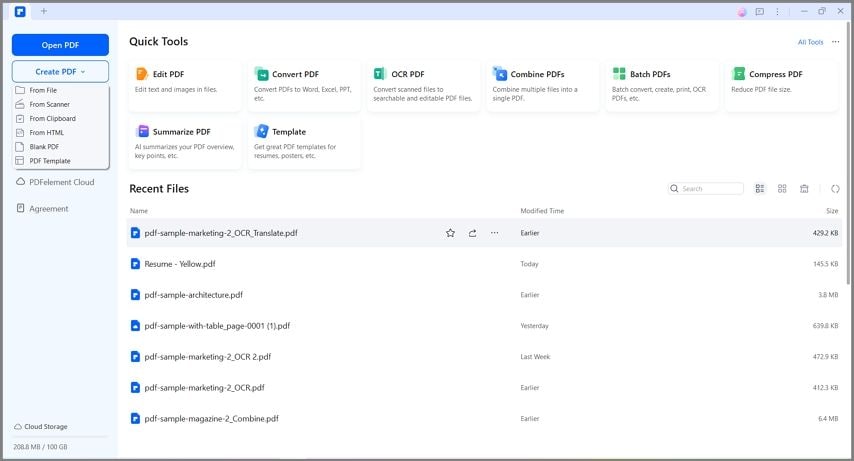
Launch PDFelement on your desktop. You can open your file by simply dragging and dropping the scanned document or image (JPG, PNG, TIFF) directly into the program window.
If you drop an image format file, PDFelement’s engine will automatically convert it into a secure PDF format instantly and display it in the main workspace.
Step 2Configure and Enable Chinese OCR
Once the scanned document is open, the software will usually detect that it contains non-editable text and display a blue notification bar at the top suggesting you "Perform OCR." Alternatively:
- Navigate to the "Tool" or "Edit" tab on the top menu ribbon.
- Click the "OCR" button.
- In the OCR setup dialog window, select the "Scan to editable text" option.
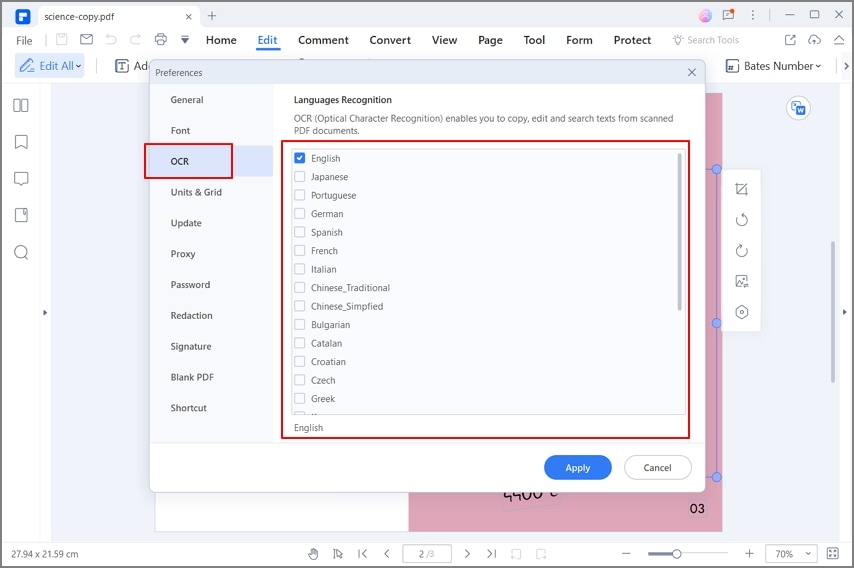
- Crucial Step: Click on "Change Language" or "More Languages." Scroll through the list and select either Traditional Chinese or Simplified Chinese depending on your document.
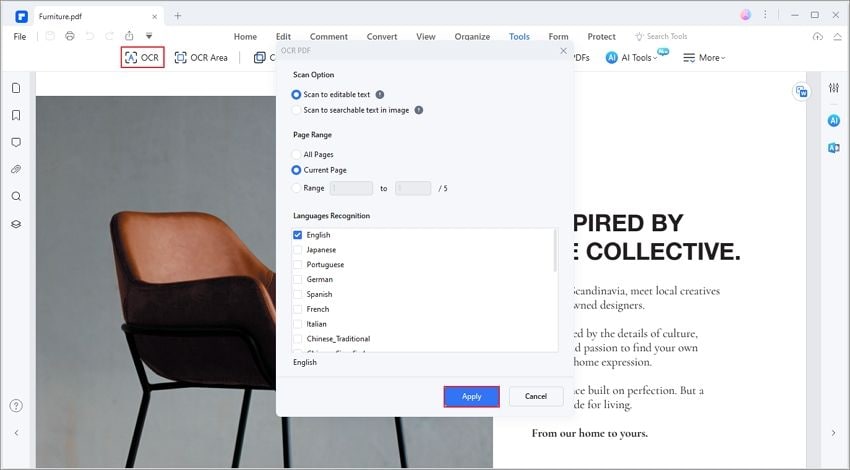
Click "Apply" to begin the process. The software will take a few moments to analyze the complex strokes and map the characters.
Step 3Edit, Translate, or Export the Extracted Text
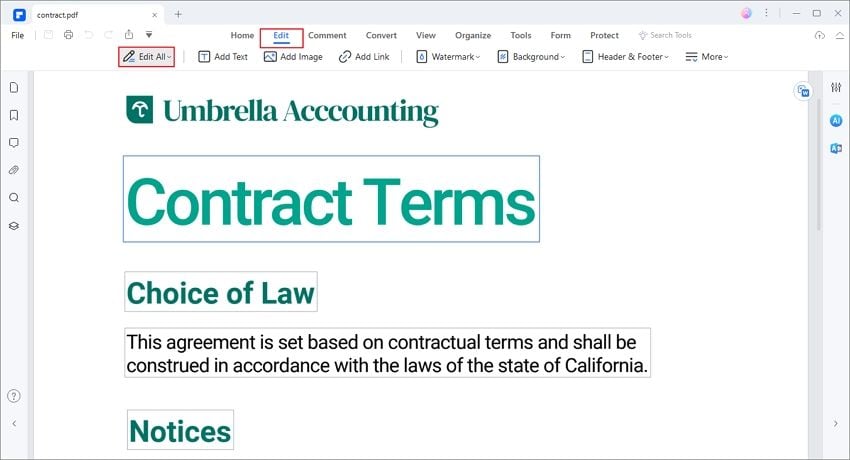
After the OCR process finishes, the previously static image is now a fully editable document.
- To Edit: Click the "Edit" button in the top-left corner. You can now click directly onto any Chinese paragraph to add text or delete characters.
- To Translate: Highlight the recognized Chinese text and use PDFelement's integrated AI tools to instantly translate the text into English or other languages, acting as a seamless Chinese OCR translator.
- To Convert: Navigate to the "Convert" tab and export the newly recognized PDF into your desired format like Microsoft Word.
G2 Rating: 4.5/5 |100% Secure
Tips for Maximizing Chinese OCR Accuracy
Even the best Chinese OCR software can stumble if the source material is of terrible quality. To ensure you get the best possible text extraction, keep these best practices in mind:
- Optimize Resolution (DPI): For intricate scripts like Traditional Chinese, ensure your scans are at least 300 DPI (Dots Per Inch).
- Enhance Contrast: The text should ideally be dark black against a stark white background. If you are taking a photo, avoid shadows and glare.
- Correct Document Skew: If the text lines are slanted, the OCR engine might misinterpret the reading order.
- Specify Multi-Language Scans: If your document contains a mix of Pinyin, English, and Chinese characters, always ensure you select both English and Chinese in the OCR settings.
Combining Chinese OCR with Translation Workflows (Chinese OCR Translator)
A common use case for extracting Chinese text is translation. For many non-native speakers, receiving a scanned invoice or contract from an overseas partner presents a major roadblock. In the past, the workflow required passing the document through an ocr simplified chinese tool, copying the plain text, pasting it into a web translator, and then manually trying to reformat it.
Today, modern tools unify this process. By using software like PDFelement, you can perform the OCR, highlight the text, and use the AI sidebar to summarize the document's contents or translate it paragraph by paragraph directly within the app. This creates a powerful Chinese OCR translator environment that saves hours of tedious copy-pasting and formatting repair.
Frequently Asked Questions (FAQ)
-
What is the best simplified Chinese OCR?
For maintaining document formatting, offline security, and high accuracy, PDFelement and Adobe Acrobat Pro are the best desktop options. For a quick, free text-only extraction, Google Docs is highly reliable for Simplified Chinese. -
Can I OCR vertical Chinese text?
Yes, but it depends on the software. Basic online tools often struggle with vertical text, misreading it as horizontal gibberish. Premium desktop software like PDFelement and ABBYY FineReader have algorithms specifically designed to detect and accurately parse vertical Asian typography. -
Is there a totally free OCR for Chinese characters?
Yes. You can use chinese ocr online tools like i2OCR, or leverage Google Drive. Upload your image to Google Drive, right-click, and open it with Google Docs to automatically extract the text for free. However, be aware that you will lose the document's original formatting. -
How do I translate scanned Chinese documents?
First, you must convert the image text into machine-readable text using a Chinese OCR tool. Once the text is editable, you can use built-in AI translation tools (found in modern PDF editors like PDFelement) or copy the text into services like DeepL or Google Translate.