

In this article
- The Challenge: Why "Excel BMP" Files Are Hard to Edit
- 4 Common Scenarios for Converting BMP to Excel
- Preparing Your BMP Image for the Best OCR Results
- Method 1: Convert BMP to Excel Using Desktop Software (Best for Accuracy)
- Method 2: Extract Specific Data from a BMP File to Excel
- Method 3: Quick Web Solutions with an Online BMP to Excel Converter
- Method 4: Digitize Paper with a Mobile BMP Scanner App
- Comparing the Best BMP to Excel Converters
- Advanced Deep Dive: How OCR Technology Rebuilds Tabular Data
- Frequently Asked Questions (FAQ)
- Conclusion
The Bitmap (BMP) file format is a foundational staple in the world of digital imagery. Originally developed for the Microsoft Windows platform, BMP files are uncompressed raster images. Because they store color data for each individual pixel without aggressive compression, they maintain high visual quality. However, this structure makes them inherently "dumb" when it comes to text or data. A BMP file does not recognize letters, words, or spreadsheet columns; to the computer, the image is simply a mosaic of colored squares.
This presents a massive roadblock if you possess a BMP file containing tabular data—such as a scanned invoice, a printed inventory list, or a screenshot of a financial report—and you need to edit the numbers. You cannot simply highlight, copy, and paste text from an image. To manipulate the data, calculate sums, run macros, or reorganize rows, you must find a way to convert bmp to excel.
Doing this requires specialized technology known as Optical Character Recognition (OCR). In this comprehensive guide, we will explore the most effective methods to turn your image files into fully functional spreadsheets. Whether you are looking for a robust offline bmp to excel converter, a targeted batch extraction tool, or a mobile bmp scanner app, this guide will help you choose the perfect workflow for your specific needs.


 G2 Rating: 4.5/5 |
 100% Secure
The Challenge: Why "Excel BMP" Files Are Hard to Edit
Before diving into the tools, it is crucial to understand why moving data from an image into a spreadsheet is technologically demanding.
Understanding the Bitmap Format
When someone shares an "Excel BMP"—meaning they took a screenshot of an Excel window and saved it as an image—they have essentially frozen the data. While a native .xlsx file stores the exact values, formulas, and formatting rules, a .bmp file only records the visual appearance of the spreadsheet at that specific moment in time. The mathematical relationship between the cells is destroyed.
The Role of Optical Character Recognition (OCR)
To reverse-engineer this image back into a spreadsheet, software must use OCR. Standard OCR simply reads text. However, spreadsheet OCR is vastly more complicated. The software must not only recognize that a specific grouping of pixels represents the number "4", but it must also map the spatial relationship of that "4" to recognize that it belongs in Row 2, Column B. If the gridlines are faint, or the image is skewed, recreating the structural integrity of the spreadsheet becomes a monumental task.
4 Common Scenarios for Converting BMP to Excel
There are numerous situations where professionals, students, and administrators find themselves needing to bridge the gap between static images and dynamic spreadsheets. Identifying your specific use case will help you determine which conversion method is best for you.
Digitizing Printed Financial Reports
Many traditional businesses and government agencies still rely on physical paperwork. When a multi-page financial report or tax document is scanned, it is frequently saved as a series of BMP or TIFF images. Manually retyping hundreds of rows of financial data into Microsoft Excel is not only tedious but practically guarantees human error. A reliable converter can process these scanned images and digitally recreate the spreadsheets in minutes.
Extracting Data from Screenshots
In the modern workplace, colleagues or clients often share data in the fastest way possible—which is rarely the most convenient format for the recipient. Instead of sending the actual source file, they might send a quick screenshot. If you are stuck with this type of image file, utilizing a dedicated bmp to excel converter is the only way to transform the picture back into a working dataset without manual data entry.
Automating Invoice Data Entry Workflows
For accounting, logistics, and human resources departments, processing hundreds of vendor invoices or employee receipts can take days of manual labor. By utilizing advanced software equipped with batch processing and form-field recognition, businesses can automate the extraction of specific line items (like total costs, dates, and vendor names) from BMP images directly into a centralized Excel database.
On-the-Go Physical Document Scanning
If you are at a networking event, managing inventory in a warehouse, or traveling for business, you might encounter physical charts or printed tables that need immediate digitization. In these scenarios, a desktop computer is not viable. Relying on a mobile bmp scanner app allows you to capture the data via your smartphone camera and export it as an Excel file instantly.
G2 Rating: 4.5/5 |100% Secure
Preparing Your BMP Image for the Best OCR Results
It is vital to understand a core rule of data extraction: the quality of your output Excel file is directly tied to the quality of your input image. No matter how advanced the OCR engine is, feeding it poor-quality images will result in scrambled data and formatting errors.
Before you convert bmp to excel, take the following steps to optimize your image:
Ensure High Resolution (DPI)
OCR algorithms require a minimum amount of pixel density to distinguish between similarly shaped characters. Ideally, your source image should be at least 300 DPI (Dots Per Inch). If your BMP file is heavily pixelated or artificially upscaled, the software might confuse a "3" for an "8", an "O" for a "0", or a "1" for an "l".
Maximize Contrast and Binarization
The textual data should stand out as clearly as possible against the background. Black text on a pure white background yields the highest accuracy rates. If your BMP has a dark, colored, or textured background, use an image editor to increase the contrast or apply a binarization filter (which forces every pixel to be either pure black or pure white).
Deskewing and Cropping
Warped text lines or tilted grids make it incredibly difficult for the software to accurately map columns and rows. If you took a photo of a document at an angle, rotate the image so the table lines are perfectly horizontal and vertical. Additionally, crop out any irrelevant background items—such as a desk surface or non-tabular text—to help the software focus purely on the data grid.
Method 1: Convert BMP to Excel Using Desktop Software (Best for Accuracy)
When dealing with complex tables, merged cells, critical numerical data, and multi-page documents, offline desktop software is the absolute gold standard. Solutions like Wondershare PDFelement feature top-tier OCR technology specifically calibrated to handle complex formatting and layout retention.
Furthermore, using desktop software ensures that your sensitive financial or personal data never leaves your computer, eliminating the privacy risks associated with uploading files to web servers.
To perform the conversion with this level of precision, follow these steps:
G2 Rating: 4.5/5 |100% Secure
Step 1Open Your BMP File
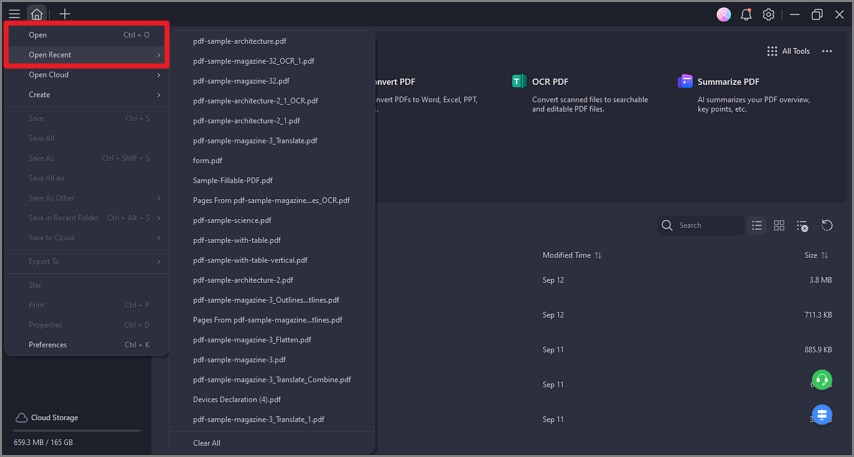
Launch PDFelement on your desktop computer. The software allows you to bypass complex import menus; simply drag and drop your BMP file directly into the application's workspace. PDFelement will automatically read the image, convert it seamlessly, and open it as an image-based PDF document ready for editing.
Step 2Perform OCR Recognition
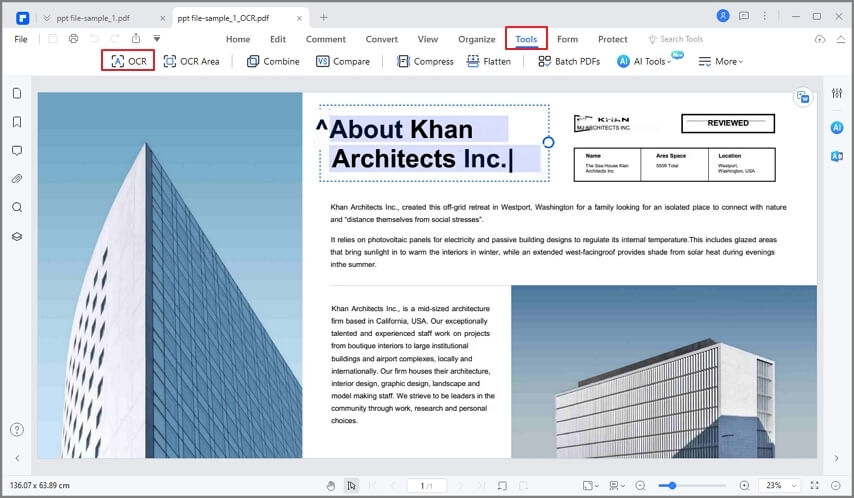
Because the file is currently just a picture of text, you must activate the OCR engine. Navigate to the "Tools" menu at the top of the interface and click the "OCR" button. A prompt will appear. It is crucial that you choose the correct language of your .bmp file content in the OCR language list, as this helps the software accurately predict characters based on linguistic dictionaries. Click "Apply" to run the process. The software will scan the document, analyze the grid structures, and convert the pixels into machine-readable characters.
Step 3Export to Editable Excel
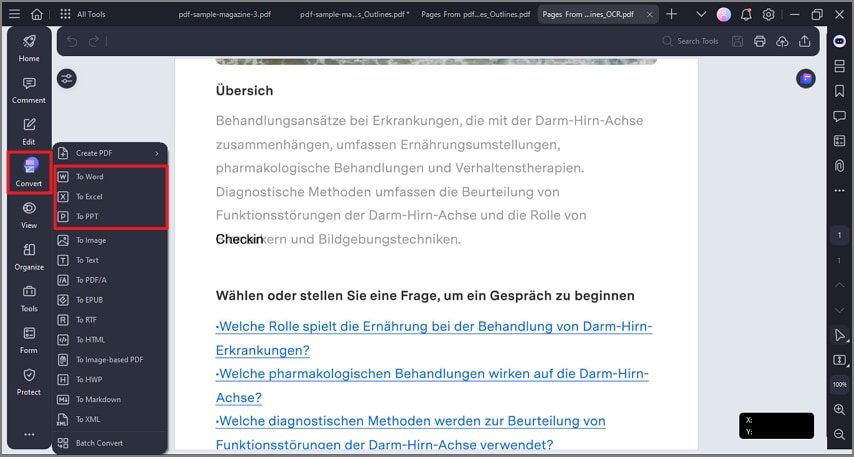
Once the OCR process is complete, the text is recognizable. Go to the "Home" tab and select the "To Excel" (or "To XLS/XLSX") button. A dialog box will appear allowing you to choose your desired output folder and adjust any final formatting settings. Once you confirm, the software will generate a fully editable Microsoft Excel spreadsheet, accurately preserving the original rows, columns, and data points.
Method 2: Extract Specific Data from a BMP File to Excel
Sometimes, you do not need to convert an entire document. If you have a stack of identical forms—such as shipping manifests or standardized invoices—you might only need to extract specific fields (like the "Total Amount" or "Customer ID") into a consolidated Excel list. In this scenario, batch data extraction is much more efficient than full-page conversion.
G2 Rating: 4.5/5 |100% Secure
Creating Data Extraction Templates
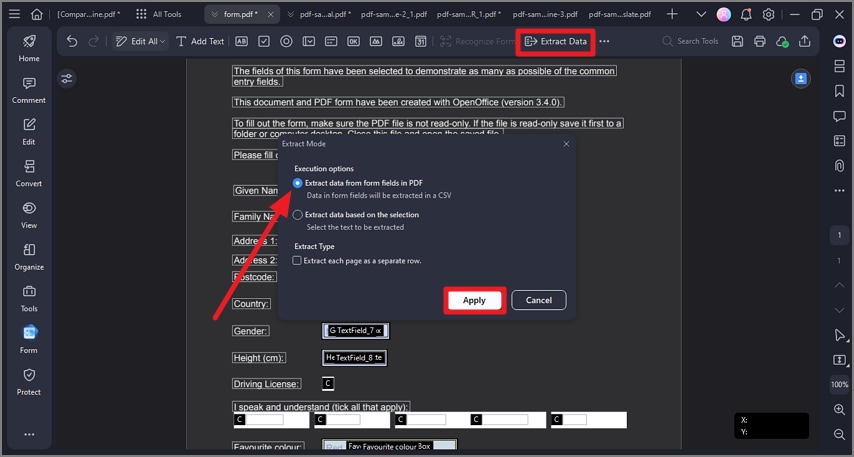
After opening your BMP file and running the initial OCR process, navigate to the "Form" tab. Click the "Extract Data" button and select the option to "Extract data from fields in PDF". Your cursor will turn into a crosshair. Use this to draw precise bounding boxes around the specific areas of data that need to be extracted.
Batch Processing Multiple BMPs
After marking up all the necessary data zones, click "Yes" (or "Save") to save your extraction template. You can now apply this exact template to a whole batch of similarly formatted BMP files. Load your batch into the software, apply the template, and click "Start". The software will instantly pull only the data from those specific boxes across all documents, compiling it neatly into a fresh, single Excel file.
Method 3: Quick Web Solutions with an Online BMP to Excel Converter
If you are using a borrowed computer, operating on a strict IT-locked network, or simply do not want to install new software for a one-off task, web-based tools are incredibly convenient.
The Pros and Cons of Browser-Based Tools
Online converters allow you to convert bmp to excel entirely within your web browser.
How to Use an Online Converter
- Open your preferred web browser and navigate to a reputable OCR conversion site.
- Look for the "Image to Excel" or "OCR" tool section.
- Click "Choose File" or simply drag your BMP file into the upload zone.
- If prompted, select the language of the document and ensure the output format is set to .xlsx.
- Click "Convert" and then "Download" to retrieve your new spreadsheet.
Method 4: Digitize Paper with a Mobile BMP Scanner App
For physical documents encountered out in the real world, firing up a desktop computer isn't always an option. This is where a dedicated mobile bmp scanner app comes into play, turning your smartphone's camera into a portable digitization station.
What to Look for in a Scanner App
- Auto-Edge Detection: The app should automatically find the corners of the paper against a contrasting background.
- Perspective Correction: The app should automatically flatten and deskew the image so it looks like a flat scan.
- Cloud Integration: The ability to push the processed file directly to Excel or save it to cloud storage.
Workflow for Mobile Data Extraction
- Open your scanner app and select the "Document" or "Table" capture mode.
- Hover your phone over the document with even lighting and snap the photo.
- Review the scan and apply filters to enhance text clarity.
- Select the "Export" function, choose Excel (.xlsx), and allow the OCR to process the layout.
Comparing the Best BMP to Excel Converters
| Feature / Metric | Desktop Software (e.g., PDFelement) | Online Web Converters (e.g., HiPDF) | Mobile Scanner Apps (e.g., MS Lens) |
|---|---|---|---|
| Best Use Case | Complex tables, batch processing, confidential data. | Quick, one-off conversions for non-sensitive data. | On-the-go scanning of physical paper. |
| OCR Accuracy | Very High | Medium to High | Medium |
| Data Privacy | Excellent (Offline) | Variable (Cloud-based) | Good |
| Data Extraction | Yes (Custom field mapping) | Rarely | No |
| Formatting Retention | Best in class | Good for simple tables | Adequate |
G2 Rating: 4.5/5 |100% Secure
Advanced Deep Dive: How OCR Technology Rebuilds Tabular Data
Have you ever wondered exactly how a computer turns a picture into an interactive spreadsheet? OCR is a fascinating subset of computer vision that generally operates in two distinct phases for text: Pattern Recognition and Feature Extraction.
- Pattern Recognition: The software compares snippets of the BMP image against a massive internal database of font styles and text layouts.
- Feature Extraction: For less standard fonts, the software breaks down shapes into features (e.g., two angled lines meeting at a peak).
However, when you convert bmp to excel, the software must also perform Structure Recognition. It doesn't just read the numbers; it actively looks for vertical and horizontal lines. If gridlines are absent, it measures the white space between clusters of text to intelligently guess where columns and rows should exist. This complex spatial mapping is why professional-grade offline tools yield vastly superior spreadsheet results compared to basic, free text extractors.
Frequently Asked Questions (FAQ)
-
Can I convert BMP to Excel for free?
Yes, there are many free online tools available (like OnlineOCR or standard tiers of HiPDF). However, they often come with limitations such as restricted file sizes, daily conversion caps, watermarks, and lower OCR accuracy. For highly complex tables or sensitive business data, investing in professional desktop software is highly recommended. -
Will the exported Excel file retain my original formatting?
It depends entirely on two factors: the quality of the original BMP file and the sophistication of the OCR engine you use. High-quality software will attempt to recreate the exact layout, including column widths, row heights, and font styles. However, degraded, blurry, or low-contrast images may require manual cleanup in Excel to fix merged cells or misaligned columns. -
Is it safe to use an online BMP to Excel converter?
Online converters require you to upload your files to a third-party server for processing. While reputable companies use encryption and auto-delete files after a short period, there is always a nominal risk. If your BMP file contains sensitive personal information, proprietary business data, or banking details, you should strictly use offline desktop software to perform the conversion locally on your hard drive. -
Why is my converted Excel file full of errors and typos?
OCR errors usually stem from poor source image quality. If the original BMP has low resolution (under 300 DPI), bad lighting, severe pixelation, or low contrast between the text and background, the software will struggle to identify characters accurately (e.g., confusing "S" and "5"). Ensure your source image is as clean, straight, and high-resolution as possible before running the conversion. -
Can I process multiple BMP files into Excel at once?
Yes, but typically only with premium desktop software. Programs like PDFelement offer Batch Processing capabilities, allowing you to load dozens or even hundreds of BMP files into a queue, apply OCR simultaneously, and export them all into individual Excel sheets or consolidate extracted data into a single master workbook.
Conclusion
Data that is permanently trapped inside an image file is essentially useless for modern business analysis. Whether you are dealing with a quick screenshot of an "Excel BMP", scanning a stack of vendor invoices, or digitizing a printed financial report, knowing how to efficiently convert bmp to excel is a vital productivity skill.
By understanding the strengths and limitations of Optical Character Recognition (OCR) technology, you can evaluate your situation and choose the right tool for the job. Desktop software provides unparalleled accuracy and security for complex tasks; online converters offer speed for simple jobs; and scanner apps provide flexibility on the go. Ensure your source images are clear and well-prepped, let the OCR software do the heavy lifting, and say goodbye to the tedious, error-prone days of manual data entry forever.