
Table of Contents
Need to copy text from a screenshot, scan, receipt, textbook photo, or JPG file? The right way to convert image to text depends on one thing: whether the words in the image are already stored as selectable text or whether they are just pixels.
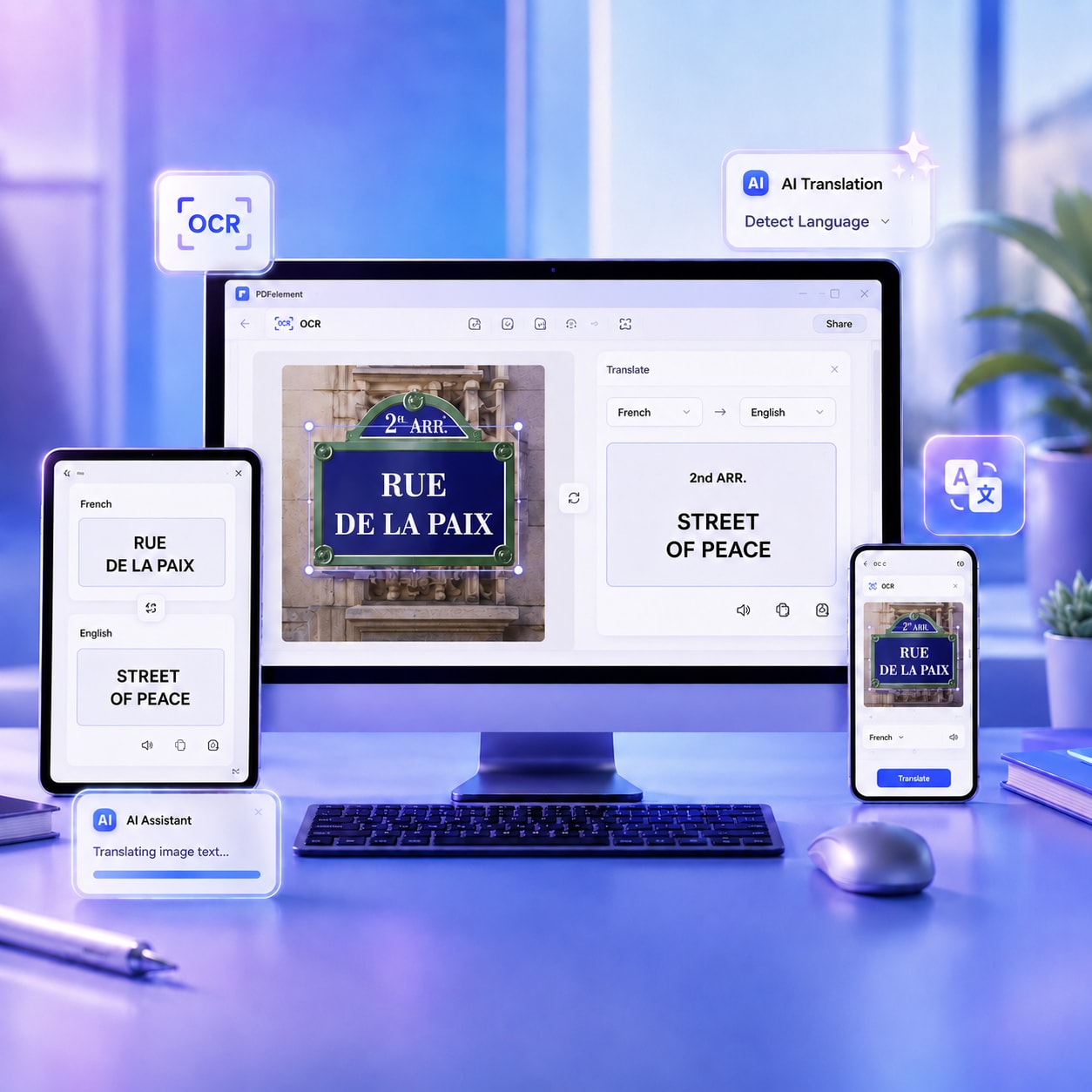
That difference matters. A screenshot of a digital PDF may behave differently from a phone photo of a printed page. Microsoft Word can help in a few cases, but for scanned documents and normal image files, you usually need OCR—Optical Character Recognition. OCR reads the shapes of letters in an image and turns them into editable text that you can copy, search, save, or convert into Microsoft Word.
This guide explains the practical options: how to extract text from image files, how to convert image to Word, when Microsoft Word works, when it does not, and how to use a dedicated OCR workflow such as PDFelement when accuracy and editable formatting matter.


 G2 Rating: 4.5/5 |
 100% Secure
What It Means To Convert Image to Text
Converting an image to text means turning visual characters in an image file into real, editable characters. After conversion, you can select the text, copy it into another app, search for words, correct mistakes, translate it, or save it as a Word, TXT, Excel, or PDF file.
The process sounds simple, but there are two very different situations.
OCR Text vs. Embedded Text
Some files already contain a text layer. For example, a PDF exported from a document editor may look like a page image, but the text is still stored behind the page. In that case, Word or a PDF reader may be able to detect and reuse the text.
A normal JPG or PNG photo is different. The text is not stored as text. It is part of the image, just like the background color or a line drawing. To extract text from image files like these, you need OCR.
Microsoft has its own guidance for converting PDFs in Word, but the result depends heavily on how the PDF was created. You can read more in Microsoft’s support article on opening PDFs in Word.
Image Types That Usually Work Best
OCR works best with clear, flat, high-contrast images. A clean scan of a printed document is easier to recognize than a tilted phone photo taken under warm light. JPG, PNG, TIFF, and scanned PDF files can all work, but quality matters more than file extension.
For printed documents, aim for 300 dpi if you are scanning. If you are taking a photo, place the page flat, avoid shadows, and crop out the desk or background. OCR tools can handle imperfect images, but every blur, reflection, fold, or skew increases the chance of wrong characters.
What You Can Do After OCR
Once the text has been recognized, you can decide what kind of output you need. If you only need to quote a paragraph, plain text may be enough. If you need to recreate a report, invoice, form, or contract, converting the image to Word is usually better because it preserves more structure.
For PDFs, another useful option is searchable PDF. This keeps the original page image visible while adding a hidden text layer. It is helpful for archives, legal records, research papers, and scanned manuals because you can search the document without changing its appearance.
Best Ways To Convert Image to Text
There is no single best method for every file. A one-line screenshot can be handled by a quick online OCR tool. A scanned contract may need desktop OCR because formatting, privacy, and accuracy matter. A batch of image files is better handled by a tool that supports multiple pages and export formats.
Here is a quick comparison before the step-by-step workflows.
| Method | Best For | Output Options | Main Limitation |
|---|---|---|---|
| Microsoft Word workaround | Simple files and PDFs with existing text data | DOCX text after opening a PDF | Not reliable OCR for normal images |
| PDFelement OCR | Scanned PDFs, JPG/PNG images, editable Word output, batch work | Word, TXT, searchable PDF, editable PDF and more | Requires installing desktop software |
| Online OCR tools | Occasional small image-to-text tasks | TXT, DOCX, PDF depending on tool | Upload privacy and internet speed |
| Mobile OCR apps | Receipts, notes, signs, quick captures | Copy text, share text, save scan | Less ideal for complex formatting |
G2 Rating: 4.5/5 |100% Secure
Method 1: Convert Image to Text With Microsoft Word
Microsoft Word does not work like a dedicated OCR engine for ordinary image files. If you insert a JPG into Word, the text in that image does not automatically become editable. However, Word can sometimes extract or recreate text when you save a document as PDF and then open that PDF in Word.
Use this method for simple images, screenshots, or files that may already contain text data. Do not rely on it for scanned paper documents, handwriting, complex tables, or low-quality photos.
Step 1: Insert the Image Into Word
Open a blank Word document. Go to Insert > Pictures and choose your JPG or PNG file. You can also drag the image onto the page.
If the image is very large, keep it readable. Do not compress it heavily before conversion. Cropping away unnecessary margins can help Word focus on the page content.
Step 2: Save the Word File as a PDF
Go to File > Save As and choose PDF as the output format. If Word gives quality options, choose the setting intended for electronic distribution or high-quality output rather than minimum-size compression.
Step 3: Open the PDF Back in Microsoft Word
Create a new Word session or go to File > Open, then choose the PDF you just saved. Word will show a conversion prompt explaining that it will convert the PDF into an editable Word document.
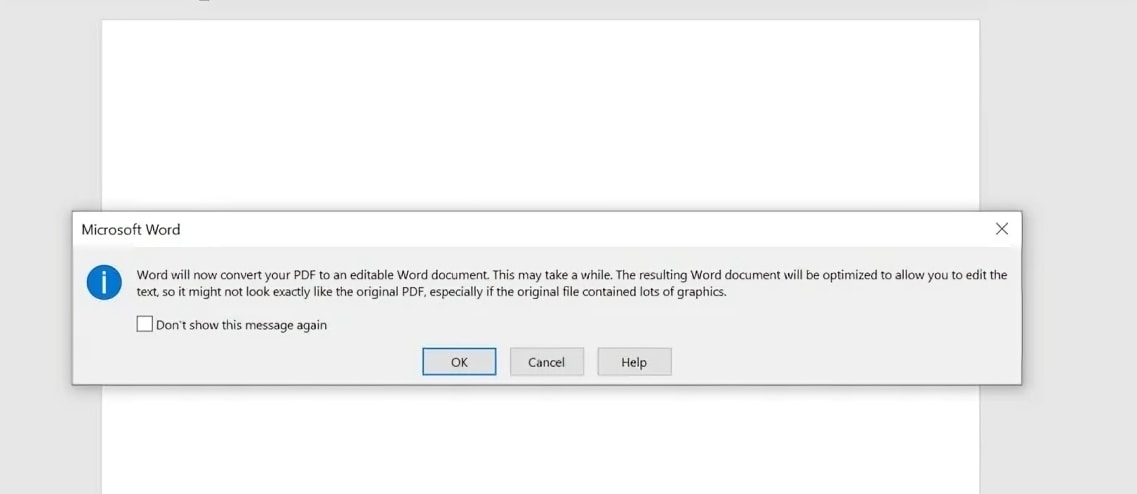
Click OK and wait for Word to process the file.
Step 4: Check Whether the Text Is Editable
Try selecting a sentence. Use Ctrl + F or Command + F to search for a word from the image. If Word finds it and lets you edit it, the conversion worked well enough for your task.
If the result is still just an image, or if the text is missing, garbled, or unselectable, switch to a real OCR method.
Method 2: Use PDFelement OCR To Extract Text From Image Files
For scanned documents, photographed pages, and image-only PDFs, a dedicated OCR tool is the more reliable route. PDFelement is useful when your end goal is not just “copy some text,” but to keep working with the document—editing it, converting it to Word, organizing pages, signing it, compressing it, or saving a searchable PDF for later.
A common workflow looks like this: open the image in PDFelement, create a PDF from it, run OCR, then export the recognized content to Word or another format. This is especially practical if you receive image-based forms, scanned contracts, old reports, receipts, or multi-page document images.
G2 Rating: 4.5/5 |100% Secure
Step 1: Create a PDF From the Image
Launch PDFelement and import your image. You can drag a JPG or PNG file into the program to create a PDF version of the image.
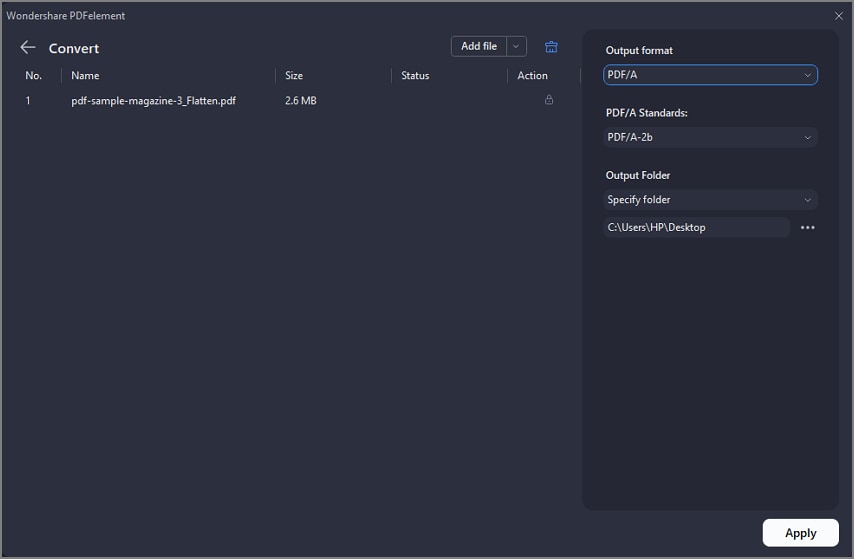
This step gives the image a document structure, which is helpful before running OCR and exporting to Word.
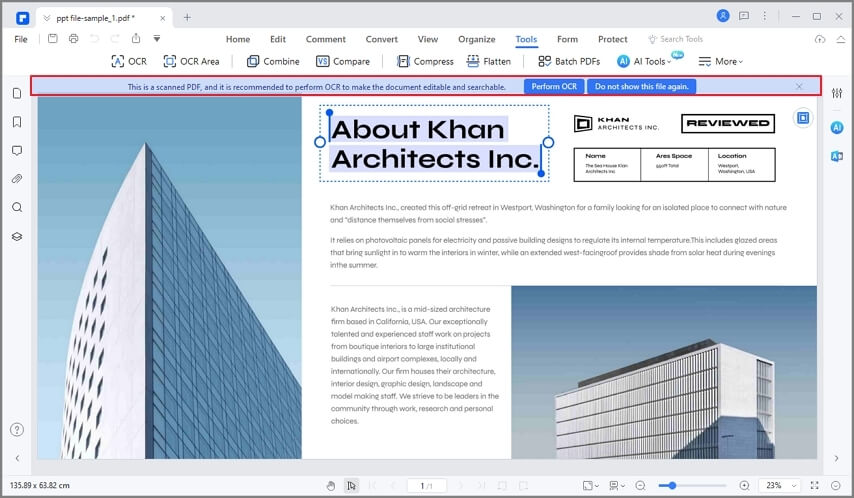
Step 2: Run OCR on the Image-Based PDF
After the image is opened as a PDF, PDFelement can detect that the file is image-based and prompt you to perform OCR. Choose the OCR option to start text recognition.
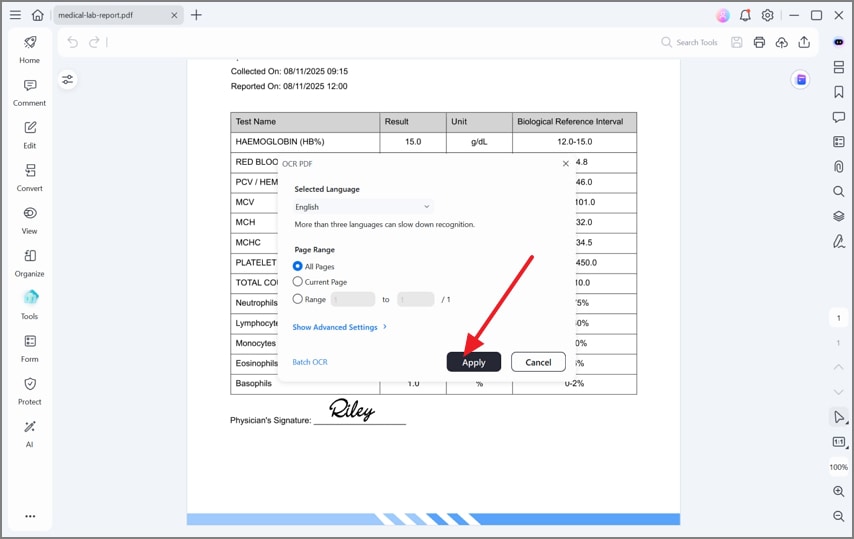
In the OCR settings, select the document language. This is easy to skip, but it affects recognition quality. English text should be recognized as English; mixed-language documents may need more careful settings.
You may also be able to choose between making the document editable or searchable. Choose editable text if you want to revise the wording. Choose searchable text if you want to preserve the original page appearance but search and copy text later.
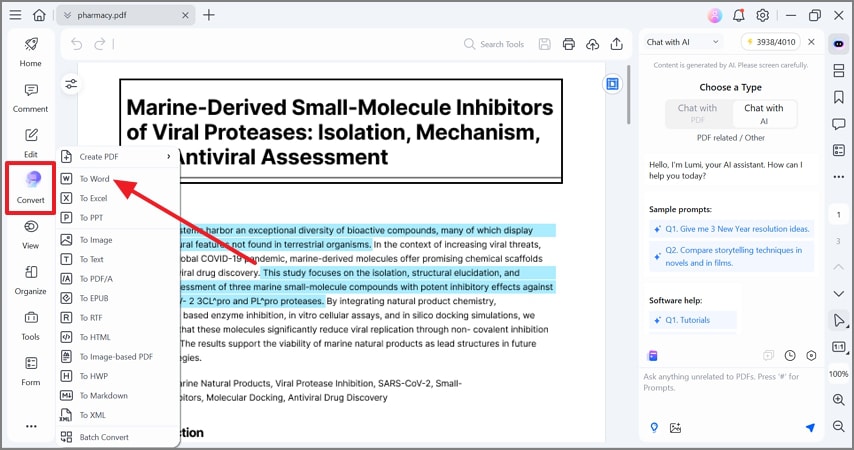
Step 3: Convert the OCR Result to Word
Once OCR is complete, use the conversion option to export the file as a Word document. This is the clearest way to convert image to Word while keeping as much layout as possible.
Open the DOCX file and proofread it before sending or archiving. OCR can be very good, but it is still recognition software. Names, numbers, tables, stamps, and small footnotes deserve a manual check.
Method 3: Convert Image to Text With an Online Tool
Online OCR tools are convenient when you have one or two non-sensitive images and do not want to install software. Upload the image, choose OCR if the tool provides that option, select a language, and download the result.
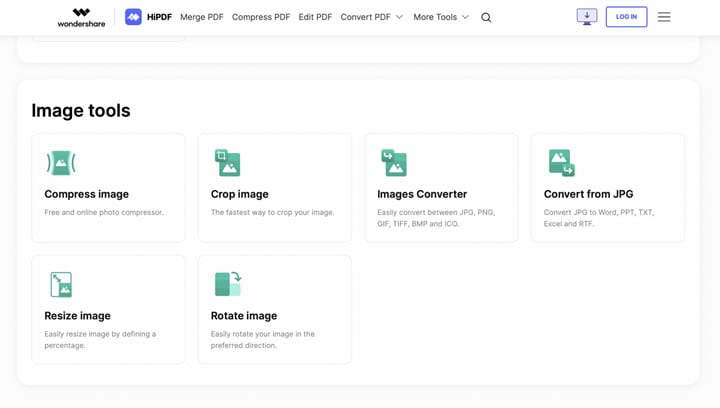
HiPDF is one online option for image and PDF conversion tasks. It can be useful if you are working from a browser and need a straightforward upload-convert-download process.
Start by opening the image tools area and choosing the relevant JPG or image conversion tool.
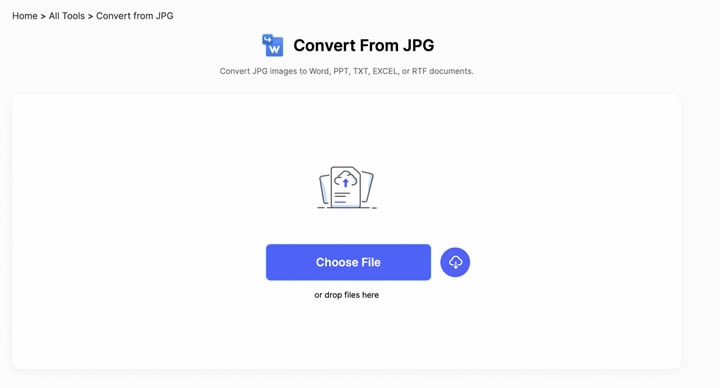
Upload your image from your computer.
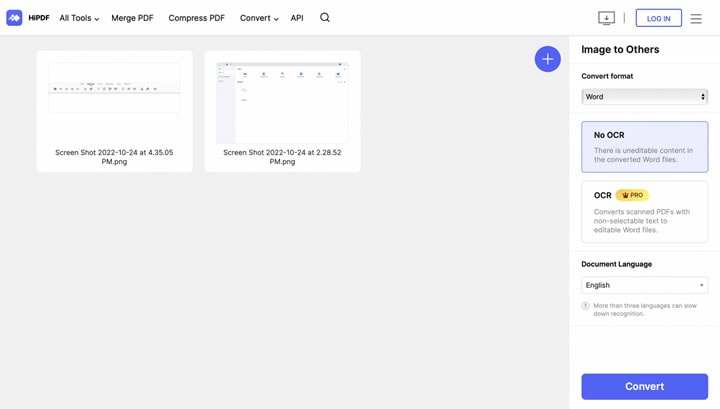
Then choose the conversion settings. If OCR is required, make sure the OCR option is enabled rather than a simple image-to-PDF conversion mode.
Online tools are best for low-risk material: class notes, public documents, screenshots, or quick personal tasks. Avoid uploading confidential contracts, IDs, financial records, medical documents, or company files unless your organization approves the service and its data handling terms.
Method 4: Use a Mobile OCR App for Quick Captures
If the source is already on paper, a phone can be the fastest tool. Microsoft 365, Google Lens, Apple Live Text, and many scanner apps can recognize text from the camera or photo library.
Mobile OCR is ideal for short text: a paragraph from a book, a receipt line, a tracking number, a business card, or text from a sign. It is less comfortable for long, formatted documents because proofreading and layout correction are harder on a small screen.
For iPhone users, Apple explains how Live Text works in its official iPhone user guide. Android users often use Google Lens or built-in camera OCR features, depending on the device.
How To Convert Image to Microsoft Word
Many users do not just want raw text. They want to convert image to Microsoft Word so the result can be edited like a normal document. The best workflow depends on the source image and the amount of formatting you need to preserve.
If You Only Need Plain Text in Word
For a short screenshot or photo, use any OCR tool to extract the text, then copy and paste it into Word. This is the fastest option when layout does not matter.
After pasting, use Word’s formatting tools to clean the result. OCR text often brings awkward line breaks, extra spaces, or inconsistent paragraph spacing. In Word, Find and Replace can help remove double spaces and repeated paragraph marks.
If You Need a Word File That Looks Like the Original
Use OCR software that exports to DOCX. This is better for invoices, letters, forms, reports, and multi-page documents. The software will try to preserve headings, paragraphs, tables, columns, and page layout.
Still, do not expect perfection from every image. A clean business letter may convert nicely. A photo of a folded page with handwritten notes, stamps, and a table may need manual repair. OCR tools can recognize text, but page design is a separate challenge.
Microsoft Word Workaround vs. OCR-to-Word
The Microsoft Word workaround is worth trying if you already use Word and the file is simple. It costs little time. But if the goal is reliable image-to-Word conversion, use OCR.
Think of Word as a document editor with some PDF conversion ability. Think of OCR software as the tool that actually reads the image. For scanned paper, OCR is the key step.
Formatting Checks After Converting Image to Word
Before you treat the converted document as final, check the parts that OCR often gets wrong:
- Numbers, dates, prices, account IDs, and serial numbers
- Similar-looking characters such as O/0, I/1, S/5, and B/8
- Tables, columns, footnotes, headers, and small text
These errors are easy to miss because the document may look correct at a glance. If the Word file will be used for legal, financial, academic, or client-facing work, proofread against the original image.
How To Get Better OCR Results Before You Convert
Good OCR starts before you click the convert button. A few minutes spent improving the image can save much more time fixing the output.
Use a Clear, High-Resolution Image
Low-resolution images are the most common cause of bad OCR. If you control the scan, use 300 dpi for normal printed text. For small fonts, old documents, or detailed tables, 400–600 dpi may help, though larger files take longer to process.
For phone photos, keep the camera parallel to the page. Avoid taking the photo from an angle, because slanted lines can confuse OCR. Good lighting matters too. Natural light from the side is usually better than a harsh overhead reflection.
Crop, Straighten, and Remove Visual Noise
OCR tools look for text patterns. Extra borders, shadows, fingers, desk texture, and nearby objects add noise. Crop the image so the page fills the frame. Straighten it if the text lines are tilted.
If the document has a gray background or poor contrast, adjust brightness and contrast before OCR. Do not overdo it, though. Blown-out letters can be just as hard to read as dark ones.
Choose the Correct OCR Language
Language settings are not cosmetic. English, French, German, Spanish, Japanese, Chinese, and Arabic have different character patterns. If the OCR engine is looking for the wrong language, it may turn real words into nonsense.
For mixed-language files, choose a tool that supports multiple OCR languages. If that is not available, process pages separately by language when accuracy matters.
Decide Between Editable Text and Searchable PDF
Editable OCR output lets you change words directly, which is useful for revising a document. Searchable PDF output keeps the original scan as the visible page while adding recognized text behind it.
If you are archiving signed documents, searchable PDF is often safer because the visual document remains unchanged. If you are rebuilding a typed report from a scan, editable text or Word export is more useful.
Common Problems When You Extract Text From Image Files
OCR problems are usually fixable once you know the cause. The symptoms may look random, but they often come from image quality, language mismatch, or layout complexity.
The Converted Text Shows Random Symbols
Random symbols usually mean the OCR tool could not clearly identify the characters. The source image may be too blurry, too small, skewed, or compressed. It can also happen when the wrong OCR language is selected.
Try rescanning at a higher resolution or retaking the photo in better light. If the image is a screenshot, export or capture it at a larger size rather than zooming into a small compressed file.
The Text Is Selectable, but the Formatting Is Broken
OCR can recognize words more easily than it can rebuild layout. Multi-column pages, tables, sidebars, stamps, and decorative fonts can lead to strange reading order or broken paragraphs.
If layout matters, export to Word and fix the structure there. If accuracy matters more than appearance, export plain text and rebuild the formatting manually. For complex tables, consider exporting to Excel if your OCR tool supports it.
Handwriting Does Not Convert Well
Printed text is much easier than handwriting. Some OCR tools support handwriting recognition, but results vary widely depending on neatness, spacing, and language. Cursive writing, personal shorthand, and mixed printed/cursive notes are especially difficult.
For important handwritten notes, use OCR as a first draft rather than a final result. Expect to review and correct the text.
Batch Conversion Takes Too Long
Microsoft Word is not designed for batch image OCR. If you have dozens of JPG files, scanned pages, or image-only PDFs, use a tool with batch OCR or combine the images into a single PDF before processing.
PDFelement can fit well into this workflow because it lets users manage PDFs after OCR. For example, after recognizing text, you can reorder pages, delete blank scans, combine related files, compress the final PDF, or export a clean Word version for editing. That matters when the task is not just “get text once,” but clean up a document set for sharing or storage.
Privacy Is a Concern With Online OCR
Online OCR requires uploading your file to a server. That may be fine for public or casual content, but it is not always appropriate for business documents. If the image contains personal data, signatures, contracts, client information, or financial details, a desktop OCR tool is usually the safer choice because the file can be processed locally depending on your setup and product configuration.
People Also Ask
-
Can Microsoft Word convert image to text?
Microsoft Word can sometimes help by converting a PDF into an editable Word document, but it is not a full OCR tool for ordinary JPG or PNG files. If you insert an image into Word, the text inside that image normally remains part of the picture. For scanned pages and photos, use OCR software or an OCR-enabled online tool. -
How do I convert image to Word?
The most reliable method is to open the image in an OCR tool, recognize the text, and export the result as a DOCX file. In PDFelement, for example, you can create a PDF from the image, run OCR, and then convert the OCR-processed file to Word. After that, open the Word document and proofread the converted text. -
How do I extract text from image files for free?
You can use built-in mobile OCR features such as Apple Live Text or Google Lens for quick text capture. Some online OCR tools also offer limited free conversions. For longer documents, private files, or better layout control, desktop OCR software is usually more practical. -
Why is my image-to-text result inaccurate?
The most common reasons are low resolution, blur, shadows, skewed pages, decorative fonts, poor contrast, or the wrong OCR language. Try rescanning at 300 dpi or higher, cropping the image, straightening the page, and selecting the correct language before running OCR again. -
Can I convert a screenshot to editable text?
Yes. Screenshots often work well if the text is clear and large enough. Use an OCR tool, browser-based converter, or mobile OCR feature to recognize the text. If the screenshot uses tiny text or heavy compression, take a higher-resolution screenshot before converting. -
Can I convert multiple images to text at once?
Yes, but you need a tool that supports batch OCR or multi-page document processing. Microsoft Word is not ideal for this. A better approach is to combine the images into a PDF, run OCR on the full file, and export the result to Word, TXT, or searchable PDF. -
What is the difference between converting image to text and converting image to Word?
Converting image to text usually means extracting plain editable characters that you can copy or save as TXT. Converting image to Word means creating a DOCX file, often with layout, paragraphs, and tables preserved. Word output is better when you need to edit a document, while plain text is better for quick copying. -
Is OCR always accurate?
No OCR tool is perfect. Clean printed text can convert very accurately, but blurry photos, handwriting, unusual fonts, and complex layouts can cause mistakes. Always review names, numbers, dates, and important terms before relying on the converted text.
Final Thoughts
The fastest way to convert image to text is not always the best one. If you only need a sentence from a clear screenshot, a mobile OCR feature or online converter may be enough. If you need to convert image to Microsoft Word, preserve formatting, or process scanned documents, use a dedicated OCR workflow.
Microsoft Word is useful as a workaround for simple PDF-based conversions, but true image text extraction depends on OCR. For document-heavy work, PDFelement offers a practical path: turn images into PDFs, run OCR, export to Word, and continue editing or managing the file in the same workspace. That keeps the conversion step connected to the work most people need to do afterward—correcting, formatting, sharing, signing, compressing, or archiving the document.