
In this article
In modern business, data is everything. Yet, a massive amount of valuable data remains trapped in scanned documents, PDFs, images, invoices, and physical receipts. To unlock this data automatically, developers and businesses rely on Optical Character Recognition (OCR). While standalone software is great for individual tasks, an api for ocr (Application Programming Interface) allows you to build OCR capabilities directly into your own applications, websites, and automated workflows.
By sending an image or document to an OCR API, developers receive structured data back—usually in JSON format—detailing the exact text, its coordinates (bounding boxes), and the document's layout. This article explores the top OCR APIs available today, compares their features, highlights the best free ocr api options, and introduces powerful desktop alternatives for non-programmers.


 G2 Rating: 4.5/5 |
 100% Secure
Top 5 OCR APIs for Developers and Businesses
Choosing the right API depends on your transaction volume, required accuracy, budget, and coding expertise. Here is a breakdown of the industry's leading solutions.
1. Google Cloud Vision API
When developers search for a reliable google ocr api, they are usually directed to the Google Cloud Vision API. Backed by Google’s industry-leading machine learning models, this API is highly adept at extracting text from a vast array of image types and document formats.
The google text recognition api feature within Cloud Vision is split into two primary endpoints: TEXT_DETECTION for sparse text in images (like street signs or billboards) and DOCUMENT_TEXT_DETECTION for dense, print-heavy documents like contracts and books.
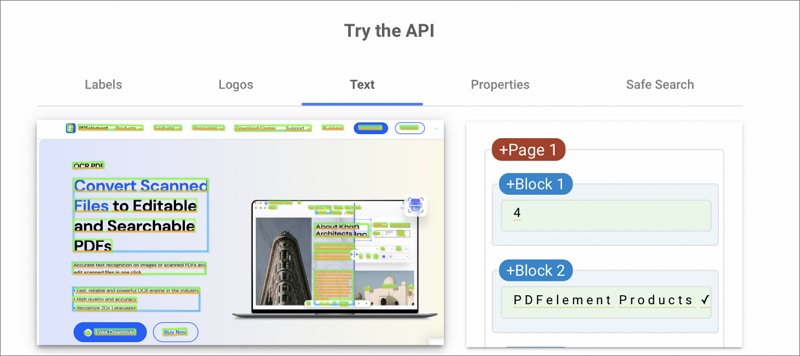
Pricing: Google offers the first 1,000 units per month for free, after which pricing scales based on usage (typically around $1.50 per 1,000 requests for text detection).
2. Microsoft Azure Computer Vision
Microsoft Azure Computer Vision is a robust AI service designed to analyze visual content. Its OCR capabilities are specifically engineered to extract text streams and structural information from UI elements, images, and scanned files.
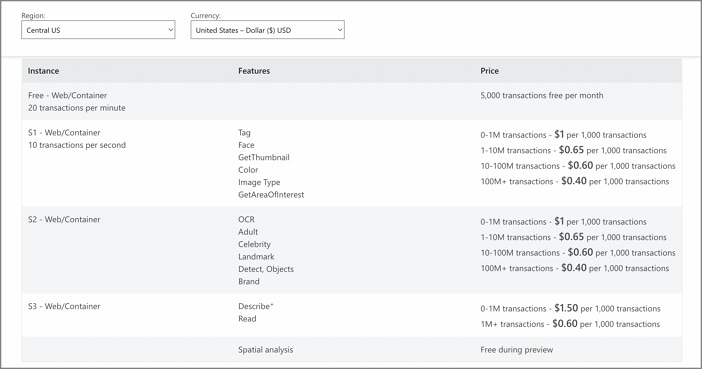
The basic features of Microsoft's offering include standard text extraction, spatial analysis, and flexible container deployment (meaning you can run the API on-premise if data privacy is a strict requirement). It excels in "Read" API operations, which process heavy text documents asynchronously to ensure high performance without timing out application requests.
Pricing: The free tier includes 5,000 transactions per month. Paid tiers depend on the exact features used, generally starting around $1.00 to $1.50 per 1,000 transactions.
3. Amazon Textract
While many OCR tools just pull raw text, Amazon Textract is designed to understand document context. It goes beyond simple optical character recognition to actively identify forms, key-value pairs, and tabular data without requiring custom templates or manual configuration.
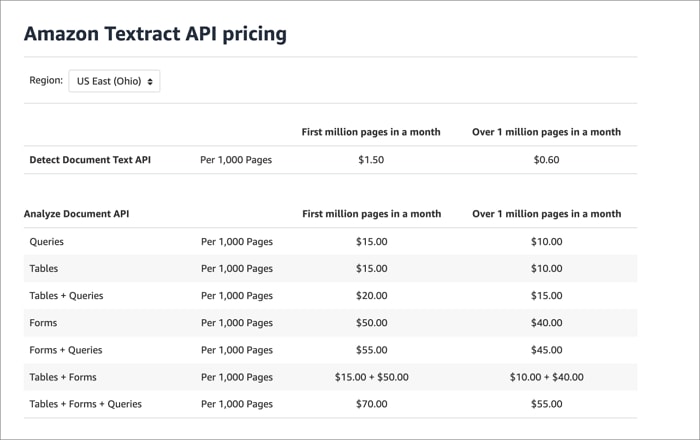
Textract is based on deep-learning neural networks. If you utilize Amazon A2I (Augmented AI), you can even build a "human-in-the-loop" workflow to verify extracted information, which further trains the architecture.
Pricing: The free tier lasts for three months and includes 1,000 pages per month for the Detect Document Text API, and 100 pages for specific document analysis endpoints.
4. OCR.space (Best Free OCR API)
If you are an independent developer or a startup looking to minimize costs, the api ocr space offering is widely regarded as one of the best budget-friendly tools available. The ocr space api allows you to parse images and PDFs without the heavy infrastructure requirements of AWS or Google Cloud.
Because it is positioned as a highly accessible free ocr api, it is incredibly popular for rapid prototyping, student projects, and internal tools where enterprise SLA guarantees aren't strictly necessary.
Pricing: 100% free for up to 25,000 requests per month. PRO plans start at a flat rate of $30/month for faster processing and offline PDF support.
5. ABBYY Cloud OCR SDK
ABBYY has been a legacy leader in optical character recognition for decades. Their Cloud OCR SDK brings their powerful FineReader engine to the web. It is built specifically for enterprise environments that require absolute precision, particularly with complex multi-language documents, barcodes, and legacy document archiving.
Pricing: Operates on a page-package system. Prices vary, but generally start around $29.99 for 500 pages, scaling down in cost-per-page as volume increases.
OCR API Comparison Summary
To help you decide which api for ocr is right for your project, use this quick comparison matrix:
| API Provider | Best Feature | Free Tier | Pricing Model | Best For |
|---|---|---|---|---|
| Google Cloud Vision | Multi-language & Handwriting | 1,000 requests/mo | Pay-as-you-go | General app development and handwriting. |
| Microsoft Azure | Container Deployment | 5,000 requests/mo | Pay-as-you-go | Enterprises needing on-premise security. |
| Amazon Textract | Form & Table Extraction | 3 months limited | Pay-as-you-go | Financial and HR document processing. |
| OCR.space | Ease of Use & Budget | 25,000 requests/mo | Flat monthly rate | Startups, hobbyists, rapid prototyping. |
| ABBYY Cloud SDK | Extreme Accuracy | 50 pages total | Page bundles | Archival, legal, and complex layouts. |
Common Cases of Using an OCR API
Integrating an OCR API into your business systems can drastically reduce manual data entry. Here are the most common real-world applications:
Financial Services and Accounting
Banks and accounting firms deal with a massive influx of receipts, checks, and invoices. By routing these documents through an API like Amazon Textract, financial software can automatically extract vendor names, transaction totals, and dates, syncing them directly to accounting ledgers and saving hundreds of hours in manual data processing.
Healthcare
Hospitals handle mountains of patient intake forms, insurance cards, and past medical records. OCR enables healthcare organizations to digitize these records instantly. Extracting data via APIs allows medical staff to build searchable databases of past illnesses, treatments, and diagnostic tests, ultimately improving patient care and insurance routing.
Legal and Compliance
The legal industry generates millions of pages of affidavits, judgments, and contracts. An api for ocr allows law firms to ingest scanned discovery documents into e-discovery platforms, making massive archives of legal text fully searchable for specific clauses, names, or dates.
Limitations of OCR APIs
While OCR APIs offer incredible automation capabilities, they are not a magic bullet. Developers must be aware of certain physical and technical limitations:
- Similar Characters: Many engines struggle to distinguish between lookalike characters, such as the number "0" and the uppercase letter "O", or the lowercase "l" and the number "1".
- Poor Handwriting: While the google text recognition api is excellent at cursive, extremely messy or overlapping handwriting will still result in gibberish output.
- Complex Languages and Scripts: Languages that are highly cursive or feature connected scripts (like Arabic or certain Asian dialects) require specialized OCR models and may have higher error rates in standard APIs.
- Image Quality & Font Size: Blurry images, extremely small fonts, watermarks, or poor lighting conditions can drastically reduce the accuracy of the JSON output.
The Best OCR Alternative for End-Users: PDFelement
APIs are powerful, but they require developers, coding environments, server infrastructure, and maintenance. What if you just need to extract text from a batch of scanned PDFs right now, without writing a single line of code?
For end-users, business professionals, and teams who need immediate, user-friendly document processing, a dedicated desktop and mobile software like PDFelement is a far more practical solution.
G2 Rating: 4.5/5 |100% Secure
Why Choose PDFelement Over an API?
PDFelement provides an intuitive graphical interface. Even if you have zero technical experience, you can successfully OCR a file in seconds.
- All-in-One Editing: Unlike an API that just returns raw text data, PDFelement overlays the recognized text perfectly over the original image, allowing you to edit the PDF exactly as if it were a Word document.
- Broad Language Support: It supports major languages including English, German, French, Italian, Spanish, Portuguese, Russian, and Japanese, ensuring high precision.
- Offline Capabilities: Cloud APIs require an internet connection and transmit your data to third-party servers. PDFelement processes OCR locally on your computer, ensuring maximum data privacy for sensitive documents.
- Batch Processing: You can process large documents (up to 100 pages) or batch process multiple files simultaneously without worrying about API rate limits or escalating per-page costs.
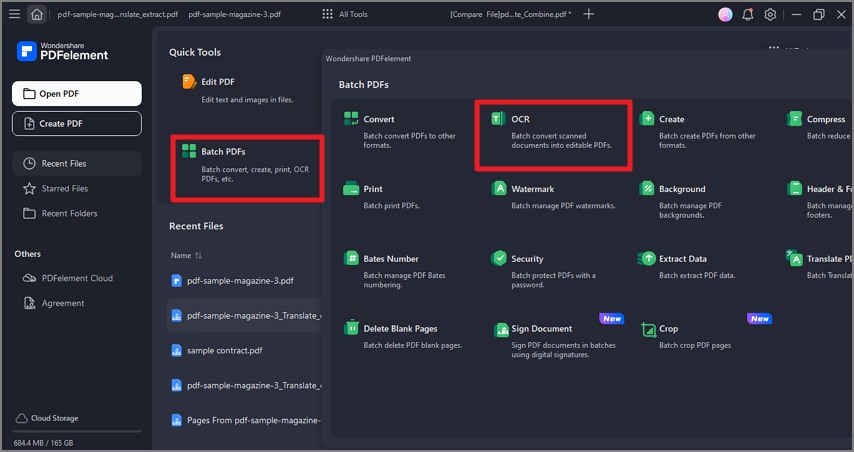
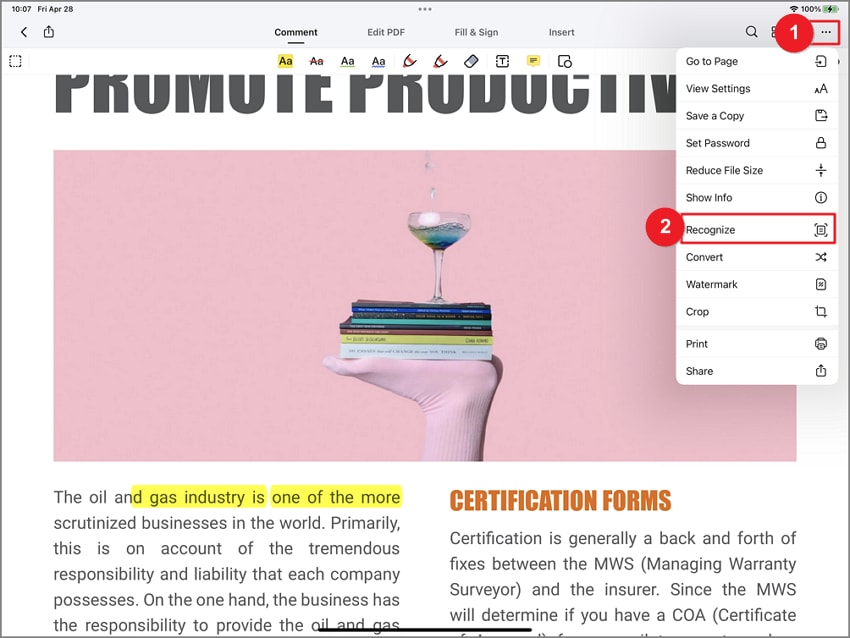
Steps for Using PDFelement OCR on iOS Devices
If you are on the go, you can use PDFelement's powerful mobile application to scan and OCR documents directly from your smartphone.
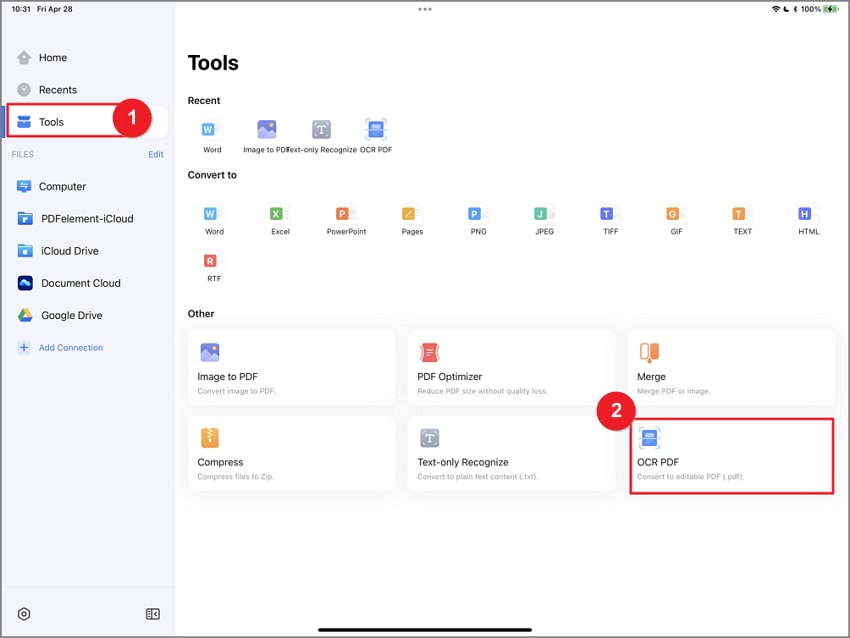
Step 1Upload the file
Launch the PDFelement application on your iPhone. On the home page, find Tools and tap OCR PDF. Select the file you want to extract text from.
G2 Rating: 4.5/5 |100% Secure
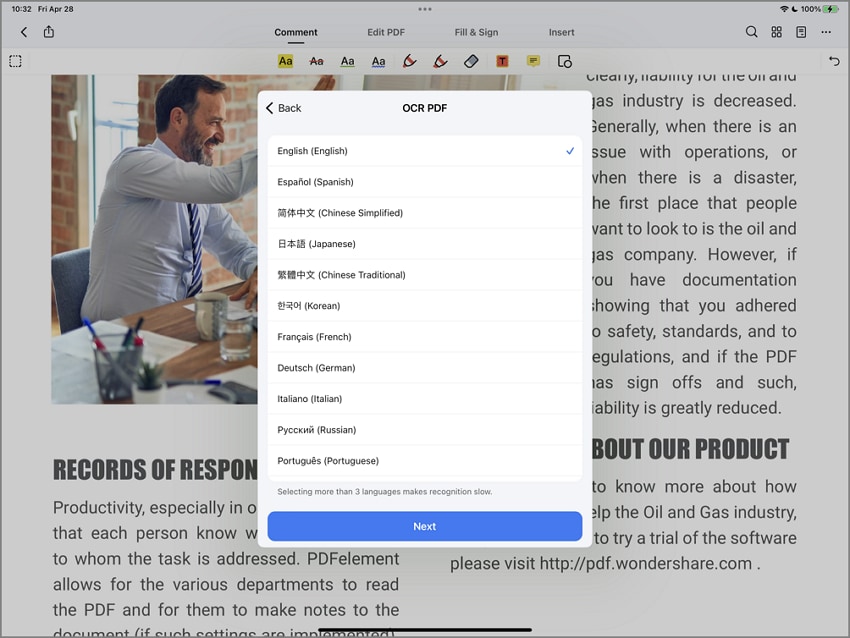
Step 2Select a language
Choose the text language that matches your document. You can select up to three languages simultaneously to handle multi-lingual documents. Tap Next to begin the recognition process.
Step 3Save or edit the file
In just a few seconds, the application will convert the static image into editable text. You can now modify the content, copy the text, or save the newly searchable file to your device.

Frequently Asked Questions (FAQs)
-
What is the best free OCR API?
For developers looking for a generous free tier without supplying a credit card, the ocr space api is highly recommended. It offers up to 25,000 free requests per month, making it the top free ocr api for prototyping and small-scale applications. -
Is the Google OCR API free?
The google ocr api (Cloud Vision) is not entirely free, but it does offer a free tier. Users get the first 1,000 units (requests) per month at no cost. Beyond that, you pay based on your usage volume. -
Should my business use an API or desktop OCR software?
If you need to process thousands of documents automatically in the background, or if you are building a custom app that requires text extraction, an api for ocr is the right choice. However, if your team just needs to occasionally make scanned PDFs editable, search through legal documents, or fix typos in an invoice, desktop software like PDFelement is much cheaper, easier to use, and requires no coding. -
How accurate is the Google text recognition API on handwriting?
Google's Vision API uses advanced machine learning models that are highly adept at reading handwritten text. While no OCR is 100% perfect, Google generally outperforms most competitors in transcribing cursive and unstructured handwriting.