
In this article
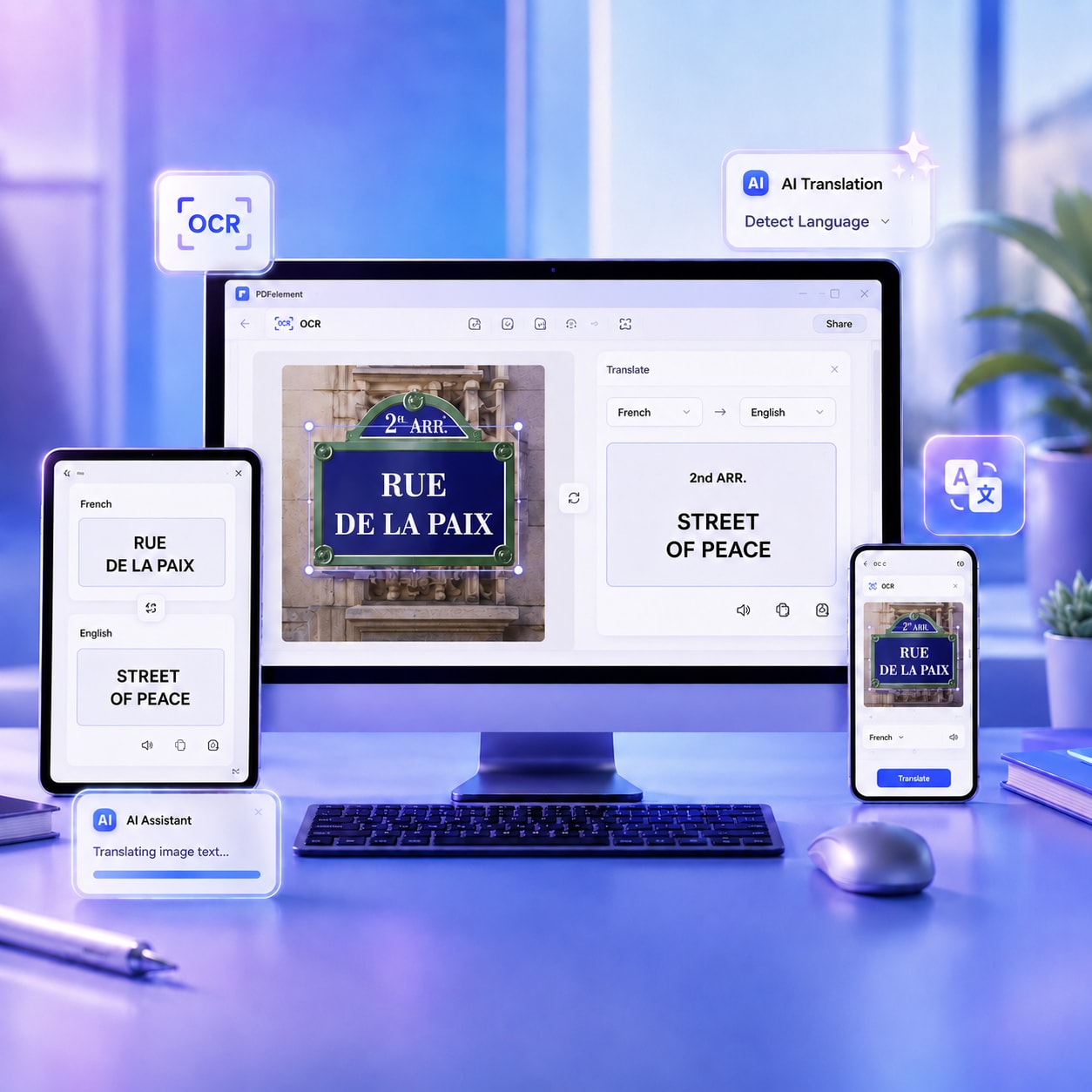
Dealing with scanned documents, flattened images, or unsearchable PDFs can bring your productivity to a grinding halt. Whether you are extracting invoice data, digitizing physical archives, or simply trying to copy text from a scanned book, Optical Character Recognition (OCR) technology is the bridge between static images and editable data.
As we move deeper into 2026, AI-enhanced document processing has evolved significantly. Finding the best OCR PDF editor 2026 has to offer isn't just about simple text recognition anymore; it's about layout retention, batch processing speeds, language support, and seamless integration into your existing workflow.
In this comprehensive guide, we will break down the top-performing desktop software, highlight the best online OCR tool for PDF 2026, and provide a detailed comparison to help you choose the ultimate ocr application for your specific needs.


 G2 Rating: 4.5/5 |
 100% Secure
Why You Need the Best OCR PDF Editor in 2026
Optical Character Recognition has transformed from a clunky, error-prone feature into a highly sophisticated, AI-driven necessity. If you are still manually typing out data from scanned PDFs, you are losing valuable time and risking human error.
A premium PDF editor equipped with top-tier OCR capabilities allows you to:
- Make Scans Searchable: Instantly turn a 100-page scanned contract into a searchable database where specific clauses can be found in seconds.
- Edit Directly on the File: Fix typos, update numbers, or change the formatting of text that was originally trapped inside a JPEG or scanned PDF.
- Extract Data Seamlessly: Pull tables, lists, and financial figures from invoices and receipts directly into Excel without losing the row and column structures.
- Translate Documents: Many modern OCR engines can recognize over 100 languages, allowing you to digitize a foreign document and seamlessly run it through translation software.
With these benefits in mind, let's explore the applications that are leading the market.
Top 5 Desktop PDF Editors with OCR Capabilities
When you need robust performance, maximum privacy, and the ability to handle massive files without relying on internet bandwidth, desktop software is the way to go. Here is our curated list of the best pdf editor with ocr 2026 has to offer.
1. Wondershare PDFelement: The Best Overall OCR Application
For users seeking the perfect balance between enterprise-grade capabilities and an incredibly intuitive, user-friendly interface, Wondershare PDFelement consistently ranks at the top. The software has been refined over the years to ensure that even novice users can digitize documents with a single click.
PDFelement utilizes a highly advanced OCR engine that accurately recognizes text in over 40 global languages. What makes it stand out as the best OCR PDF editor 2026 is its ability to not only recognize the text but perfectly match the original document's font, size, and formatting. Whether you are dealing with a skewed scan or a faded receipt, PDFelement's AI-enhanced image processing cleans up the file before extracting the text, resulting in exceptionally high success rates.
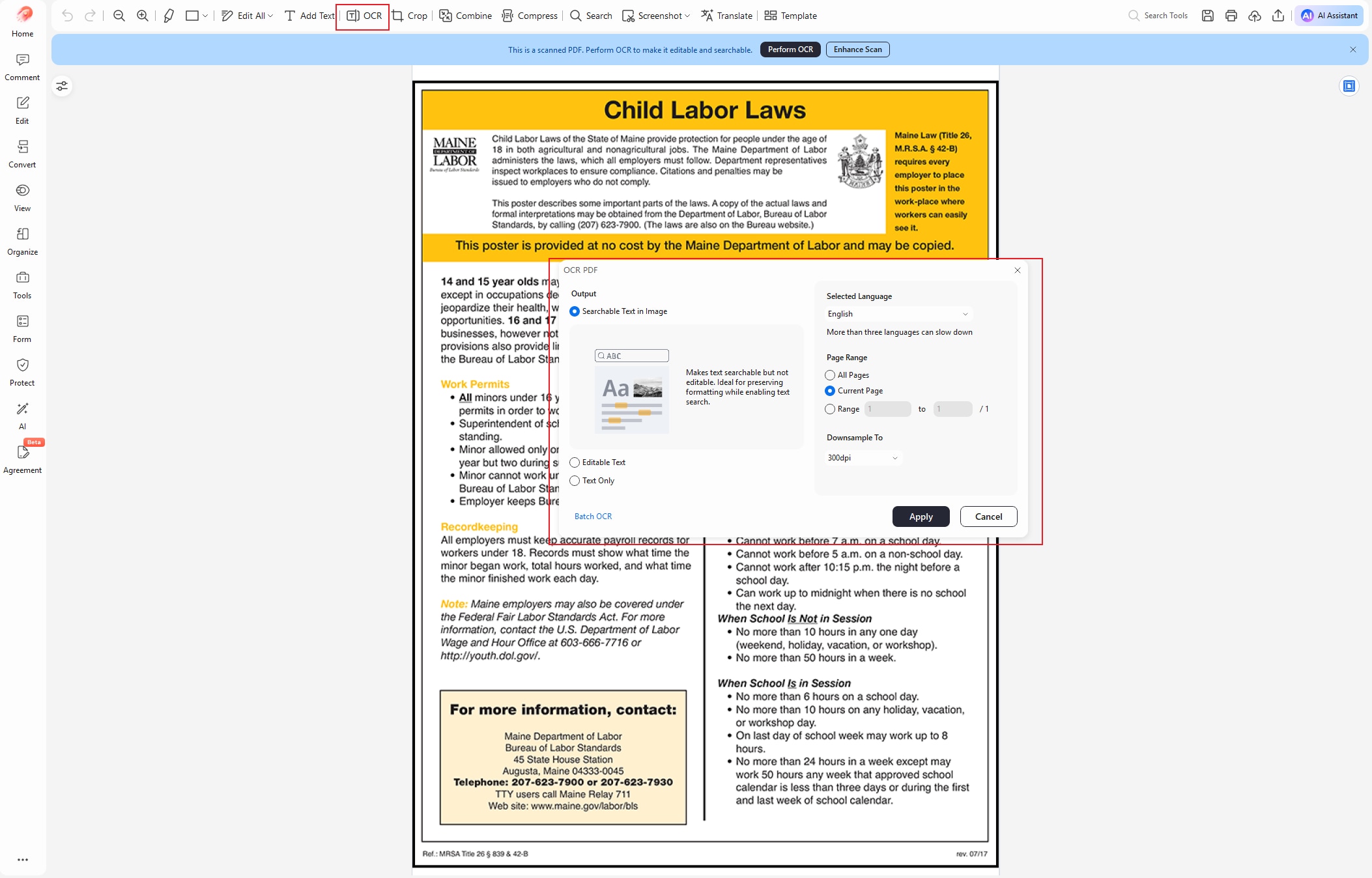
Key Features:
- Searchable or Editable Modes: Choose between making a document purely searchable (great for archives) or fully editable text (ideal for modifying contracts).
- Batch Processing: Apply OCR to dozens of PDFs simultaneously, saving countless hours for corporate users.
- Multi-Language Recognition: Accurately process documents containing mixed languages.
- Bates Numbering & Watermarking: Corporate users can seamlessly add organizational metadata right after OCR processing.
G2 Rating: 4.5/5 |100% Secure
2. Adobe Acrobat Pro: The Industry Standard
Adobe invented the PDF format, so it is no surprise that Adobe Acrobat Pro remains a heavyweight contender in the document management space. Acrobat Pro's OCR functionality works automatically in the background. When you open a scanned document, Acrobat instantly prompts you to run text recognition.
Its OCR engine is incredibly reliable and integrates deeply with the Adobe Creative Cloud ecosystem. For enterprises that rely entirely on Adobe products, Acrobat Pro provides a seamless workflow.
Key Features:
- Custom Font Generation: Acrobat can generate a custom font to match the scanned document precisely, ensuring edits look completely natural.
- Automatic Deskewing: Automatically straightens and cleans up poorly scanned pages.
- Deep Integrations: Connects seamlessly with Microsoft 365, SharePoint, and Adobe Sign.
3. ABBYY FineReader PDF: Best for Complex Text Recognition
ABBYY FineReader is legendary in the OCR space. Developed initially in 1993, its core OCR engine has been licensed by countless other software companies. FineReader PDF is a dedicated ocr application that also happens to be a great PDF editor.
If your primary goal is converting highly complex documents—such as old legal archives, multi-column academic papers, or documents with mixed graphics and text—FineReader is arguably the most powerful tool on the market.

Key Features:
- Unrivaled Language Support: The program supports text recognition in an astonishing 192 languages, which is among the highest in the industry.
- Cross-Format Conversion: Excels at converting complex PDFs into perfectly formatted Word, Excel, or PowerPoint files.
- Document Comparison: Automatically compare a scanned PDF against a digital Word document to spot discrepancies.
4. Foxit PDF Editor: The Lightweight Powerhouse
Foxit PDF Editor has carved out a massive market share by offering an experience very similar to Adobe Acrobat but with a lighter system footprint and a more traditional Microsoft Office-style ribbon interface.
Its OCR functionality is robust and highly efficient, making it a favorite among IT departments looking to deploy software across hundreds of computers without bogging down system resources.
Key Features:
- Quick OCR Engine: Designed for speed, allowing fast conversion of daily invoices and memos.
- Cloud Integration: Connects easily to Google Drive, Dropbox, and Box for immediate saving post-OCR.
- Redaction Integration: Run OCR to find specific sensitive words (like Social Security Numbers) and automatically redact them across the whole document.
5. Kofax OmniPage Ultimate: Best for High-Volume Batch Processing
OmniPage has been around for decades and remains a powerhouse for large-scale document conversion. If you run a law firm, a medical office, or a data-entry hub, OmniPage Ultimate is designed to process thousands of pages a day without breaking a sweat.
While it is primarily an ocr application rather than a casual PDF editor, its ability to route extracted data directly into databases, ERPs, and cloud storage systems makes it indispensable for enterprise automation.

Key Features:
- OmniPage Launchpad: A dedicated interface designed exclusively for setting up automated batch conversions.
- Amazon Textract Integration: Utilizes advanced cloud AI for complex layout recognition.
- Automated Workflows: Set up watch folders so that any scanned PDF dropped into a folder is automatically OCR'd and routed to the correct department.
The Best Online OCR Tool for PDF in 2026
Not everyone wants or needs to download heavy desktop software. If you are working on a Chromebook, using a borrowed computer, or just need to perform a quick extraction, cloud-based tools are the perfect solution. Here is how to find the best online OCR tool for PDF 2026.
1. HiPDF: Best All-in-One Online PDF Editor
HiPDF is a comprehensive suite of online PDF tools that brings desktop-level OCR power straight to your web browser. Powered by robust AI, HiPDF allows you to upload a scanned document and convert it into a searchable PDF, Word doc, or Excel sheet in seconds.
Why it stands out:
Unlike many free online tools that destroy your document's formatting, HiPDF maintains the structural integrity of your file. It supports multiple languages and processes files on secure cloud servers, ensuring your data is deleted shortly after conversion for privacy.
Ideal for: Users who need a reliable, high-quality OCR conversion without the hassle of installation, but who still demand professional-looking output.
2. Smallpdf: Best for Quick, Casual Conversions
Smallpdf is famous for its colorful, incredibly simple interface. If you have a scanned JPEG or a flattened PDF, you can simply drag and drop it into Smallpdf's web interface. Their "PDF to Word" tool automatically applies OCR if it detects a scan.
Why it stands out:
Smallpdf removes all the technical jargon from the OCR process. There are no language settings to tweak or resolution dpi metrics to adjust; it just works.
Ideal for: Students or casual users who need to quickly extract text from a single document and don't want to navigate complex software settings.
Comprehensive Feature Comparison Table
To help you decide which tool fits your workflow, here is a breakdown of the top contenders in the best OCR PDF editor 2026 landscape:
| Feature / Software | PDFelement | Adobe Acrobat Pro | ABBYY FineReader | Foxit PDF Editor | Kofax OmniPage |
|---|---|---|---|---|---|
| Best For | Overall Value & Usability | Industry Standard Integration | Complex Layouts & Tables | Lightweight Speed | High-Volume Automation |
| OCR Accuracy | Very High | Very High | Excellent | High | Excellent |
| Batch Processing | Yes | Yes | Yes | Yes | Yes (Advanced Automated) |
| Language Support | 40+ | 40+ | 192 | 40+ | 120+ |
| UI/UX Friendliness | Excellent | Good | Moderate | Excellent | Poor (Technical) |
| Pricing Model | Perpetual & Subscription | Subscription Only | Perpetual & Subscription | Perpetual & Subscription | Perpetual (Enterprise) |
| OS Compatibility | Win, Mac, iOS, Android | Win, Mac, iOS, Android | Win, Mac | Win, Mac, iOS, Android | Windows Only |
G2 Rating: 4.5/5 |100% Secure
How to Choose the Best PDF Editor with OCR in 2026
With so many powerful tools on the market, narrowing down the best pdf editor with ocr 2026 depends entirely on your specific use case. Here are the crucial factors you should evaluate before making a decision.
Accuracy and AI Enhancement
The core metric of any ocr application is accuracy. Modern tools don't just match shapes to letters; they use AI and natural language processing to understand context. This means if a scan is blurry and the software isn't sure if a letter is an "e" or a "c," it will look at the surrounding word to make an educated guess. For documents with low DPI (dots per inch) or faded ink, look for software like PDFelement or FineReader that feature built-in image enhancement pre-processing.
Multi-Language Support
If you work in an international business, standard English OCR will not suffice. Software like ABBYY FineReader excels here, offering support for 192 languages. However, for most users dealing with standard European or Asian business languages, the 20+ to 40+ language support offered by PDFelement and Adobe Acrobat is more than sufficient. Ensure the software can handle "mixed language" documents if you frequently process translated legal texts.
G2 Rating: 4.5/5 |100% Secure
Formatting Retention
Extracting a raw block of text is easy; keeping that text looking like the original document is hard. The best OCR PDF editor 2026 must be able to recognize columns, tables, headers, and footers. If you are scanning financial reports or invoices, you need the software to export flawlessly into Excel without merging columns. Always test a software's formatting retention on a complex document before purchasing.
Batch Processing Capabilities
If you have a backlog of 500 scanned invoices, you cannot afford to open and OCR them one by one. Batch processing allows you to queue up hundreds of files, set your OCR parameters, and let the software run in the background. While Foxit and PDFelement handle standard batching beautifully, enterprise users with massive daily quotas should look toward Kofax OmniPage for automated watch-folder processing.
Desktop vs. Online Privacy
If you are processing medical records, legal contracts, or confidential financial data, uploading your files to an online OCR tool poses a security risk, even with tools that promise instant deletion. In these cases, a desktop solution where the OCR processing happens locally on your machine is non-negotiable. Save the best online OCR tool for PDF 2026 for public documents, casual text extraction, or non-sensitive schoolwork.
Frequently Asked Questions (FAQ)
-
What is the best OCR software for Windows 10 and Windows 11?
Wondershare PDFelement is highly recommended as the best OCR software for Windows operating systems due to its seamless integration, high-speed processing, and intuitive user interface. It offers full support for Windows 10 and 11, ensuring stable performance even during heavy batch processing. -
Can I use an OCR application for handwritten text?
Yes, but with varying degrees of success. Standard OCR is designed for printed text (fonts). For handwriting, you need advanced Intelligent Character Recognition (ICR). Tools like Adobe Acrobat and specialized AI cloud services perform better on handwriting, provided the handwriting is neat and legible. -
Are free online OCR tools safe to use?
While reputable tools like HiPDF and Smallpdf use secure encryption and delete your files from their servers after processing, it is generally advised not to upload highly sensitive information (like unredacted tax forms or private legal documents) to any free online service. For sensitive data, always use a secure desktop ocr application. -
Why does my OCR result have spelling errors?
OCR accuracy relies heavily on the quality of the original image. If the scanned document has low resolution, skewed pages, faded ink, or complex background watermarks, the engine may misinterpret characters (e.g., confusing "rn" with "m", or "1" with "l"). Using software with pre-processing cleanup tools will significantly reduce these errors. -
What is the difference between searchable and editable OCR?
"Searchable OCR" places an invisible text layer over the original image, allowing you to highlight, copy, and search for words while keeping the visual look of the original scan intact (ideal for legal archiving). "Editable OCR" actually replaces the image text with real, editable computer fonts, allowing you to delete words, change paragraphs, and alter the document's design.
![[2026] 11 Most Recommended Nanonets OCR Alternatives](https://images.wondershare.com/pdfelement/images2026/pdf-like-article-2.png)