

Table of Contents
A PDF is easy to share, but it is not easy to calculate with. If someone sends you a price list, invoice report, budget table, or inventory sheet as a PDF, Apple Numbers cannot treat that PDF like a spreadsheet. To edit the rows and columns, you usually need to convert the PDF to an Excel-compatible file first, then open that file in Numbers.
That is the most reliable PDF to numbers workflow: convert the PDF into .xlsx or .csv, open it in Numbers, then save or export it as needed. If your goal is the opposite — turning a Numbers spreadsheet into a PDF — Apple already gives you built-in export options on Mac, iPhone, iPad, and iCloud.
This guide covers both directions: how to convert PDF to Numbers for editing, and how to convert Numbers to PDF for sharing.


 G2 Rating: 4.5/5 |
 100% Secure
Before You Convert: What Works Best With Numbers
Numbers is Apple’s spreadsheet app. It opens native .numbers files, but it can also import Excel files, CSV files, and tab-delimited text files. That matters because most PDF converters do not create a native Numbers file directly. Instead, they convert the PDF into a spreadsheet format that Numbers can open.
For most table-based PDFs, .xlsx is the best bridge format. It keeps more table structure than plain CSV, including multiple sheets, cell formatting, and some layout information. CSV is useful for simple data tables, but it cannot preserve formulas, colors, multiple worksheets, or merged cells.
A clean conversion depends heavily on the original PDF. A digital PDF generated from Excel, Numbers, accounting software, or a database usually converts better than a scanned paper document. If the PDF is scanned, the text is actually part of an image. In that case, you need OCR — optical character recognition — before the data can become editable spreadsheet cells.
You should also expect some cleanup after conversion. PDF pages are designed for fixed visual layout, while spreadsheets are designed for structured data. A converter can detect rows and columns, but it may not perfectly understand wrapped text, split tables, footnotes, or multi-line headers. The goal is not just to get a file into Numbers; the goal is to get a spreadsheet you can trust.
How To Convert PDF to Numbers on Mac
The simplest Mac workflow is to convert the PDF to Excel first, then open the Excel file in Numbers. PDFelement is useful here because it can convert PDF tables to Excel and also handle common PDF tasks before conversion, such as OCR, page organization, password handling, and annotation review.
G2 Rating: 4.5/5 |100% Secure
Step 1: Open the PDF in PDFelement
Launch PDFelement on your Mac and open the PDF you want to convert. You can drag the file into the app or use the open-file option.
If the PDF is password-protected, unlock it first with the correct password. A locked PDF may prevent conversion, copying, or editing depending on the permissions applied by the document owner.
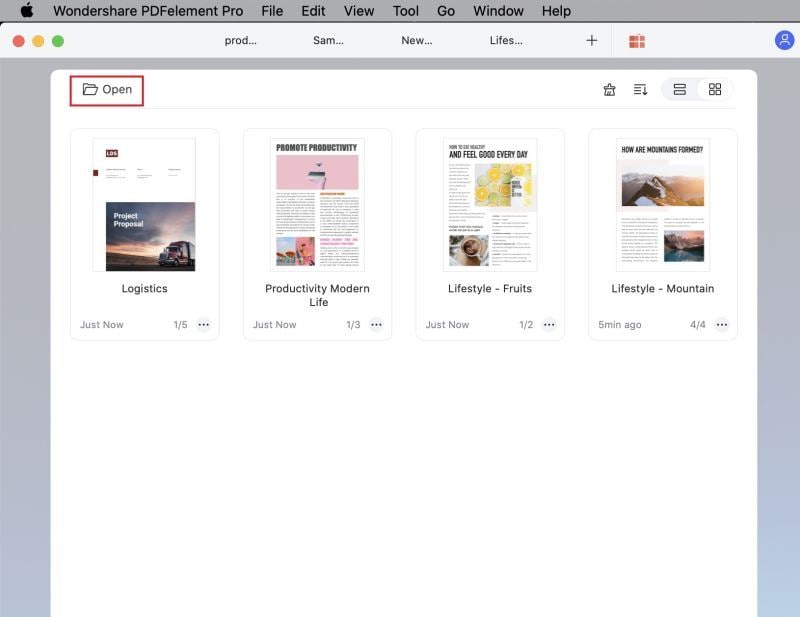
Before converting, quickly scan the PDF pages. If the table spans several pages, check whether each page has the same column structure. If the file includes pages you do not need — for example, a cover page, terms page, or signature page — removing them before conversion can reduce cleanup later.
Step 2: Convert the PDF to Excel
In PDFelement, choose the export option and select Excel as the output format. This creates an .xlsx file, which Numbers can open.
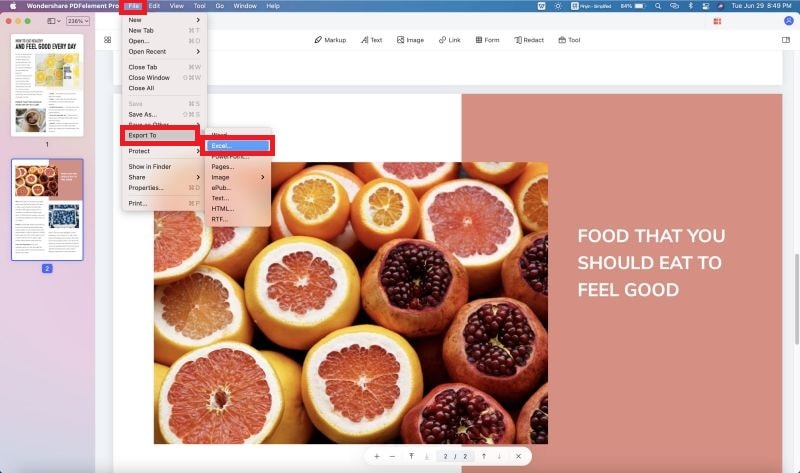
This step is important: you are not usually converting PDF straight into a native .numbers file. You are creating an Excel spreadsheet from the PDF, then using Numbers to open and edit that spreadsheet.
If your PDF is scanned, run OCR before exporting to Excel. Without OCR, the converter may treat the page as an image instead of editable rows and columns.
Step 3: Open the Excel File in Numbers
After conversion, locate the .xlsx file in Finder. Right-click it, choose Open With, and select Numbers. You can also open Numbers first, then use File > Open to select the converted Excel file.
Numbers will import the file and show a warning if anything was changed during import. For example, fonts, charts, formulas, or unsupported formatting may be replaced. Apple explains Numbers compatibility and import behavior in its Numbers user guide.
Once the file opens, save it as a Numbers spreadsheet if you want to continue working in Apple’s native format.
Step 4: Clean Up the Spreadsheet
After you convert PDF to Numbers through Excel, check the spreadsheet before using it for calculations. Start with the header row and the first few data rows. Make sure names, dates, prices, quantities, and totals landed in the correct columns.
Pay special attention to numbers that imported as text. Currency symbols, commas, spaces, or footnote markers can stop Numbers from treating a cell as a real value. If formulas return errors, inspect the cells they reference.
A quick cleanup pass usually includes widening columns, deleting blank rows, fixing merged headers, and correcting date formats. For financial reports or inventory data, compare the converted totals with the original PDF totals before relying on the spreadsheet.
Batch Convert Multiple PDFs to Numbers-Compatible Files
If you have several PDF reports to convert, use batch conversion instead of processing each file one by one. In PDFelement, open the batch conversion tool, add your PDFs, choose Excel as the output format, and start the conversion.

Batch conversion is most helpful when the PDFs share a similar structure, such as monthly sales reports, bank statements, order exports, or recurring invoices. If every file has a different layout, you may still need to review each spreadsheet manually after opening it in Numbers.
G2 Rating: 4.5/5 |100% Secure
How to Convert PDF to Numbers on iPhone or iPad
You can also convert a PDF to a Numbers-compatible spreadsheet on iPhone or iPad. The mobile workflow is similar: convert the PDF to Excel, then open the result in Numbers.
Step 1: Import the PDF
Install PDFelement for iOS, open the app, and import your PDF. You can usually bring in files from the Files app, cloud storage, email attachments, or other apps using the iOS share menu.
This is useful when someone sends you a PDF report, and you need to make quick edits or extract a table without going back to your Mac.
Step 2: Convert the PDF to Excel
Open the PDF in PDFelement, tap the menu option, and choose the conversion feature. Select Excel as the output format.
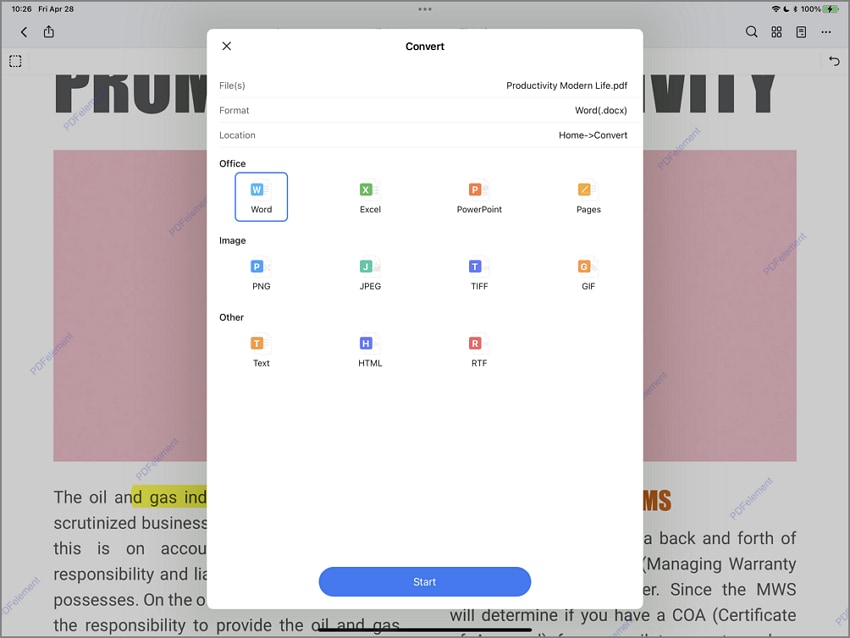
After conversion, the app saves the spreadsheet file. From there, you can send it to Numbers using the share sheet or open it from the Files app.
Step 3: Open the Spreadsheet in Numbers
Open the converted .xlsx file in Numbers. The app will import the spreadsheet and let you edit cells, add formulas, adjust formatting, and create charts.
On a small screen, it is easy to miss conversion errors. If the spreadsheet is important, check it again on iPad or Mac before sending it to others. Multi-page PDFs and wide tables are especially easier to review on a larger screen.
For basic tables, the iPhone workflow is convenient. For scanned PDFs, complex financial statements, or documents with many pages, a desktop workflow gives you more room to inspect and correct the result.
How To Convert PDF to Numbers Online
Online tools can also convert PDF tables into spreadsheet files. Some tools advertise direct PDF to Numbers conversion, while others convert PDF to Excel or CSV. In practice, Excel conversion is usually more flexible because Numbers can open .xlsx files reliably.
A typical online workflow looks like this: upload the PDF, choose Numbers, Excel, or CSV as the output format, start the conversion, then download the converted file. If the output is .xlsx, open it in Numbers and save it as a Numbers document.
Online converters are convenient when you only have one simple PDF and do not want to install software. They are less ideal for sensitive files. If your PDF includes financial records, contracts, customer data, medical information, employee lists, or internal business reports, think carefully before uploading it to a third-party website. Review the tool’s privacy policy and file deletion policy first.
Online conversion also varies widely in quality. A simple one-page table may convert well. A scanned invoice, bank statement, or multi-page table with repeated headers may need OCR and manual correction. If accuracy matters, use a desktop PDF converter with OCR and compare the result against the source PDF.
How To Convert Numbers to PDF
The reverse workflow is more direct. If you want to convert Numbers to PDF, you can export from Numbers itself. This is useful when you want to send a spreadsheet to someone who should view or print it without editing the original data.
You might also see this task described as convert Numbers file to PDF, convert Numbers document to PDF, convert from Numbers to PDF, or simply Numbers to PDF. They all refer to the same basic export process.
Convert Numbers to PDF on Mac
Open the spreadsheet in Numbers on your Mac. Choose File > Export To > PDF. Numbers will show export settings, including image quality and layout-related options. Choose the settings that fit your purpose, then save the PDF.
Before exporting, switch to print view or check the sheet layout. Spreadsheets can become awkward PDFs if columns spill onto extra pages. Adjust page orientation, margins, scaling, and sheet size before you export.
If the PDF is for a client, manager, or accountant, export a copy and review it page by page. Make sure totals are visible, tables are not split in confusing places, and chart labels are readable.
Convert Numbers to PDF on iPhone or iPad
Open the spreadsheet in the Numbers app. Tap the share icon or document menu, choose Export, then select PDF. After Numbers creates the PDF, you can save it to Files, email it, share it through Messages, or upload it to cloud storage.
Apple’s mobile export tools are useful for quick sharing, but layout review matters even more on iPhone. A sheet that looks fine while editing may not fit neatly on a PDF page. If the file has many columns, export and preview the PDF before sending it.
Convert Numbers to PDF in iCloud
If you use Numbers for iCloud, open the spreadsheet in your browser, then use the download or export option to create a PDF. This can be helpful on a shared or work computer where the Numbers app is not installed.
Numbers for iCloud also lets you download spreadsheets in other formats, including Excel and CSV, depending on the file. Apple provides more details about Numbers file compatibility and exporting in its Numbers for iCloud documentation.
What To Check Before Exporting a Numbers PDF
A PDF export freezes the spreadsheet as a viewable document. That is good for sharing, but it also means mistakes become harder for the recipient to fix. Before exporting, check formulas, visible rows, filters, hidden columns, and page breaks.
If you plan to send the PDF for signature or approval, PDFelement can help after export. Open the PDF in PDFelement to add comments, highlight important totals, apply a password, compress the file, organize pages, or add a digital signature field. This is especially useful when the Numbers spreadsheet becomes part of a business workflow, such as a quote, budget approval, purchase order, or monthly report.
G2 Rating: 4.5/5 |100% Secure
PDF to Numbers Troubleshooting and Formatting Tips
PDF-to-spreadsheet conversion is never just a file format change. It is also a structure-recognition task. The converter has to decide where rows begin, where columns end, and which text belongs together. When a PDF was designed for printing rather than data editing, the spreadsheet may need repair.
If the PDF Is Scanned
A scanned PDF needs OCR before conversion. Without OCR, the page is just an image. OCR identifies text and numbers so they can be exported into spreadsheet cells.
For best results, use a clear scan with straight pages, strong contrast, and readable text. Crooked scans, shadows, stamps, handwriting, and low-resolution images can reduce OCR accuracy. After OCR, check similar-looking characters carefully, such as 0 and O, 1 and I, or decimal points in prices.
If Columns Shift or Merge Incorrectly
Column problems often happen when the original PDF uses uneven spacing, wrapped text, or multi-line headers. In Numbers, start by fixing the header area. Once the headers are correct, it is easier to spot where rows drift out of alignment.
If a table converted into one crowded column, try converting again to Excel instead of CSV. Excel output usually preserves table structure better than plain text formats.
If the PDF Has Multiple Tables
A PDF page may contain several unrelated tables, notes, and totals. The converter may place them on one worksheet or split them in unexpected ways.
If you only need one table, consider extracting or cropping the relevant PDF pages before conversion. Removing extra content gives the converter less to interpret and often produces a cleaner spreadsheet.
If Dates, Currency, or Percentages Look Wrong
Numbers may import some values as text. This is common with currency symbols, thousands separators, footnotes, and regional date formats. For example, 03/04/2025 may be interpreted differently depending on your locale settings.
After importing, test a few cells with simple formulas. If a sum does not calculate correctly, the values may be stored as text. Clean the symbols or adjust the cell format in Numbers.
If the PDF Is Protected
Some PDFs restrict copying, editing, or conversion. If you own the file or have permission, unlock it with the password before converting. If you do not have permission, ask the document owner for an editable version or an unlocked copy.
Do not try to bypass restrictions on documents you are not authorized to edit. For business records, it is better to request the original Excel or Numbers file when possible.
People Also Ask
-
Can I convert a PDF directly to a .numbers file?
Sometimes an online converter may offer direct.numbersoutput, but the more reliable workflow is usually PDF to Excel, then Excel to Numbers. Numbers opens.xlsxfiles well, and you can save the imported spreadsheet as a native Numbers document afterward. -
What is the best format for opening a PDF table in Numbers?
For most PDFs,.xlsxis the best intermediate format. It preserves more layout and table structure than CSV. Use CSV only for simple data tables where you do not need formatting, formulas, charts, or multiple sheets. -
Can Numbers open PDF files?
Numbers can insert or display some file content depending on the workflow, but it does not turn a PDF into editable spreadsheet cells by itself. To edit PDF table data in Numbers, convert the PDF to Excel or CSV first. -
How do I convert Numbers to PDF for free?
Open the spreadsheet in Numbers, then use the built-in export option. On Mac, choose File > Export To > PDF. On iPhone or iPad, open the document menu, choose Export, and select PDF. -
Why did my PDF table convert incorrectly?
PDFs store page layout, not spreadsheet logic. If the PDF has wrapped text, merged headers, scanned pages, irregular spacing, or multiple tables on one page, the converter may misread the structure. Try OCR for scanned files, convert to.xlsx, and review the result carefully in Numbers. -
Can I convert a scanned PDF to Numbers?
Yes, but you need OCR first. Use a PDF tool with OCR to recognize the text, then export the PDF to Excel and open the spreadsheet in Numbers. Always check the converted data against the original scan, especially for prices, dates, and account numbers. -
Is it safe to use an online PDF to Numbers converter?
It depends on the document and the service. Online converters can be fine for non-sensitive files, but avoid uploading PDFs that contain personal, financial, legal, medical, or confidential business data unless you trust the provider’s privacy and deletion practices. For sensitive files, desktop conversion is safer. -
Can I convert Numbers to Excel and PDF?
Yes. Numbers can export spreadsheets to both Excel and PDF. Use Excel when the recipient needs to edit the spreadsheet in Microsoft Excel or another spreadsheet app. Use PDF when the recipient only needs to view, print, approve, or sign the document.
![All the Methods to Convert a PDF to Black and White [2026]](https://images.wondershare.com/pdfelement/images2026/pdf-like-article-2.png)