

In this article
- What Does It Mean to Deskew a PDF? (Rotate vs. Deskew)
- Why You Need to Straighten Scanned PDF Documents
- Method 1: How to Deskew a Scanned PDF Using PDFelement (Desktop)
- Method 2: How to Straighten a Scanned PDF Using Adobe Acrobat Pro
- Method 3: How to Deskew a PDF File Online
- Desktop vs. Online Deskewing Tools: Which Should You Choose?
- Troubleshooting Common Deskewing Issues
- Frequently Asked Questions
- Conclusion
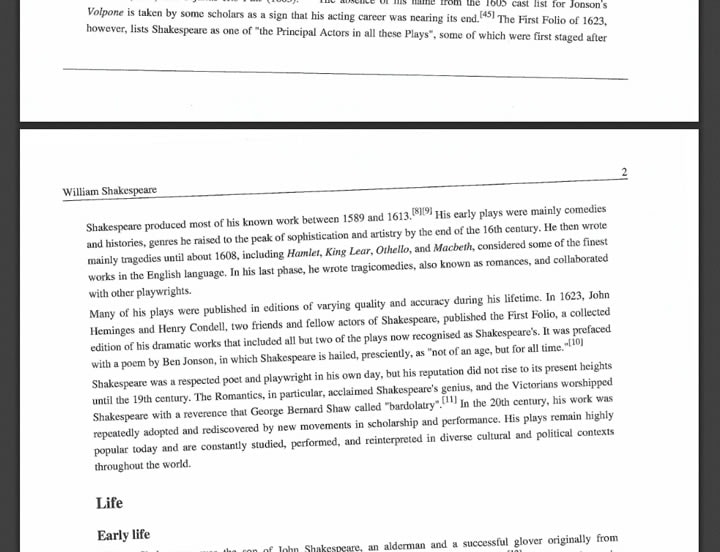
Picture this: Your final exam is tomorrow, and a classmate finally sends you the reviewer notes they promised. You open the file, only to find a hastily scanned PDF where every page is tilted, crooked, and difficult to read. Not only does this trigger a sense of disorganization, but tilting your head just to read the text quickly leads to physical discomfort and eye strain.
When documents are scanned improperly, they become lopsided. You cannot pass a skewed, unprofessional document on to a client or colleague. Fortunately, you don't have to rescan the physical papers. You simply need to deskew the PDF.
In this comprehensive guide, we will explore exactly what it means to deskew a document, why it is critical for document processing, and how you can straighten PDF pages using both professional desktop software and free online tools.


 G2 Rating: 4.5/5 |
 100% Secure
What Does It Mean to Deskew a PDF? (Rotate vs. Deskew)
When people see a crooked document, their first instinct is often to look for a "rotate" button. However, rotating and deskewing are two fundamentally different functions in PDF management.
Rotation turns an entire page by fixed, rigid angles—usually 90, 180, or 270 degrees. This is useful if a page was scanned completely upside down or in landscape mode when it should be portrait.
Deskewing, on the other hand, makes micro-angle corrections. If your paper went through the scanner feeder slightly tilted (e.g., off by 3 or 4 degrees), rotation tools will not help. A deskew algorithm analyzes the text lines or the borders of the page and calculates the exact fraction of a degree needed to make the text perfectly horizontal.
Why You Need to Straighten Scanned PDF Documents
Leaving a document crooked might seem like a minor aesthetic issue, but it actually creates several significant functional problems for digital document management.
Improving OCR Accuracy
Optical Character Recognition (OCR) is the technology that turns a static image of text into searchable, editable data. OCR algorithms are highly sensitive to alignment. They read documents by scanning horizontal lines of pixels. If the text is skewed, the OCR software struggles to distinguish between letters (for instance, mistaking an "l" for a "t" or blending two words together). Deskewing is an essential preprocessing step. If you want to successfully search, copy, or edit your scanned PDF, you must straighten the PDF scan first.
Enhancing Professional Appearance
In a business environment, presentation is everything. Sending a contract, invoice, or resume that is visibly crooked implies a lack of attention to detail. A straightened document looks clean, authoritative, and professionally digitized.
Reducing File Size and Print Errors
Skewed documents often introduce artifacts—black triangles at the corners of the scan or messy, uneven borders. These dark artifacts unnecessarily increase the file size of the PDF because the compression algorithm has to encode this useless visual data. Furthermore, printing a skewed document often results in text being cut off at the margins.
Method 1: How to Deskew a Scanned PDF Using PDFelement (Desktop)
For users who need to perform accurate OCR, preserve document privacy, and straighten PDF pages reliably, desktop software is the optimal choice. Wondershare PDFelement makes the process of deskewing a scanned PDF incredibly straightforward while offering robust editing features.
G2 Rating: 4.5/5 |100% Secure
Step-by-Step Guide
Here are the precise steps to learn how to straighten a scanned PDF using this comprehensive PDF manager:
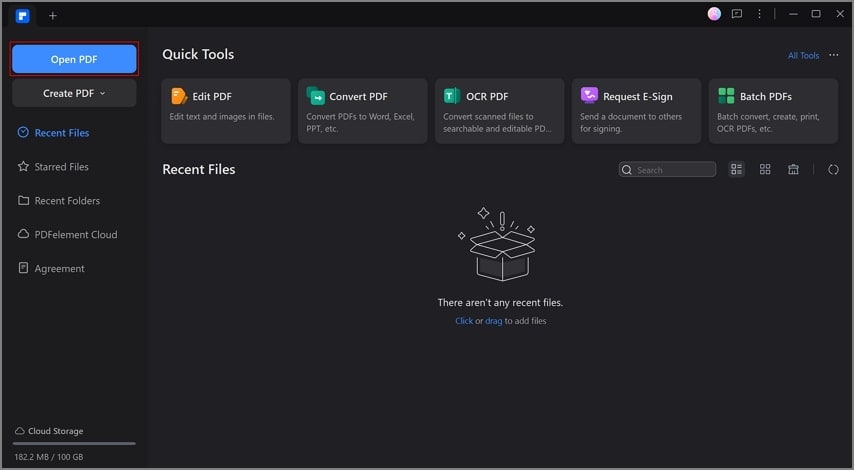
Step 1Access the Document on PDFelement’s Interface
To start the process, launch the tool on your device. Import your skewed document by clicking the “Open PDF” button on the home screen, or simply drag and drop the file into the workspace.
Step 2Perform Optical Character Recognition (OCR)
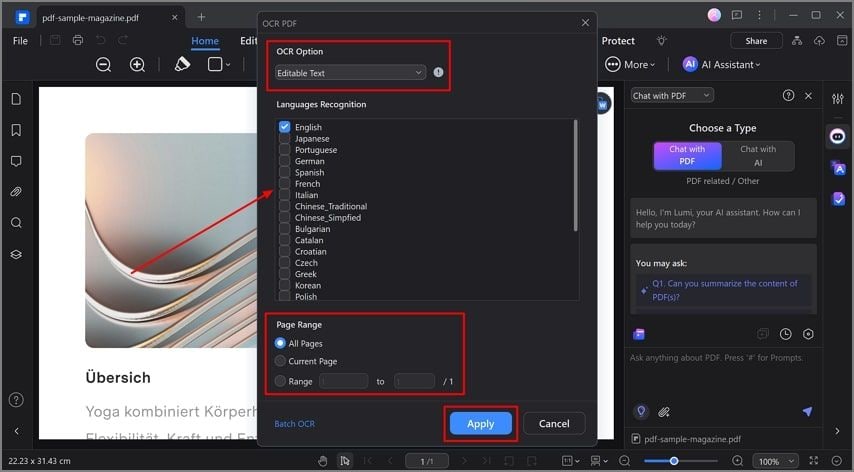
Once the PDF is successfully imported, access the "OCR" option located on the toolbar at the top of the page under the "Tools" tab.
A pop-up window will appear. Here, you must select the “OCR Option” as “Scan to editable text” from the drop-down menu. This ensures the text can be modified later. Next, select the correct language used in the document from the provided options (e.g., English, Spanish, French) to ensure maximum accuracy.
You can also specify the "Page Range" if only certain pages are crooked. Once all settings are configured, hit the "Apply" button. The software will automatically detect the angle of the text and apply a micro-rotation to deskew it.
Step 3Make Changes to the Document if Required
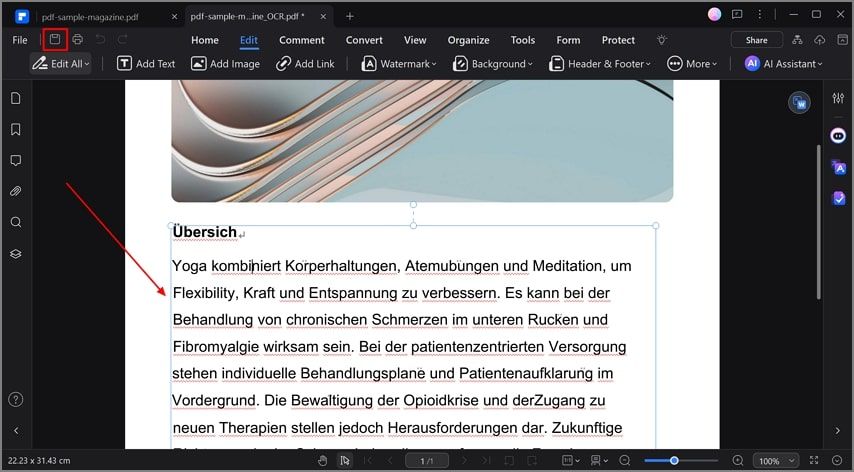
After the successful completion of the OCR process, your PDF will appear perfectly straight, and the text will be fully editable. You can now fix typos, delete messy borders, or update figures. Once satisfied with the results, click the "Save" icon to save the straightened document to your computer.
Advanced Tips for Messy Backgrounds
Very rarely, an OCR engine might place words into individual, fragmented text boxes if the scan quality is exceptionally poor. If this makes editing difficult, close the outputted document without saving, and perform the OCR on the original file again, ensuring the language settings are perfectly matched.
Additionally, after you straighten a PDF, you may notice the background has messy shadows or dark edges left over from the physical scan. Because PDFelement makes the document editable, you can simply click on these background artifacts and press Backspace or Delete on your keyboard to clean up the page.
Additional PDFelement Features
- Edit like Word: Change font styles, colors, and sizes seamlessly.
- Form Creation: Turn non-fillable Word or Excel forms into interactive, fillable PDF forms with one click.
- Markup and Annotation: Highlight text, add comments, and monitor changes easily.
- Digital Signatures: Add legally binding signature fields to your PDFs.
- AI Translation: Using built-in LLMs, PDFelement can translate documents into over 50 languages automatically while preserving formatting.
G2 Rating: 4.5/5 |100% Secure
Method 2: How to Straighten a Scanned PDF Using Adobe Acrobat Pro
If you already have a subscription, you can use Adobe Acrobat Pro DC to fix scanned PDF files that are lopsided. Acrobat has built-in features specifically designed to clean up scans.
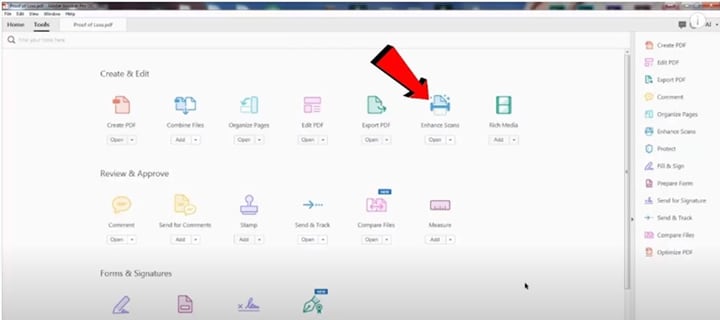
Launch Adobe Acrobat Pro DC and open the skewed scanned PDF. From the right-hand pane or the top menu, you have two primary options: Enhanced Scans and Optimize PDF.
A. Using the Enhanced Scans Tool
- After opening the Enhanced Scans toolset, look for the Recognize Text option at the top center of the screen.
- Click In This File.
- On the drop-down menu, click Recognize Text. You can specify the exact pages you want to straighten.
- Adobe Acrobat Pro DC will initialize its OCR function to read and simultaneously deskew the document. Wait for the processing bar to finish, and your text will be straightened.
B. Using the Optimize PDF Tool
- Go to the Tools menu and select Optimize PDF.
- Click Optimize Scanned Pages on the top center of the screen.
- A dialog box will appear. Here, you can adjust the quality you want the deskewed PDF to be using a slider (balancing file size vs. quality). Ensure the "Deskew" filter is turned on.
- Click OK. You will see text at the bottom saying "Optimizing." Once done, the straightened version of the PDF will render on your screen.

Method 3: How to Deskew a PDF File Online
What if you don't have enough space on your computer for a new program, or you are working on a public computer where you cannot install software? Do not worry; there are online alternatives to deskew a PDF online for free.
Using Sejda to Deskew PDF Online
Sejda is one of the most reliable web-based PDF editors that includes a dedicated deskewing algorithm.
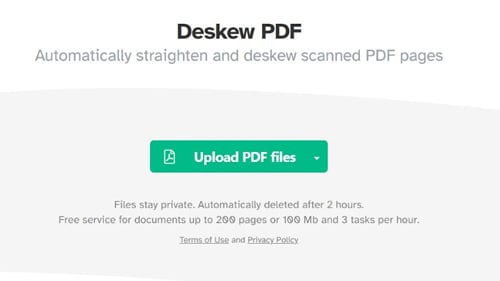
- Open any modern web browser and visit Sejda's Deskew PDF tool page.
- Click the large Upload PDF Files button. Optionally, you can expand the drop-down menu to import directly from Dropbox, Google Drive, or via a web URL.
- Once the file is uploaded, click Deskew PDF. Sejda's algorithm will automatically analyze the text lines and fix the alignment.
- After processing is complete, click Download to save your straightened PDF.
Security Considerations for Online Tools
Online tools are incredibly convenient, but they require uploading your documents to a remote server. Sejda deletes files automatically after 2 hours. However, if you are handling highly sensitive data—such as medical records, financial statements, or confidential legal contracts—it is strongly recommended to use offline desktop software like PDFelement or Adobe Acrobat to guarantee data privacy.
Desktop vs. Online Deskewing Tools: Which Should You Choose?
To help you decide which method is best for your current situation, refer to this quick comparison:
| Feature | PDFelement (Desktop) | Adobe Acrobat Pro (Desktop) | Online Tools (e.g., Sejda) |
|---|---|---|---|
| Deskew Accuracy | Very High (OCR-based) | Very High (OCR-based) | Moderate (Algorithm-based) |
| Data Privacy | 100% Secure (Offline) | 100% Secure (Offline) | Risk for sensitive data |
| Internet Required | No | No | Yes |
| Cost | Affordable | High Subscription | Free (with limits) |
| Batch Processing | Yes | Yes | Limited |
G2 Rating: 4.5/5 |100% Secure
Troubleshooting Common Deskewing Issues
Sometimes, deskewing doesn't go perfectly on the first try. Here is how to handle common edge cases.
Text Becomes Unreadable After Deskewing: If you run an OCR or optimization process and the text becomes blurry or turns into gibberish, the scan resolution was likely too low (below 300 DPI). To fix this, try deskewing the document without running compression, or increase the DPI settings if you have the chance to rescan the physical document.
PDF Remains Skewed (Manual vs. Auto Fixes): Automated deskew algorithms rely on finding horizontal lines of text. If your PDF contains mostly images, abstract art, or diagonal watermarks, the software might not know what "straight" is. In these rare cases, you may need to use a standard "Rotate" tool and input a custom rotation degree (e.g., 2.5 degrees) manually in advanced PDF editors.
Frequently Asked Questions
-
What’s the difference between rotate and deskew?
Rotate turns an entire page by fixed angles, usually in 90-degree increments (90/180/270). Deskew makes microscopic angle corrections (fractions of a degree) to precisely straighten scanned content that was fed into a scanner crookedly. -
Can I deskew PDF online for free?
Yes. There are several web-based tools like Sejda and PDF24 that allow you to straighten PDF pages online. However, these free tools often auto-delete files within 2 hours and impose limits on page counts or task frequencies. For ultimate privacy and batch processing, desktop software is recommended. -
Will OCR keep text searchable after deskew?
Yes, running OCR is actually the preferred method for deskewing. It preserves selectable and searchable text, preventing the software from simply rasterizing the pages into flat, unreadable images. -
Why does my scanned PDF have black borders after I straighten it?
When a crooked rectangular image is rotated slightly to become straight, the empty space left behind at the corners is often filled with black or white pixels by the software. You can crop the PDF pages afterward to remove these unsightly borders.
Conclusion
A skewed PDF file looks unprofessional, is difficult to read, and actively hinders text recognition software. Whether you are archiving old receipts, submitting school work, or sending corporate contracts, learning how to deskew PDF files is a vital digital skill.
For quick, non-sensitive documents, online tools like Sejda offer a fast, free fix. However, for those who regularly deal with scanned documents, require high-fidelity OCR, and prioritize data security, a robust desktop solution is essential. Software like Wondershare PDFelement and Adobe Acrobat Pro not only straighten your scanned PDFs perfectly but also equip you with the tools needed to edit, compress, and manage your digital paperwork flawlessly.