
Table of Contents
A stack of business cards is easy to collect and surprisingly hard to use. After a trade show, sales meeting, conference, or local networking event, the real work is not keeping the cards—it is turning them into searchable contact records. That is where a business card scanner to Excel workflow helps. Instead of typing every name, phone number, email, company, and job title by hand, you can scan the cards, run OCR, review the extracted text, and export the data into a spreadsheet.
Excel is still one of the most practical places to store contact information. It is flexible, easy to sort, simple to share with a team, and compatible with many CRM import tools. The key is choosing the right scanning method and setting up your spreadsheet so the data does not become messy later.
This guide explains how to scan business cards to Excel using OCR tools, including a practical PDFelement workflow, plus alternative apps and cleanup tips that make the final spreadsheet easier to use.


 G2 Rating: 4.5/5 |
 100% Secure
Why Scan Business Cards to Excel?
A business card contains structured information, but the card itself is not a structured file. The name may be large, the company logo may interrupt the layout, the email may sit at the bottom, and the phone number may include country codes or extensions. OCR software helps bridge that gap by reading text from an image or scanned PDF.
The goal is not only to “read” the card. The useful outcome is a clean Excel sheet where each piece of information sits in the right column.
What a business card scanner to Excel workflow usually includes
A typical workflow looks like this:
- Scan or photograph the business card.
- Save the scan as an image or PDF.
- Run OCR to recognize the printed text.
- Check the extracted contact details.
- Export or copy the data into Excel.
- Clean, sort, and deduplicate the spreadsheet.
Some apps do several of these steps automatically. Others give you more control but require more review. For a small batch, either approach can work. For dozens or hundreds of cards, batch OCR and a consistent Excel template matter much more.
What OCR can and cannot do
OCR is very good at recognizing clear printed text. It can usually read names, company names, job titles, emails, websites, and phone numbers from a clean scan.
It may struggle with:
- Glossy cards with glare
- Very small text
- Decorative fonts
- Vertical layouts
- Low-contrast colors, such as light gray on white
- Cards with multiple languages
- Logos that resemble text
- Handwritten notes added after a meeting
Because of that, you should expect to review the extracted data before relying on it. Even strong OCR tools can confuse “O” and “0,” miss a phone extension, or split a company name incorrectly.
Why Excel is a good destination
Excel gives you control. You can sort by company, filter by event, add notes, mark follow-up status, remove duplicates, and prepare the file for CRM import. Microsoft also provides detailed support for spreadsheet functions and data management in its Excel help center, which is useful if you plan to clean or merge larger contact lists.
For many teams, Excel acts as the staging area before contacts are moved into Outlook, Google Contacts, HubSpot, Salesforce, or another CRM.
How To Scan Business Cards to Excel With PDFelement
PDFelement is useful when your business cards are already scanned as PDFs, when you want to batch process card scans, or when you prefer a desktop workflow for OCR and file conversion. Instead of treating each business card as a one-off phone photo, you can scan cards into PDF, run OCR, review the text, and convert the recognized content into an Excel-friendly format.
G2 Rating: 4.5/5 |100% Secure
This is especially helpful if your contact collection process includes PDFs already—for example, scanned visitor badges, event sign-in sheets, lead forms, brochures with contact blocks, or business card scans saved from a multifunction printer.
Step 1: Scan the business card into PDFelement
Open PDFelement and create a PDF from your scanner. In many workflows, this begins with the scanner option inside the software.
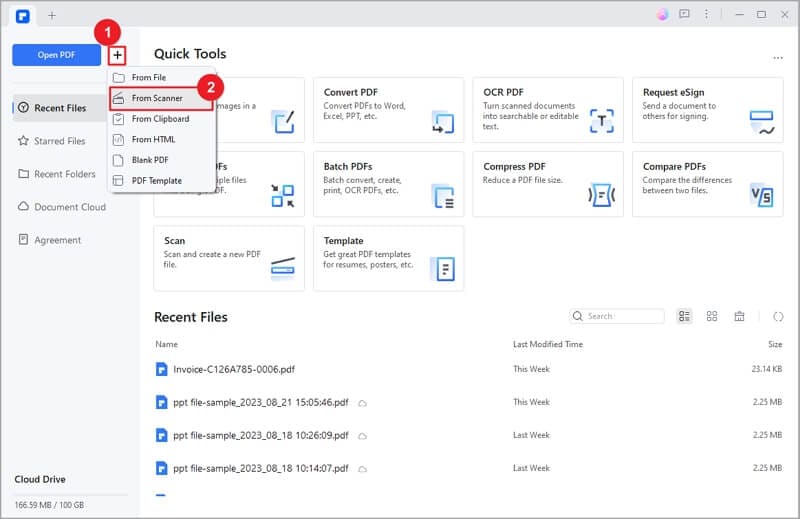
For best results, scan at a readable resolution and keep the card aligned. If you are scanning multiple cards, place them consistently so the text direction does not change from page to page. Avoid scanning several cards as one crowded page unless you are prepared to separate or manually review the extracted text later.
Step 2: Run OCR on the scanned card
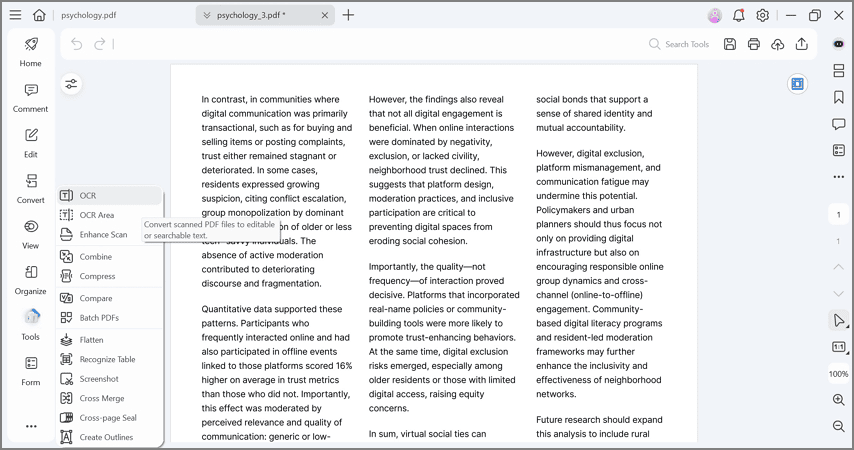
Once the scanned business card appears in PDFelement, use the OCR tool to recognize the text. OCR turns the image-based card into selectable and searchable text.
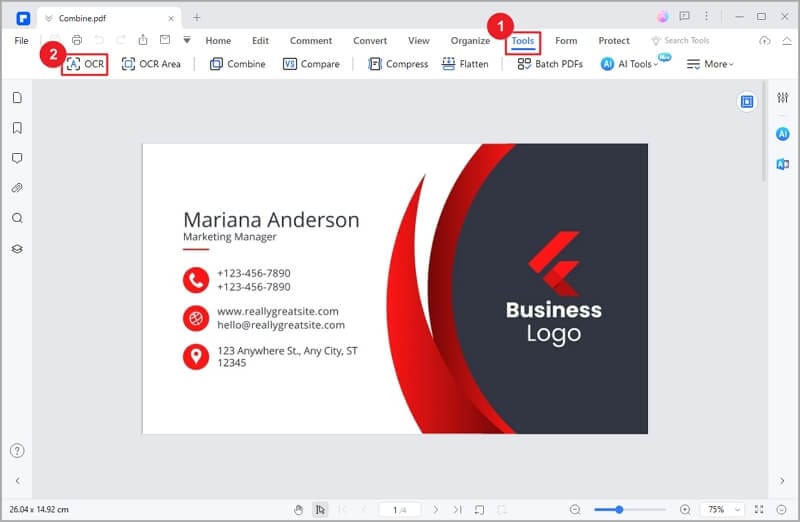
Choose the correct OCR language if the card is not in English or contains accented characters. This small setting can improve recognition for names, addresses, and company names.
Step 3: Review the recognized text
After OCR, check the extracted information before exporting. Pay close attention to:
- Email addresses
- Phone numbers
- Country codes
- Names with unusual spelling
- Company suffixes such as Ltd., GmbH, LLC, or Pty Ltd.
- Website URLs
- Job titles
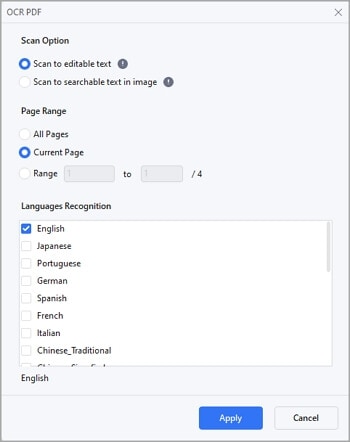
This review step is worth the time. One incorrect character in an email address can make the contact unusable.
Step 4: Convert the scanned business card to Excel
After OCR is complete, use the conversion option to export the recognized content to Excel.
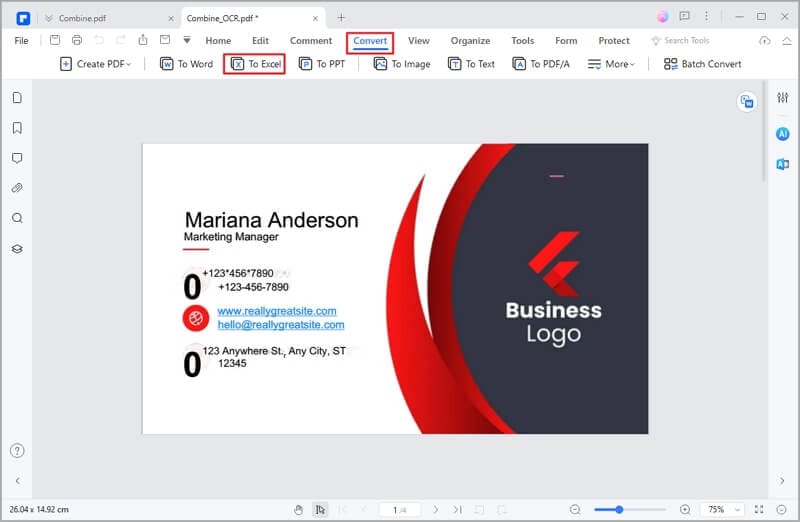
Depending on the card design, the output may not land perfectly in your preferred columns on the first try. That is normal. Business cards are designed for people, not spreadsheets. Use Excel cleanup to move details into consistent fields such as First Name, Last Name, Company, Job Title, Email, Phone, Website, Address, Source, and Notes.
Step 5: Use AI assistance to organize extracted contact text
If the OCR output is readable but not neatly arranged, PDFelement’s AI chat feature can help you reorganize the extracted text. For example, you can paste the recognized business card text and ask it to format the details into labeled fields.
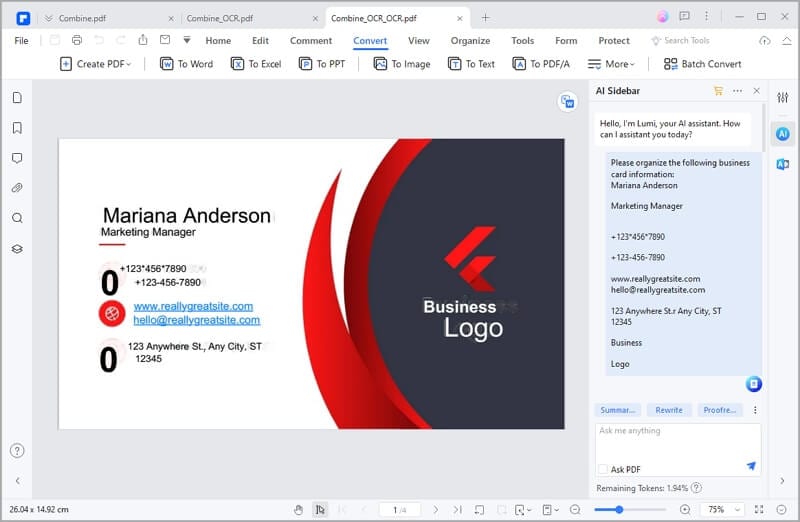
A practical prompt might be:
Convert this business card text into contact fields: First Name, Last Name, Job Title, Company, Email, Phone, Website, Address, and Notes. If a field is missing, leave it blank.
Then you can copy the structured result into your spreadsheet.
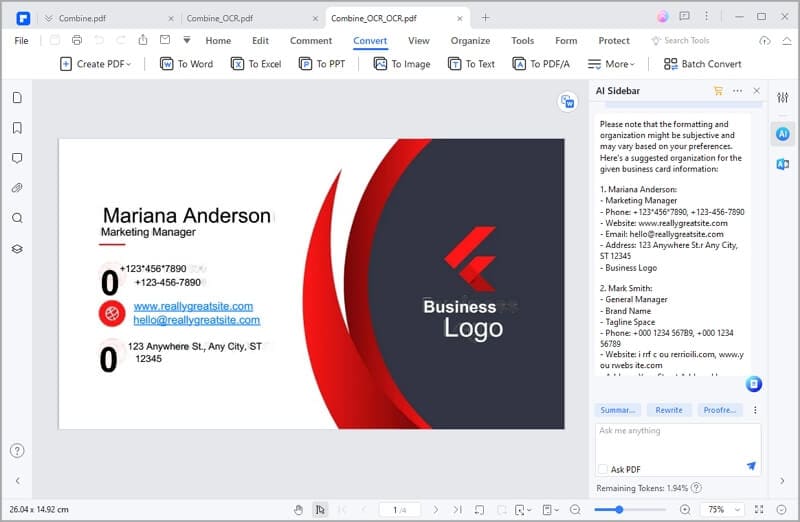
AI formatting is not a substitute for verification, but it can reduce the repetitive work of separating a block of OCR text into contact fields.
When PDFelement is the right fit
PDFelement is a strong fit if you want more than a quick mobile scan. It makes sense when you need to:
- OCR scanned business card PDFs
- Convert scanned files to editable formats
- Batch process multiple scanned documents
- Review and edit PDF scans before exporting
- Keep card scans as searchable PDF records
- Organize related PDF documents from the same event or client
G2 Rating: 4.5/5 |100% Secure
For a sales team, this can be useful beyond the card itself. You might scan business cards, attach related signed forms, compress the final PDF packet, annotate meeting notes, and convert selected contact information into Excel for follow-up. That broader PDF workflow is where PDFelement is most useful.
How To Prepare Business Cards for Better OCR Accuracy
The quality of your Excel file depends heavily on the quality of the scan. A better scan means less cleanup, fewer mistakes, and a faster import into your contact system.
Use even lighting and avoid glare
Glossy business cards look good in person but can cause OCR errors. If you are using a phone camera, move the card away from direct overhead light. If you are using a scanner, close the scanner lid fully and keep the card flat.
Dark shadows, reflections, and angled photos often create more work later.
Scan one card at a time for accuracy
For small batches, scan one card per page or image. This gives OCR software the best chance of identifying text correctly.
For large batches, you may be tempted to place several cards on a scanner bed at once. That can save time at the scanning stage, but it may create confusion during OCR and export. If you do scan multiple cards per page, leave enough space between cards and expect more manual cleanup.
Keep the card straight
OCR tools can handle slight rotation, but a badly tilted card can produce broken lines and misplaced text. Align the card with the scanner edge or use a mobile scanning app with automatic edge detection.
Choose the right file type
PDF is convenient for desktop OCR and archiving. JPG or PNG may work well for mobile apps. If your goal is Excel, the final file format matters less than the clarity of the text and the reliability of the OCR.
For long-term record keeping, searchable PDF is useful because you can search the original card scan later even after exporting contact details.
Name files before batch processing
If you are scanning many cards after an event, use a consistent file naming system. For example:
2025-TradeShow-Day1-Card-001.pdf2025-TradeShow-Day1-Card-002.pdfClientDinner-March-Card-001.pdf
This helps if you need to trace an Excel row back to the original scan.
Check international details carefully
A visiting card scanner to Excel workflow often involves contacts from different countries, especially at international events. Watch for:
- Country codes in phone numbers
- Local address formats
- Accented characters
- Multiple phone numbers
- Messaging app numbers
- Non-English company names
- Different name order conventions
Do not force every contact into a first-name/last-name structure without checking. Some names do not map cleanly to that format.
Best Business Card Scanner to Excel Options
There is no single best tool for every situation. The right choice depends on how many cards you handle, whether you need PDF processing, whether you use a CRM, and how much cleanup you are willing to do.
PDFelement
PDFelement works well for users who scan business cards as PDFs and want OCR plus conversion tools in one desktop workflow. It is especially practical when business card scanning is part of a larger document process, such as digitizing event paperwork, contracts, brochures, invoices, or meeting notes.
Best for:
- Scanned PDF workflows
- OCR and PDF conversion
- Batch document handling
- Users who want searchable PDF copies
- Teams that need to review, edit, annotate, or manage scanned documents
Possible limitation:
- If you want a phone-first app that automatically creates a contact record from a single snapshot, a dedicated mobile business card app may feel faster.
G2 Rating: 4.5/5 |100% Secure
ABBYY FineReader PDF
ABBYY FineReader PDF is known for OCR and document conversion. It can recognize text from scanned documents and export content into editable formats, including spreadsheets.
Best for:
- High-accuracy OCR needs
- Multilingual documents
- Users who already work with scanned PDFs
- More complex document conversion tasks
Possible limitation:
- It may be more than you need if your only task is scanning a few cards after occasional meetings.
MagneticOne Business Card Reader CRM Pro
MagneticOne Business Card Reader CRM Pro is designed around extracting business card data and sending it into contact systems or CRM tools. It is a better fit if your main goal is sales contact capture rather than PDF document management.
Best for:
- CRM-focused teams
- Salespeople who scan cards frequently
- Users who want contact-field extraction
- Teams that need cloud sync or CRM integration
Possible limitation:
- CRM setup and field mapping may take extra time at the beginning.
BizConnect
BizConnect focuses on business card scanning and contact management, with options for syncing or connecting contact data across apps. It can be useful if you want a mobile-driven contact database rather than a PDF-first workflow.
Best for:
- Mobile scanning
- Contact organization
- App-based workflows
- Users who want business card data available on the go
Possible limitation:
- If your final destination is a carefully formatted Excel workbook, check the export options and field structure before scanning hundreds of cards.
Folocard
Folocard is another mobile option for scanning business cards and exporting contact information. It suits people who collect cards while traveling or attending events and want to process them quickly from a phone.
Best for:
- Quick phone scanning
- Individual professionals
- Light to moderate card volume
- Simple Excel export needs
Possible limitation:
- Mobile scans depend heavily on camera quality, lighting, and card design.
Manual phone scan plus Excel cleanup
For a small number of cards, you may not need a dedicated business card scanner. You can photograph the card, use a phone’s built-in text recognition, copy the text, and paste it into Excel.
For example, Apple provides Live Text features on supported devices, and Google Lens can recognize text from images. Google explains Lens capabilities in its Google Lens help documentation.
Best for:
- One or two cards at a time
- No-budget workflows
- Quick personal contact capture
Possible limitation:
- It is not efficient for batches, and field cleanup is almost entirely manual.
How To Structure Your Excel Contact Sheet
Scanning is only half the job. A badly structured spreadsheet can become as frustrating as a pile of physical cards. Before you scan business card to Excel, create a clean template.
Recommended Excel columns
A practical contact sheet can include:
| Column | Why it helps |
|---|---|
| First Name | Useful for email personalization |
| Last Name | Helps with sorting and deduplication |
| Full Name | Keeps the original name format intact |
| Job Title | Adds context for follow-up |
| Company | Essential for account-based sales or networking |
| Main follow-up channel | |
| Phone | Useful for direct outreach |
| Mobile | Separate from office phone if available |
| Website | Helps identify the company quickly |
| Add manually if found later | |
| Address | Useful for regional sorting |
| City | Easier filtering than full address |
| Country | Important for international contacts |
| Source/Event | Tracks where you met the person |
| Date Added | Helps prioritize recent leads |
| Follow-Up Status | Example: Not contacted, emailed, replied |
| Notes | Meeting context or personal reminders |
| Original File Name | Links the row back to the scan |
G2 Rating: 4.5/5 |100% Secure
You do not need every column for every project. A freelancer may only need name, company, email, phone, and notes. A sales operations team may need source, region, owner, lead status, and CRM ID.
Keep one contact per row
Do not place two people from the same company in the same row. Excel works best when each row represents one contact. If a card lists a general office number and a personal mobile number, keep them in separate phone columns rather than mixing both in one cell.
Split names carefully
Many CRM imports require separate First Name and Last Name fields. Still, keep a Full Name column. It helps preserve the original formatting, especially for names with prefixes, suffixes, compound surnames, or non-Western name order.
Standardize phone numbers
Phone numbers can become messy fast. Decide how you want to store them before importing into a CRM. For international contacts, include country codes where possible.
Example format:
+1 212 555 0198+44 20 7946 0958+81 3 1234 5678
Avoid storing phone numbers as numeric values in Excel because leading zeros may disappear. Format phone columns as text.
Use data validation for status fields
For fields such as Follow-Up Status, Lead Type, Region, or Owner, use dropdown lists. This prevents inconsistent entries like:
- Followed up
- Follow-up sent
- Emailed
- Email sent
- Contacted
A clean dropdown makes filtering much easier later.
Remove duplicates before importing
Duplicate contacts are common after events. Someone may give you a card, scan at a booth, and fill out a form. Before importing your spreadsheet into a CRM, check duplicates by email first, then phone number, then name plus company.
Excel’s built-in duplicate tools can help, but be cautious. Two people at one company may share a main office number, so deleting based on phone alone can remove valid contacts.
Add a notes field immediately
The most valuable detail is often not printed on the card. Add notes while the meeting is still fresh:
- “Asked for pricing sheet”
- “Interested in partner program”
- “Met at booth 214”
- “Prefers email, not phone”
- “Follow up after April budget meeting”
Those notes turn a scanned card into a useful contact record.
Choosing the Right Visiting Card Scanner to Excel Workflow
“Business card” and “visiting card” usually refer to the same object in this context. The best visiting card scanner to Excel workflow depends less on the wording and more on volume, accuracy needs, and where the data goes next.
If you scan only a few cards per month
Use a simple workflow. A phone scan, built-in text recognition, or a lightweight mobile app may be enough. Copy the details into a small Excel template and check the email address carefully.
A dedicated desktop OCR workflow may be unnecessary unless you also want a searchable PDF archive.
If you scan cards after events
Use batch-friendly software and create an event-specific Excel file. Add Source/Event and Date Added columns before scanning. If multiple team members collect cards, add an Owner column so follow-up responsibility is clear.
For events, speed matters, but accuracy matters more. A fast scan with wrong email addresses wastes the opportunity.
If your team uses a CRM
Choose a scanner that supports CRM export or produces a clean CSV/XLSX file. Before importing, check your CRM’s required fields. Some systems require Last Name, Email, Company, Lead Owner, or Country.
Excel should act as the review layer. Do not push raw OCR output directly into a CRM unless you are comfortable cleaning it there.
If you manage scanned PDFs regularly
Use a PDF-focused tool such as PDFelement. This is practical when contact extraction is part of a broader document workflow. You can OCR business card scans, convert selected information to Excel, keep searchable PDF copies, and manage related documents in one place.
If you need maximum accuracy
No scanner removes the need for human review. For high-value contacts, verify the details manually. Check the company website, email domain, and LinkedIn profile if needed. The more important the relationship, the less you should rely on raw OCR output alone.
People Also Ask
-
What is the easiest way to scan business cards to Excel?
The easiest method is to use a business card scanning app that supports Excel or CSV export. For scanned PDFs, use an OCR and conversion tool such as PDFelement: scan the card, run OCR, review the extracted text, and export or organize the data into Excel.
-
Can I scan business cards directly into Excel?
Not usually in a true one-step way. Excel does not function as a full business card OCR scanner by itself. You normally need a scanning or OCR tool first, then export the recognized data to Excel or copy it into a spreadsheet template.
-
What is the best business card scanner to Excel tool?
It depends on your workflow. PDFelement is a good choice for scanned PDF and OCR conversion workflows. Mobile apps such as BizConnect or Folocard are convenient for phone-based scanning. OCR tools such as ABBYY FineReader PDF are useful for more advanced document recognition.
-
Can PDFelement convert scanned business cards to Excel?
Yes, PDFelement can help by scanning business cards into PDF, running OCR to recognize the text, and converting the recognized content to Excel. You should still review the output because business card layouts vary and may require cleanup in Excel.
-
How accurate is OCR for business cards?
OCR accuracy depends on scan quality, font style, card layout, language, and contrast. Clean, flat, high-resolution scans usually produce better results. Decorative fonts, glossy cards, tiny text, and unusual layouts can cause errors.
-
What columns should I use in Excel for business card contacts?
Useful columns include First Name, Last Name, Full Name, Job Title, Company, Email, Phone, Website, Address, Source/Event, Date Added, Follow-Up Status, Notes, and Original File Name. For CRM imports, match your CRM’s required fields.
-
Is “visiting card scanner to Excel” the same as “business card scanner to Excel”?
In most cases, yes. “Visiting card” is commonly used in some regions to mean business card. The scanning workflow is the same: capture the card, run OCR, extract contact details, and organize them in Excel.
-
Can I batch scan business cards to Excel?
Yes, but the process depends on the tool. Desktop OCR tools and PDF converters are better suited for batches than manual phone scanning. For best results, scan cards consistently, review OCR output, and use a prepared Excel template.
-
Should I export business card data as Excel or CSV?
Use Excel if you want to review, format, filter, and add notes. Use CSV if you plan to import the contacts into a CRM or email platform that requires CSV. Many teams keep an Excel master file and export CSV only when needed.
-
How do I avoid duplicate contacts after scanning business cards?
Use email as the first duplicate check, then phone number, then name plus company. Add a Source/Event column so you can see where each contact came from. Review duplicates manually before deleting, especially for people from the same company.