

Many users struggle when trying to edit PDF picture elements inside documents. Some PDFs contain embedded images that can be selected and modified directly, while others are flattened scans that behave like a single photo of a page. The right workflow depends on which kind of file you actually have.
Research from Foxit shows that inefficient document processes and image challenges can hurt productivity. This guide walks through practical ways to edit images in PDF files, explains when OCR is necessary, and helps you choose between desktop tools, online editors, and image-focused software.
In this article
- Quick Answer: What Is the Best Way to Edit PDF Pictures?
- How Do Different Methods Compare for Editing PDF Pictures?
- What Does It Actually Mean to Edit PDF Picture?
- How to Edit Images in PDF Files with PDFelement?
- How Can You Edit an Image-Based PDF Successfully?
- Is It Possible to Edit a PDF Image Online Safely?
- PDFelement vs. Online Tools vs. Photoshop: Which Should You Choose?
- What Are the Common Tasks You Can Do with a PDF Image Editor?
- How Do You Fix Common Problems When Editing Images in PDF Files?
- Frequently Asked Questions
Quick Answer: What Is the Best Way to Edit PDF Pictures?
The best method depends on whether the PDF contains selectable image objects or a scanned page layer. If the image can already be clicked and adjusted, a full PDF editor such as PDFelement is usually the fastest and most precise option. If the page is a scan, OCR must come first so the content becomes editable.
Best for Editing Images Inside a PDF
Use a professional PDF image editor when the pictures are already stored as independent objects. This makes it much easier to replace, crop, rotate, resize, move, or delete visuals without disrupting the rest of the layout.
Best for Editing an Image-Based PDF
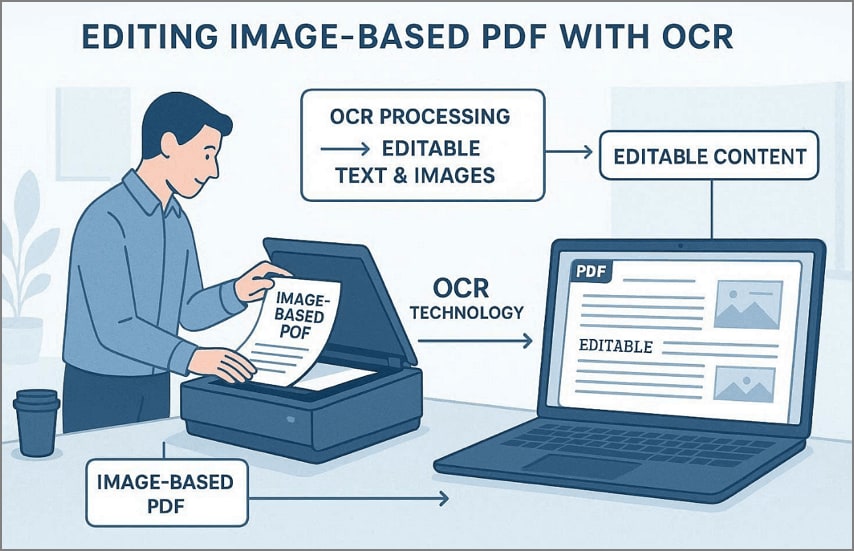
If the entire page behaves like one flat image, OCR is the required first step. OCR converts scanned content into editable layers so you can modify both text and visuals with much better control.
Best for Quick Online Edits
Browser-based tools work for simple, one-off changes such as adding, moving, or trimming a picture in a non-sensitive file. They are convenient, but they usually offer far less control than a desktop PDF editor.
How Do Different Methods Compare for Editing PDF Pictures?
Different workflows offer very different levels of control, OCR support, privacy, and flexibility. The table below makes it easier to see which option fits embedded image editing, scanned PDF editing, or advanced image manipulation.
| Feature | PDFelement | Online PDF Editor | Photoshop | OCR + PDF Editor Workflow |
|---|---|---|---|---|
| Best for | All-in-one PDF editing and OCR workflows | Quick, simple edits | Advanced image manipulation | Editing scanned/image-based PDFs |
| Can edit image objects? | Yes | Limited | Yes (after import) | Yes (after OCR) |
| Can edit image-based/scanned PDFs? | Yes | No / Very limited | No (without OCR workflow) | Yes |
| OCR support | Yes | Limited | No | Yes |
| Works online? | No (desktop-based) | Yes | No | Depends on tools |
| Editing control | High | Low | Very high (image only) | Medium to High |
| Main limitation | Requires installation | Restricted features and privacy concerns | Not ideal for full PDF editing | Multi-step process |
What Does It Actually Mean to Edit PDF Picture?
Editing a PDF picture can refer to two very different tasks: adjusting an image object that already exists inside a digital PDF, or trying to modify a scanned page that is essentially just a picture of a document. Knowing the difference saves time and prevents failed editing attempts.
Editing an Image Inside a PDF
In a digitally created PDF, the image is often stored as a separate object. That means you may be able to select it directly and make object-level changes without affecting the full page.
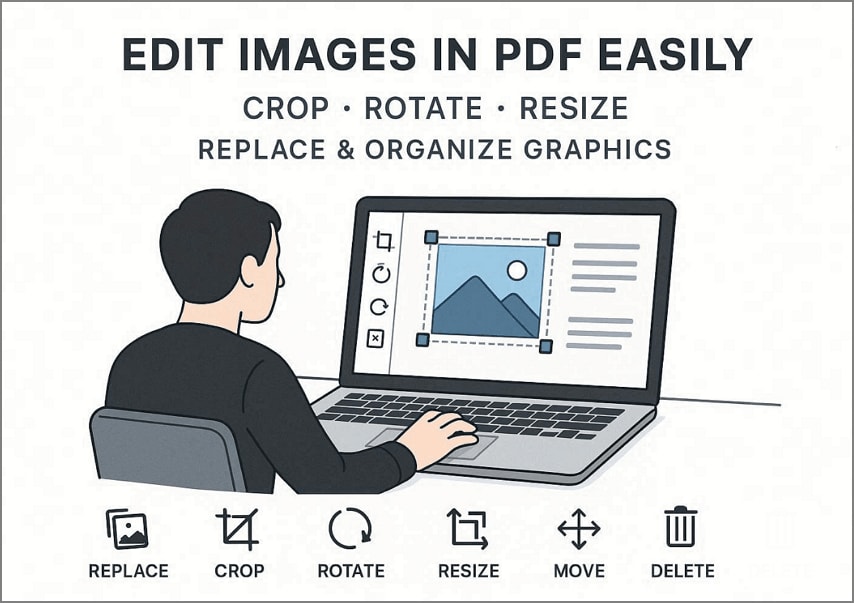
Replace Image: Swap out an old graphic for a new file while keeping the surrounding page structure intact.
Crop Image: Remove unnecessary edges so attention stays on the most important visual content.
Rotate Image: Change orientation to better align the image with nearby text and layout.
Resize Image: Adjust height and width so the picture fits the page more cleanly.
Move Image: Reposition the object to improve flow, spacing, or emphasis.
Delete Image: Remove unneeded visuals to simplify the document.
Editing an Image-Based PDF
These PDFs are effectively pictures of pages. The document often loads as one flat layer, which means the editor cannot directly isolate and modify text boxes or individual graphics until OCR has been applied.
Scanned Limitations: The file starts out as static visual content rather than editable objects.
OCR Necessity: Optical character recognition is needed to unlock the content for real editing.
Editable Transition: After OCR, the scan becomes a more interactive document that can be revised with far greater flexibility.
Why This Difference Matters
Many editing problems come from using the wrong workflow for the file type. The comparison below shows why object-based PDFs and scanned PDFs should not be treated the same way.
| Feature | Editing an Image Object | Editing an Image-Based PDF |
|---|---|---|
| Electability | Images can be clicked and moved | The entire page is one single image |
| Direct Edits | Possible without extra processing | Requires OCR to make content active |
| Flexibility | High control over individual pixels | Depends on recognition and accuracy for quality |
| Ideal Tool | Standard PDF Image Editor | PDF Editor with Advanced OCR |
How to Edit Images in PDF Files with PDFelement?
Editing images in PDFs becomes much easier with PDFelement because it supports direct object-level edits inside the document. You can replace, crop, rotate, and reposition images while preserving the surrounding layout, which makes it a practical workflow for polished document updates.
Why PDFelement Works Well as a PDF Image Editor
All-in-One Editing: It lets you work on text and images inside the same PDF workflow.
Precision Placement: Alignment controls help position visuals more accurately on the page.
Batch Processing: Repeated edits can be applied more efficiently across larger files.
Advanced OCR: Scanned PDFs can be converted into editable documents before revision.
Resource Efficiency: Large image-heavy PDFs remain easier to manage in a dedicated desktop environment.
In addition, the PDF Association notes that intelligent text recognition continues to become more important in modern document workflows.
Step 1
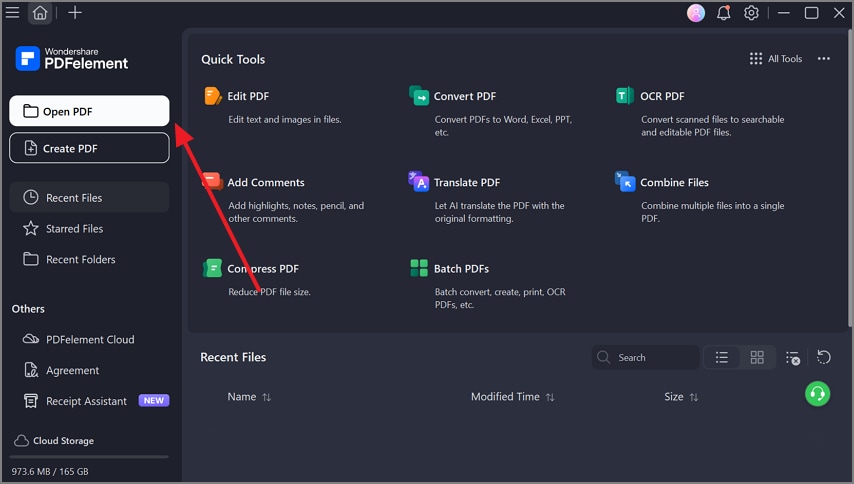
On the main PDFelement screen, click Open PDF to import the file you want to edit.
Step 2
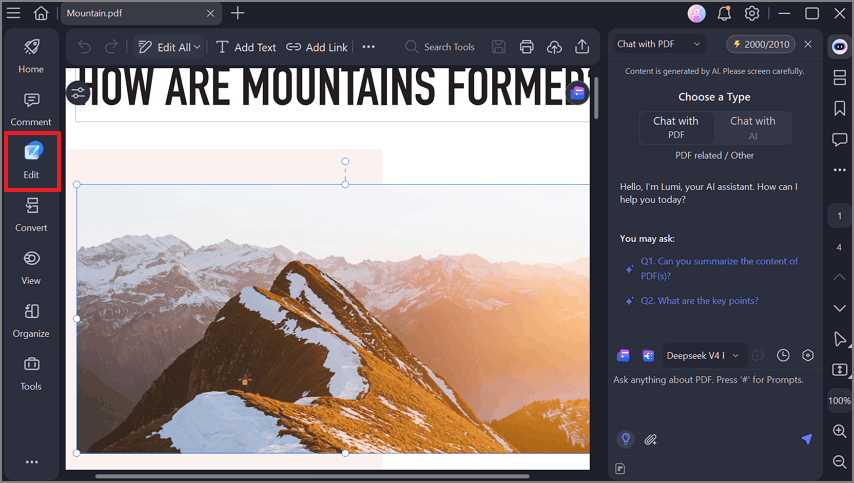
After the PDF opens, choose the Edit feature so the document enters editing mode.
Step 3
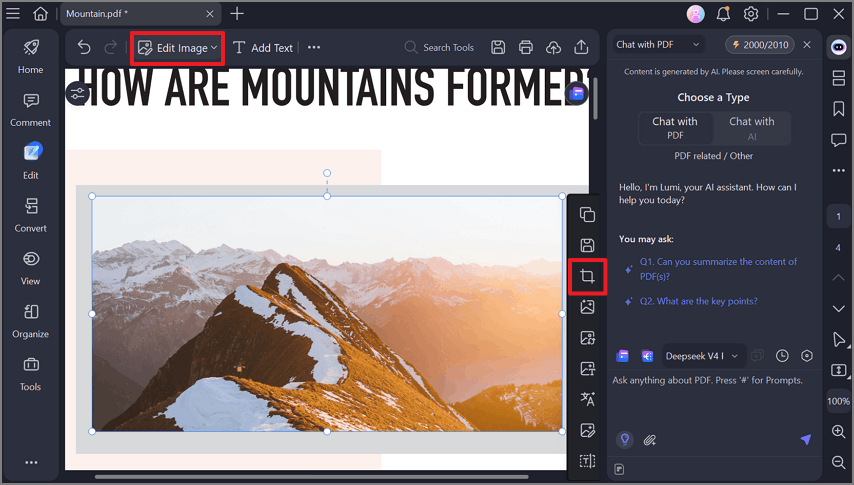
Open Edit Image from the dropdown, then select the picture you want to modify. If needed, use the Crop icon to trim the image to fit your layout.
Step 4
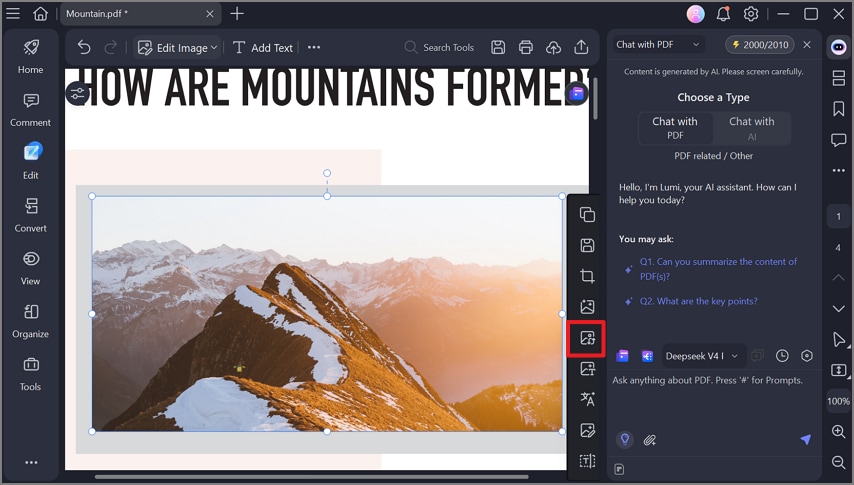
If you need a different visual, click the Replace Image icon and choose the new picture from your device.
Step 5
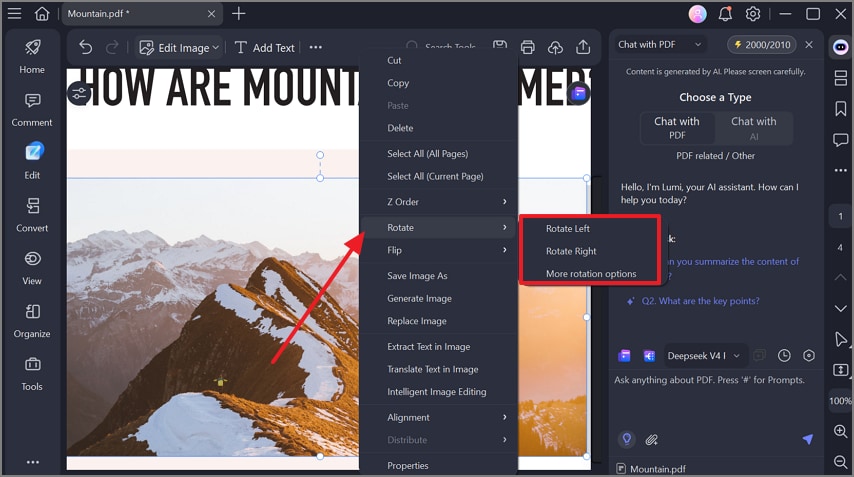
To change orientation, right-click the image, open the Rotate section, and choose the direction that fits the page best.
Step 6
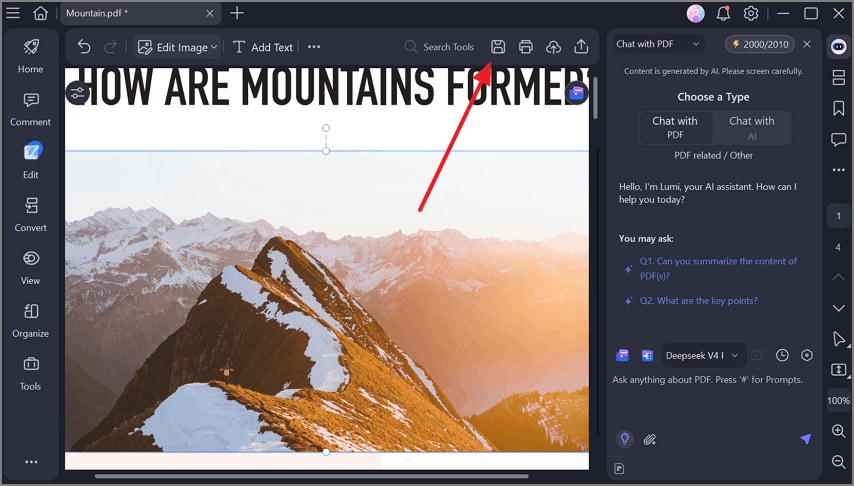
Review the final result, then click the Save icon to keep the updated PDF.



 G2 Rating: 4.5/5 |
 100% Secure
How Can You Edit an Image-Based PDF Successfully?
When you need to edit an image-based PDF, direct changes are usually impossible at first because the page is flattened. A tool with built-in OCR, such as PDFelement, can convert the scan into editable content so text and visuals become much easier to adjust.
Step 1
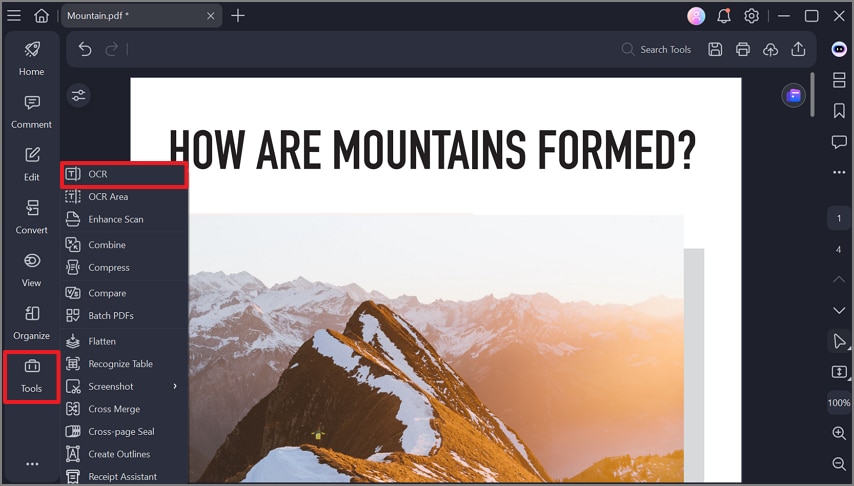
Open the scanned PDF in PDFelement, go to the Tools tab, and choose OCR.
Step 2
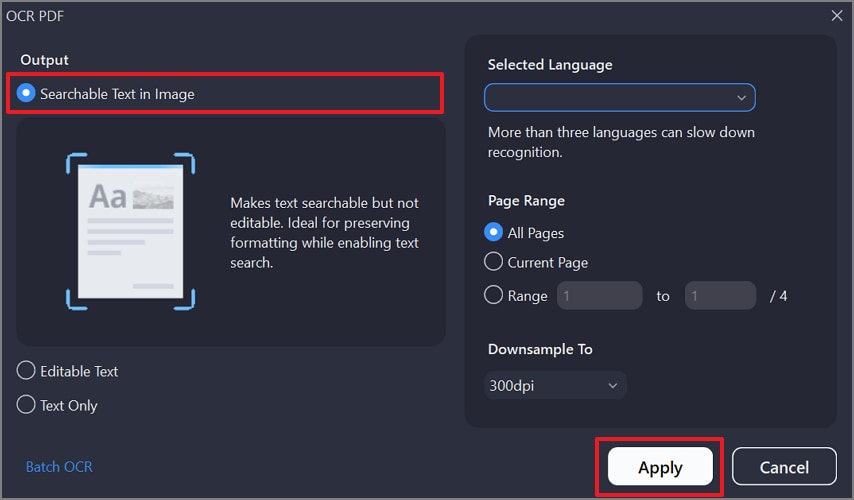
Enable Searchable Text In Image, choose the correct language and page range, then click Apply to process the file.
Step 3
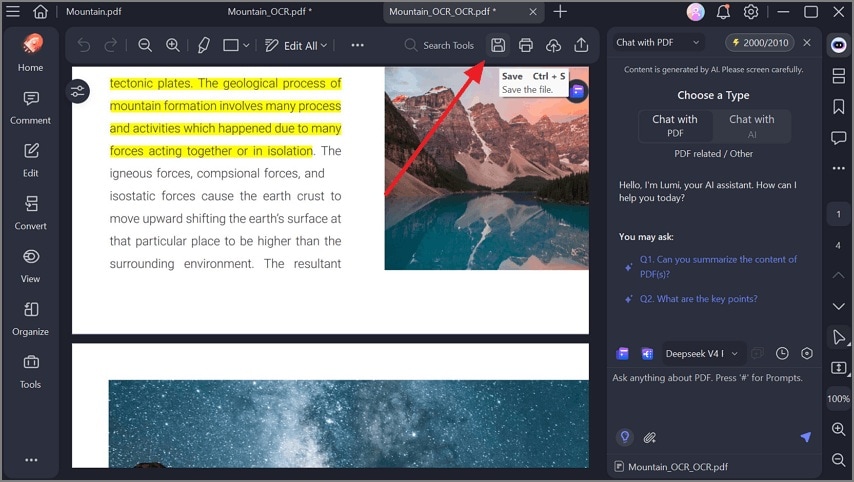
After the converted file opens in a new window, make your edits and click the Save icon to export the updated PDF.
When OCR Is Necessary
A report from Business Research Insights highlights the continuing demand for OCR in scanned PDF workflows. These are common situations where OCR should come before editing.
| Scenario | Why OCR Is Required |
|---|---|
| Scanned Contracts | Text and images are locked as a flat layer |
| Printed Forms | No selectable fields without conversion |
| Image-only Reports | Entire content treated as a single image |
| Photos Converted to PDF | No editable structure exists initially |
| Archived Paper Documents | Requires digitization for editing and reuse |
Main Limitations
OCR accuracy depends heavily on scan clarity and resolution.
Choosing the wrong language can reduce recognition quality and create formatting issues.
Complex layouts that include tables or layered graphics may still need manual cleanup after conversion.
Is It Possible to Edit a PDF Image Online Safely?
Yes, online tools can help with quick changes when you do not want to install software. They are most suitable for lightweight edits on small, non-sensitive files, but they generally lack deeper OCR support and stronger privacy controls.
Step 1
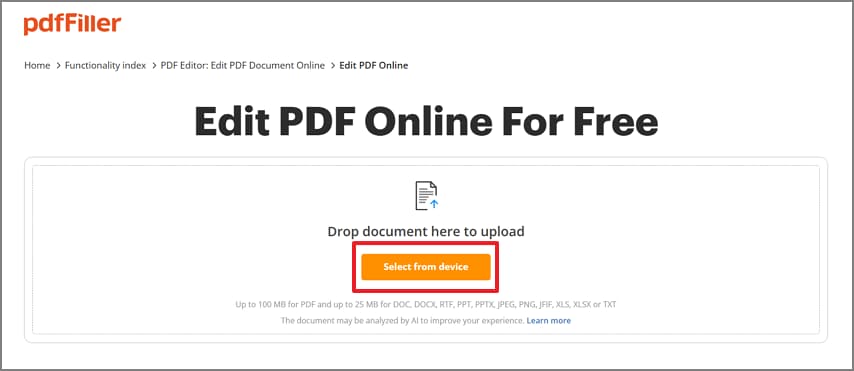
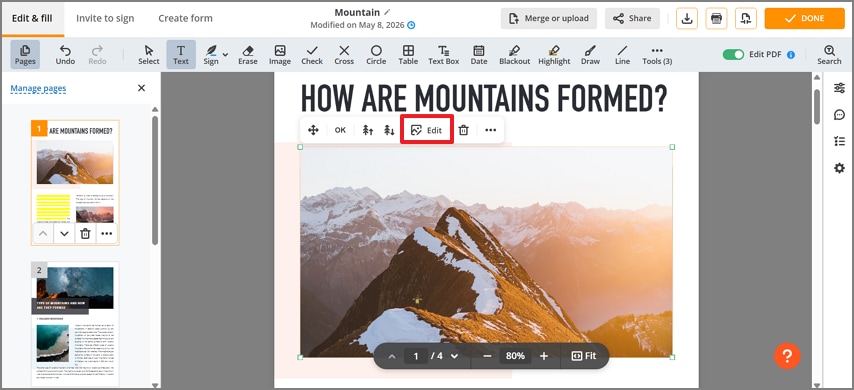
Open an online PDF tool such as pdfFiller and use Select From Device to upload the file.
Step 2
Select the image and choose the Edit option to access basic picture controls.
Step 3
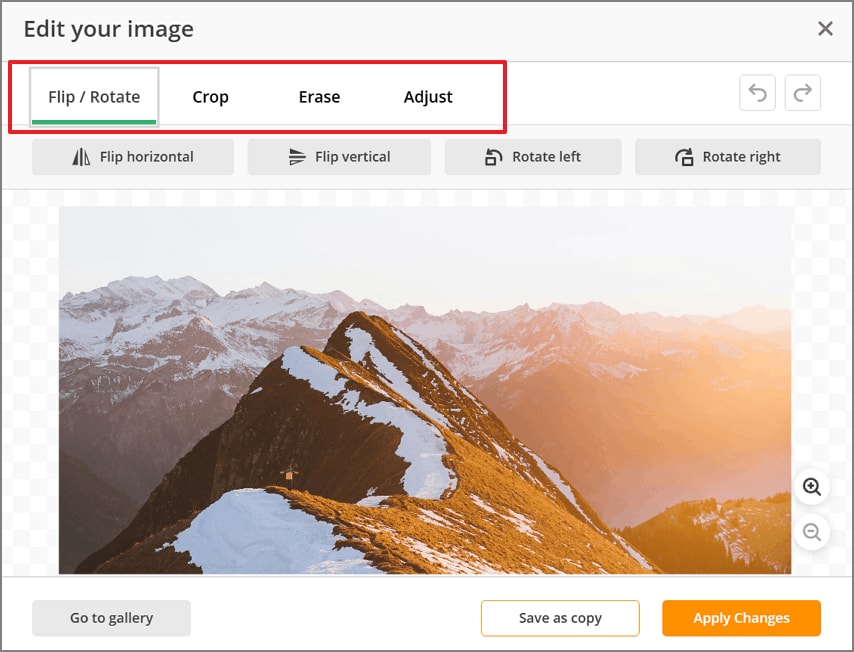
Apply simple actions such as Flip/Rotate or Crop depending on what the editor supports.
Step 4
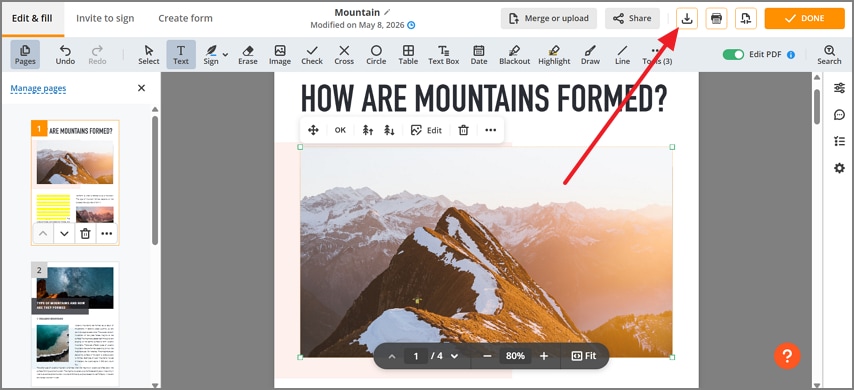
Preview the result and click Download to export the edited file.
Best Use Cases
| Use Case | Why It Works Well |
|---|---|
| Quick one-time edits | No installation needed, fast and convenient |
| Small file handling | Faster upload and processing in browser environments |
| Minor image adjustments | Suitable for adding, moving, or deleting simple images |
| Remote access tasks | Accessible from any device with an internet connection |
| Non-sensitive documents | Lower risk when files do not contain private data |
Main Limitations
Online editors usually provide fewer controls for precise image replacement or layout-sensitive adjustments.
Uploading confidential files to a browser service can create privacy and compliance concerns.
Many web tools do not offer robust OCR, which makes scanned PDF editing much harder.
PDFelement vs. Online Tools vs. Photoshop: Which Should You Choose?
Each option solves a different problem. If your main goal is complete PDF editing with image control and OCR, a dedicated PDF editor will usually be more practical than an online editor or an image-only design tool.
| Feature | PDFelement | Online PDF Editors | Photoshop |
|---|---|---|---|
| Best for | Complete PDF editing and OCR workflows | Quick, simple edits | Advanced image manipulation |
| Ease of use | User-friendly interface | Very easy, browser-based | Requires design experience |
| Image editing control | High control within PDFs | Limited controls | Very high (image-focused only) |
| OCR capability | Built-in and accurate | Limited or unavailable | Not available |
| Workflow efficiency | Smooth all-in-one editing | Fast but basic | Complex for PDF workflows |
| Installation requirement | Desktop software required | No installation needed | Desktop software required |
| Main limitation | Requires installation | Privacy risks and limited features | Not ideal for full PDF editing |
Simple Verdict
PDFelement: Best for users who need dependable PDF image editing, OCR, and stronger document control in one workflow.
Online Tools: Best for very basic, non-sensitive edits when convenience matters more than precision.
Photoshop: Best only when the job requires detailed pixel-level image work rather than full PDF document editing.
G2 Rating: 4.5/5 |100% Secure
What Are the Common Tasks You Can Do with a PDF Image Editor?
A capable PDF image editor supports much more than simply moving a picture. These are the most common operations users perform when improving image-heavy PDF documents.
Replace a PDF Picture: Swap outdated graphics for new ones without rebuilding the whole page.
Crop an Image: Cut off extra edges and keep the focus on the relevant details.
Resize a PDF Image: Adjust image dimensions so they fit the page more naturally.
Rotate or Flip: Change orientation to better match the surrounding layout.
Move to Position: Drag visual elements to a cleaner or more logical location.
Delete an Image: Remove unnecessary graphics to simplify the page.
Edit Text with OCR: Use recognition tools to modify scanned or image-based PDFs that start out as static pages.
How Do You Fix Common Problems When Editing Images in PDF Files?
Common editing failures usually come from either using the wrong tool for the file type or skipping OCR when the document is scanned. The troubleshooting table below covers the most frequent problems and practical fixes.
| Problem | Cause | Solution |
|---|---|---|
| Image cannot be selected | The PDF is image-based or flattened | Use OCR to convert it into editable content |
| PDF is a scanned file | The entire page is treated as a single image | Run OCR before attempting any edits |
| The edited image looks blurry | Low resolution or compression applied | Replace with a higher-quality image or adjust export settings |
| Cannot replace the image properly | Limited editor functionality | Use a full-featured PDF editor like PDFelement |
| Online editor lacks features | Browser tools have restricted capabilities | Switch to desktop software for advanced editing control |
Frequently Asked Questions
Can I edit a picture inside a PDF?
Yes. If the image exists as a selectable object in the PDF, a compatible editor can let you move, crop, replace, rotate, or resize it directly.
What is the best PDF image editor?
The best option depends on the workflow, but a tool that combines direct image editing with OCR support is usually the most flexible for both standard and scanned PDFs.
How do I edit an image-based PDF?
Run OCR first so the flattened scan becomes editable. After that, you can revise text and images with a full-featured PDF editor.
Can I edit PDF image online?
Yes, but mostly for simple edits. Online tools are useful for quick browser-based work, though they are weaker for privacy-sensitive files and complex OCR tasks.
Can I replace an existing image in a PDF?
Yes. If the editor recognizes the image as a separate object, you can select it and swap it for a new file without rebuilding the page from scratch.
Why can’t I edit the image in my PDF?
The PDF may be a flattened scan, or your current tool may not support object-level image editing. In many cases, OCR or a stronger editor is required.
Do I need OCR to edit PDF pictures?
Only for scanned or image-based PDFs. If the PDF is already digital and the images are separate objects, OCR is usually unnecessary.
G2 Rating: 4.5/5 |100% Secure