

Table of Contents
Saving one page from a Word document sounds like it should be simple. You can save a whole document as DOCX or PDF, and you can print selected pages, but Microsoft Word does not include a direct command that says “save every page as a separate file.” That gap is why many people end up searching for how to save separate pages in Word after trying Save As, Export, and Print without finding the exact option they need.
The most reliable workflow depends on what you want at the end. If you need separate Word files, you can copy pages manually or use a Word add-in. If you need separate PDFs, the cleaner approach is usually to convert the Word document to one PDF first, then split that PDF into individual pages. This preserves layout better and avoids the repeated copy-paste work that can easily break headers, footers, tables, and page numbering.
Below are the practical ways to separate Word pages, including built-in workarounds, PDF tools, online options, and a recommended PDFelement workflow for users who need individual PDF files.


 G2 Rating: 4.5/5 |
 100% Secure
Why Word Makes Separate Page Export Tricky
Word is not a fixed-page layout program in the same way a PDF editor is. A “page” in Word is partly dynamic. It can change when you switch printers, adjust margins, update fonts, edit a paragraph, or open the document on another computer. That is one reason Word gives you tools for sections, page breaks, and printing ranges, but not a simple built-in feature to save page 1, page 2, and page 3 as separate files automatically.
PDF works differently. Once a Word document is converted to PDF, the pages become fixed. Page 1 stays page 1, and its contents do not reflow when someone opens it on another device. That is why the answer to how do I split a Word document into multiple PDFs usually starts with converting the Word file to PDF.
There are three common scenarios:
You want one page from a Word document as a separate Word file.
You want every Word page saved as a separate PDF.
You want page ranges, such as pages 1–3, 4–6, and 7–10, saved as separate PDFs.
For the first case, Word workarounds may be enough. For the second and third, a PDF splitter is usually faster and more accurate.
Best Method: Convert Word to PDF, Then Split It by Page
If your goal is to save each Word page as a separate PDF, first convert Word to PDF online, then split the converted PDF into individual pages. Then use a PDF tool to split the file into one-page PDFs. This method is cleaner than copying text into new Word documents and exporting them one by one.
Before you convert, quickly review the Word document. Make sure page breaks are where you expect them to be, update the table of contents if the document has one, and check headers and footers. If page numbers, watermarks, or letterheads matter, this review saves rework later.
Microsoft’s own support documentation explains the standard ways to save or convert a document to PDF. Once you have a PDF, you can split it with a desktop PDF editor, Adobe Acrobat, or an online PDF splitter.
Method 1: Split a Word Document Into Multiple PDFs With PDFelement
PDFelement is a practical choice when you need more than a one-time split. It can convert a Word file to PDF, organize pages, split PDFs, rename and save output files, compress the final files, and continue working on them with editing, annotation, OCR, or e-signature tools.
That matters in real workflows. For example, if you are separating a 40-page Word proposal into one-page PDFs for different reviewers, you may also need to add comments, redact sensitive information, compress large files before emailing them, or combine selected pages again later. A basic split tool only handles one step; PDFelement is useful because it keeps the rest of the PDF cleanup in the same workspace.
Here is the general workflow.
G2 Rating: 4.5/5 |100% Secure
Step 1: Open the Word document in PDFelement
Install and open PDFelement on your Windows or Mac computer. Choose the option to create or open a PDF from a file, then import your Word document. PDFelement will convert the Word file into a PDF so the pages become fixed and ready to split.
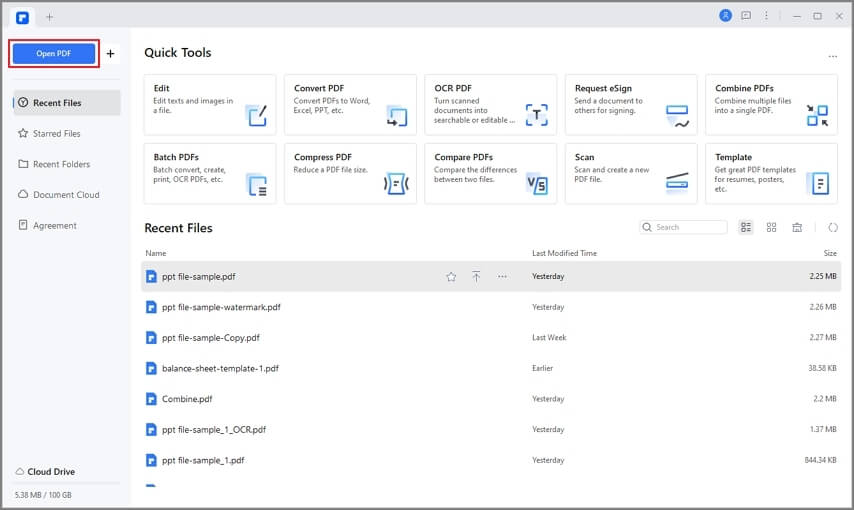
After conversion, scan through the PDF quickly. Check that the page count matches the Word document and that no images, tables, or page breaks have shifted unexpectedly.
Step 2: Open the page organization tools
With the PDF open, go to the page management or organize pages area. Choose the Split option. This is where you tell the software how to divide the PDF.
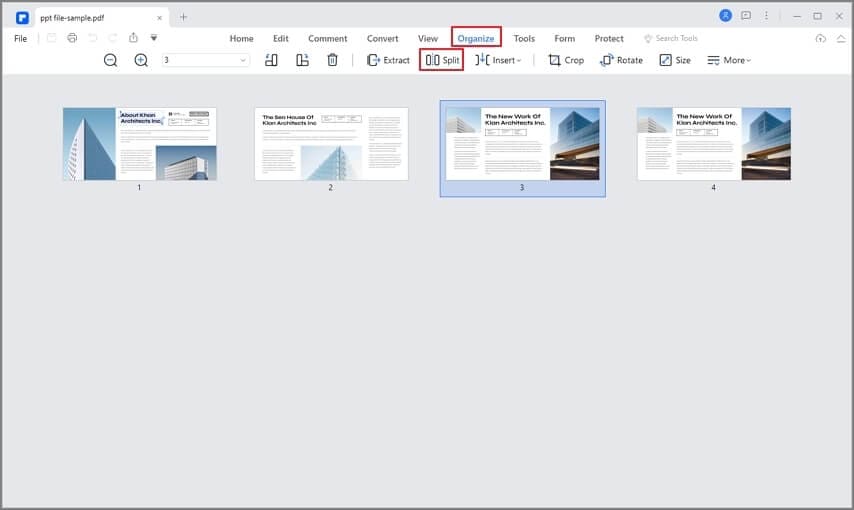
Step 3: Split by number of pages
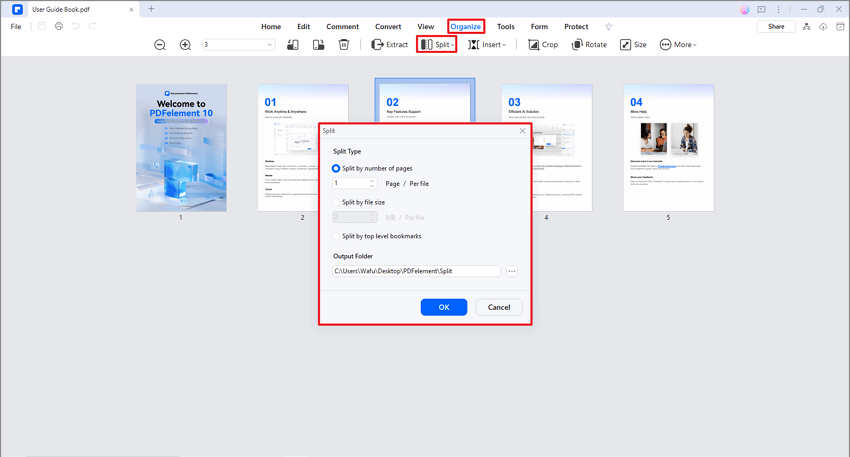
To save each Word page as its own PDF, choose the option to split by number of pages and enter 1 page per file. If you want groups of pages instead, enter the number you need, such as 2, 3, or 5 pages per PDF.
Step 4: Choose an output folder and save
Select the folder where the split PDFs should be saved. If the tool provides file-naming options, use a clear prefix such as Invoice_, Chapter_, or Application_Page_. Then run the split. You should end up with separate PDF files, each containing one page from the original Word document.
This is the most direct workflow for users asking how to split Word document into multiple PDF files while keeping the original design intact.
G2 Rating: 4.5/5 |100% Secure
Method 2: Save Each Page as a Separate PDF in Adobe Acrobat
Adobe Acrobat Pro can also split a PDF into individual pages. As with PDFelement, you first need to convert the Word document to PDF. You can do this from Word by selecting File > Save As or File > Export, then choosing PDF.
Once you have the PDF, follow these steps in Acrobat Pro.
Step 1: Open Organize Pages
Open the PDF in Adobe Acrobat Pro. Go to Tools, choose Organize Pages, and open the page organization workspace.
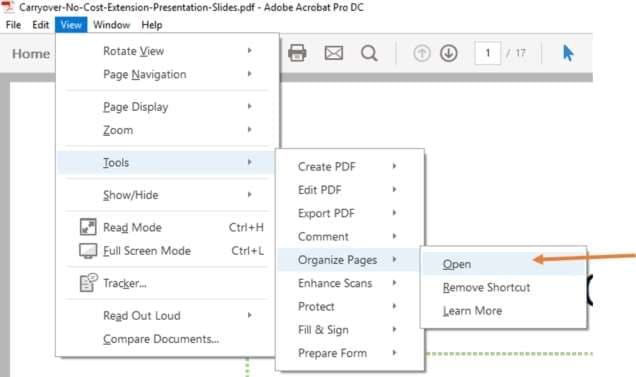
Step 2: Choose Split
In the Organize Pages toolbar, select Split.
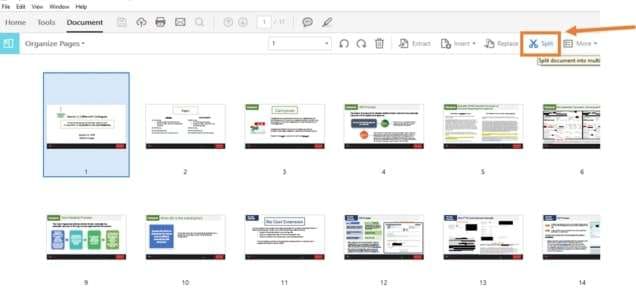
Step 3: Split by one page
In the split settings, choose to split by number of pages. Enter 1 so Acrobat creates a separate PDF for every page.

Step 4: Set output options
Open the output settings and choose the destination folder. You can also adjust file labeling so the exported files are easier to identify later.
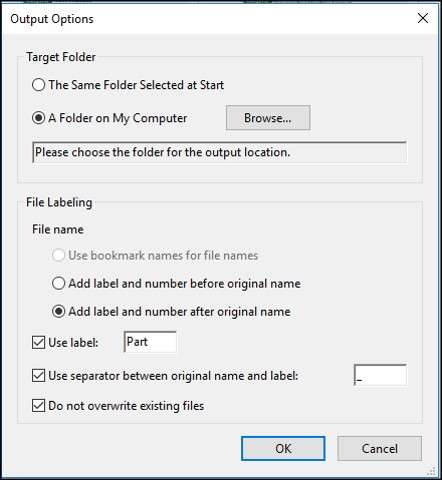
Step 5: Run the split
Click Split to create the separate PDF files. When the process finishes, open the destination folder and confirm that each page has been exported correctly.
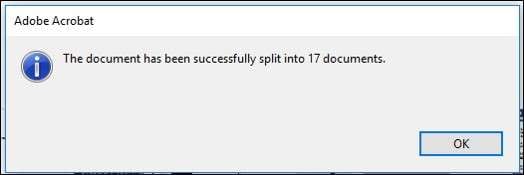
Acrobat is a strong option if your organization already subscribes to it. If not, PDFelement may be a more approachable choice for users who need PDF conversion, splitting, editing, and compression in one application.
How to Save Separate Pages in Word Without Converting First
If you need separate DOCX files rather than PDFs, you can stay inside Microsoft Word. Just be aware that Word’s page-based editing can be fragile. A page may not remain identical after it is copied into a new document, especially if the original uses complex formatting.
Copy One Page Into a New Word Document
For a short document, the manual method is often enough.
Open the Word document and go to the page you want to save separately. Select the content on that page, copy it, create a new blank document, and paste the content. Then save the new file with a clear name.
This works best for plain text pages. It can be less reliable with:
- headers and footers that depend on sections;
- footnotes or endnotes;
- tables that continue from a previous page;
- images anchored to paragraphs on nearby pages;
- automatic numbering that depends on earlier content.
If the pasted page looks wrong, try using Keep Source Formatting when pasting. You may also need to copy the relevant header or footer separately.
Use Page Breaks and Section Breaks Before Separating Content
If the document has chapters, forms, letters, or reports that need to be separated, structure it before you split it. Word’s page breaks and section breaks help define where one part ends and another begins.
A page break pushes the next content to a new page. A section break can also create a new page, but it carries more formatting control. For example, each section can have different headers, footers, page numbers, margins, or page orientation.
Microsoft provides a useful explanation of section breaks in Word. If you are preparing a long document for later splitting, section breaks are often cleaner than repeatedly pressing Enter to force content onto the next page.
Use section breaks when each separated file needs its own header, footer, or numbering style. Use regular page breaks when you only need to control where the next page starts.
Use Kutools or a Word Add-In
Word add-ins can add splitting features that Word does not include natively. Kutools for Word, for example, includes a split document feature that can separate a Word document by page, section, heading, or other rules depending on the version.
A typical workflow is:
- Open the Word document.
- Go to the Kutools or add-in tab.
- Choose the split document feature.
- Select a rule such as every page, every section, or every heading.
- Choose an output folder and file prefix.
- Run the split.
This can be useful if you often need separate DOCX files. However, if your final target is PDF, it is usually simpler to convert the Word document to PDF first and split the PDF by page.
Online Ways to Split a Word Document Into Multiple PDFs
Online tools can be convenient for quick, non-sensitive documents. Most of them follow the same pattern: upload a file, convert or split it, then download the results. The trade-off is that you are sending your document to a third-party server, so online tools are not the best choice for contracts, HR files, financial documents, medical forms, unpublished manuscripts, or confidential client work.
iLovePDF
iLovePDF offers PDF splitting, merging, compression, and conversion tools. If your file is still in Word format, you may need to convert it to PDF first, then use the Split PDF tool.
A typical workflow is to upload the PDF, choose a split mode, select page ranges or extract all pages, and download the ZIP file containing the separated PDFs. It is useful for quick tasks, especially when you are not working on a private document.
PDF2GO
PDF2GO includes an online PDF splitter and related conversion tools. Depending on the workflow available at the time you use it, you may be able to upload a Word document or first convert it to PDF.
To create one PDF per page, choose the option that splits all pages individually. Then save and download the results. As with any web-based tool, review the output before sharing it, because conversion can occasionally affect spacing, fonts, or image placement.
Aspose
Aspose offers document processing tools that can split Word documents and other file types. It is useful when you want to separate a document by page or page range directly in the browser.
One thing to check carefully is the output format. Some document splitters export separate Word files rather than separate PDFs. If that happens, you will need an extra conversion step to turn those split Word files into PDFs.
Privacy and Formatting Notes for Online Tools
Online splitters are fine for low-risk files, but use a desktop tool for sensitive documents. Even if a service says uploaded files are deleted after a period of time, your organization may still have policies against uploading internal documents to external websites.
Formatting is the other concern. Word-to-PDF conversion depends on fonts, embedded images, page size, margins, and layout features. If the file has a strict design, convert and inspect the PDF before splitting it. One small layout shift before splitting will be repeated across the separate files.
Which Method Should You Use?
The best method depends on the format you need and how often you do this task.
If you only need to save one page from a Word document once, copying that page into a new Word file may be enough. It is not elegant, but it works for simple documents.
If you need every page as a separate PDF, convert the Word document to PDF and split it by one page. This is the most reliable answer for word save each page as separate PDF because it locks the layout before separation.
If you work with private or business-critical documents, use desktop software such as PDFelement or Adobe Acrobat rather than an online splitter. A desktop workflow gives you more control over file storage and usually handles follow-up tasks better, such as editing, compressing, protecting, signing, or combining PDFs.
If you need separate DOCX files on a regular basis, consider a Word add-in like Kutools. It is more suited to splitting Word documents into Word documents, while PDF editors are better for producing individual PDFs.
For teams, file naming may matter as much as the split itself. A folder full of document-1.pdf, document-2.pdf, and document-3.pdf is easy to create but hard to manage later. Use names that match the content, recipient, date, or page purpose whenever possible.
Tips to Avoid Formatting and File-Naming Problems
Before splitting anything, save a copy of the original Word document. Work from the copy so you can return to the source file if the layout shifts or you choose the wrong split settings.
Check the page size in Word before exporting. A document designed for Letter size may not look the same if converted using A4 settings. Also confirm that the correct fonts are installed, especially if the document was created by someone else. Missing fonts can change line breaks, which changes page endings.
If the Word document contains tracked changes or comments, decide whether they should appear in the PDF. In Word, the export result can differ depending on whether markup is shown. For a clean final PDF, accept or reject changes, hide comments, or set the document to show the final version before export.
For long documents, split a short test version first. Export the first few pages to PDF, split them, and inspect the results. This is faster than processing a 200-page document and discovering later that the footer, watermark, or page numbering was wrong.
File naming deserves a little planning. If the files must stay in order, use leading zeros: Report_001.pdf, Report_002.pdf, Report_003.pdf. Without leading zeros, some systems sort files in an awkward order, placing page 10 before page 2.
Finally, if you plan to email the separated PDFs, check file size. Image-heavy Word documents can create large PDFs. After splitting, a tool like PDFelement can compress the individual PDFs or the full PDF before splitting, depending on which gives you better results.
People Also Ask
-
Can Microsoft Word save each page as a separate PDF?
Not directly. Word can save or export the whole document as a PDF, and it can print selected page ranges, but it does not have a built-in command to automatically save every page as its own PDF. The usual solution is to export the Word document to PDF, then split the PDF into separate one-page files. -
How do I split a Word document into multiple PDFs?
First, convert the Word document to PDF. Then open the PDF in a tool such as PDFelement or Adobe Acrobat and use the Split feature. To create one PDF per Word page, set the split option to one page per file and choose an output folder. -
Can I save only one page from a Word document?
Yes. For a Word file, you can manually copy the page content into a new document and save it. For a PDF result, you can export the Word document as a PDF and then extract or split the page you need. If you only need one page, extraction is usually faster than splitting the entire document. -
Why did my Word pages change after I copied them into a new document?
Word pages can reflow when content is moved. Different margins, fonts, headers, footers, section settings, or printer defaults can change where text breaks across pages. To preserve the exact page appearance, convert the document to PDF before splitting. -
Is it better to split the Word file or split the PDF?
If you need separate PDFs, split the PDF. PDF pages are fixed, so the output is more predictable. If you need editable DOCX files, split the Word document, but expect to review formatting afterward. -
Can I split a Word document by headings instead of pages?
Yes, but usually with an add-in, macro, or document-processing tool. Word’s built-in Navigation Pane can help you move through headings, but it does not automatically save each heading section as a separate file. Some Word add-ins can split by Heading 1, section break, or page. -
Are online Word-to-PDF splitters safe?
They can be safe enough for non-sensitive files, but they are not ideal for confidential documents. If the file contains personal data, business contracts, legal content, financial information, or client material, use a desktop tool and keep the document local. -
What is the easiest way to save every Word page as a separate PDF?
The easiest reliable method is: export the Word document as a PDF, open it in a PDF editor such as PDFelement, choose Split, set the split interval to one page, and save the output files to a folder. This gives you one PDF for each page while preserving the Word document’s layout.