
Adobe Acrobat Standard vs Pro: Which One Should You Choose in 2026?
Compare Adobe Acrobat Standard vs Pro in 2026, including pricing, OCR, redaction, PDF comparison, e-signatures, and which plan best fits your workflow.
 100% Secure |
 Powered by AI
 Home
>
PDF Software Comparison
> Adobe Acrobat Standard vs Pro: Which One Should You Choose in 2026?
Home
>
PDF Software Comparison
> Adobe Acrobat Standard vs Pro: Which One Should You Choose in 2026?
Choosing between Adobe Acrobat Standard and Adobe Acrobat Pro in 2026 mainly comes down to the advanced PDF workflows you actually need. For U.S. individual plans, Adobe currently lists Acrobat Standard at $14.99/month and Acrobat Pro at $19.99/month when billed monthly on an annual plan. Standard covers everyday PDF editing, conversion, organization, forms, and signatures, while Pro adds higher-end workflows such as OCR for scanned documents, permanent redaction, PDF comparison, and expanded e-signature tools.
If your work is mostly editing text, converting files, organizing pages, and handling routine forms, Standard is usually enough. If you regularly process scanned PDFs, confidential documents, contracts, or document revisions, Pro is easier to justify. This guide compares the plans by real tasks rather than simply listing features, and also explains what Acrobat DC, Acrobat 2020, and Acrobat Pro 2024 mean today.


 G2 Rating: 4.5/5 |
 100% Secure
- Choose Acrobat Standard for everyday PDF work: edit text and images, convert files, organize pages, protect documents, and collect routine e-signatures.
- Choose Acrobat Pro for scanned or sensitive documents: Pro adds advanced OCR, PDF comparison, redaction, web forms, and more advanced e-signature workflows.
- The current price gap is $5/month: whether Pro is worth it depends less on the feature count and more on how often you use its Pro-only workflows.
- Acrobat DC is legacy naming: Adobe now primarily markets Acrobat Standard and Acrobat Pro, while cloud-connected services continue under the broader Acrobat ecosystem.
- Acrobat Pro 2024 is a separate desktop-only option: it uses a prepaid, non-renewing three-year term rather than the current Acrobat subscription model.
Decision answer: Acrobat Standard is the better fit for routine PDF editing, conversion, page organization, forms, and everyday signing. Acrobat Pro is worth the extra cost when OCR for scanned documents, permanent redaction, document comparison, or advanced review controls are recurring parts of your work. Adobe currently lists the U.S. individual plans at $14.99/month for Standard and $19.99/month for Pro on annual plans billed monthly, so the practical question is whether those Pro-only workflows justify the $5 monthly difference.
Adobe Acrobat Standard vs Pro: Key Differences in 2026
Both Acrobat Standard and Pro handle the core jobs most people expect from a paid PDF editor. The practical difference is that Pro is designed for workflows where the PDF itself needs deeper processing or verification. Adobe currently positions Pro as the plan that adds scanned-document OCR, PDF comparison, redaction, web forms, reusable e-sign templates, and bulk signature requests on top of the Standard toolset. Prices and plan details below were re-checked against Adobe's U.S. plan comparison in September 2026 and can vary by region or promotion.
|
Decision Factor
|
Adobe Acrobat Standard
|
Adobe Acrobat Pro
|
|---|---|---|
| Best For | Everyday PDF editing, conversion, organization, forms, and routine signing. | Scanned, sensitive, regulated, or review-heavy PDF workflows. |
| U.S. Individual Price | $14.99/month on an annual plan billed monthly. | $19.99/month on an annual plan billed monthly. |
| Edit & Convert PDFs | Yes. Edit text and images, convert files, organize pages, and password-protect PDFs. | Yes. Includes the Standard toolset plus advanced workflows. |
| OCR for Scanned PDFs | Not listed by Adobe as a core Standard differentiator for turning scans into editable, searchable PDFs. | Yes. Adobe specifically lists scanned-document OCR as a Pro capability. |
| Redact Sensitive Information | Not included in Adobe's Standard feature set. | Yes. Pro can permanently redact sensitive content from PDFs. |
| Compare Two PDFs | Not included in Adobe's Standard feature set. | Yes. Pro can compare versions and highlight document differences. |
| E-signature Workflow | Yes. Request and collect binding e-signatures and track responses. | Yes. Includes the Standard signing workflow plus more advanced e-signature options such as branded agreements and web forms; exact sending limits depend on the current Adobe plan. |
| Where You Can Work | Desktop, web, and mobile access. | Desktop, web, and mobile access with the broader Pro feature set. |
What Happened to Acrobat 2020, Acrobat DC, and Acrobat Pro 2024?
Older searches still use names such as Acrobat Standard DC vs Pro DC or Acrobat 2020 Standard vs Pro, but those labels no longer describe Adobe's current subscription lineup. "Acrobat DC" was widely used when Document Cloud branding was more prominent; Adobe now primarily presents the subscription products as Acrobat Standard and Acrobat Pro.
Acrobat 2020 belongs to Adobe's older perpetual-license generation and is no longer the current product line for a 2026 buying decision. If you already own Acrobat 2020, treat support, compatibility, and upgrade planning as a separate question from choosing between today's Acrobat Standard and Acrobat Pro subscriptions.
Adobe now offers Acrobat Pro 2024 as a separate desktop-only product with a prepaid, non-renewing three-year term. It can work offline during that term, but it does not include the same web, mobile, cloud, e-signature, or AI services found in Adobe's subscription ecosystem.
For most buyers comparing Standard and Pro today, the relevant choice is therefore the current subscription plans, not Acrobat 2020 or the old DC naming.
Is Acrobat Pro Worth the Extra $5 per Month?
A simple upgrade test is to count how often you need a Pro-only task. If you redact confidential data, compare contract versions, or OCR scans every week, Pro can remove repeated manual work. If those jobs are rare, Standard or another editor with the specific advanced feature may be more economical than paying for the higher tier year-round.
For basic PDF work, paying more for Pro may not change your day-to-day experience. If you mainly edit text and images, convert files, rearrange pages, protect documents with passwords, and collect occasional signatures, Standard already covers the essential workflow.
Pro becomes much easier to justify when at least one advanced task is part of your regular work. A legal team comparing contract revisions, an HR team redacting personal data, or an operations team turning scanned paperwork into searchable PDFs can save repeated manual work by using Pro's OCR, comparison, redaction, and expanded e-signature tools. If those tasks happen every week, the $5 monthly difference is usually more important than the total number of features on the product page.
Adobe also now sells Acrobat Studio above Pro, bundling Acrobat Pro with PDF Spaces, AI Assistant, and Adobe Express Premium. That makes Studio a different decision: Standard vs Pro is mainly about advanced PDF and e-sign workflows, while Studio is aimed at users who also want a broader AI and content-creation layer.
When an Adobe Acrobat Alternative May Make More Sense
If neither Adobe plan fits your budget or licensing preferences, Wondershare PDFelement - PDF Editor Wondershare PDFelement Wondershare PDFelement is worth comparing before you subscribe. PDFelement combines traditional PDF editing with OCR, redaction, document comparison, forms, batch processing, e-signatures, and AI-assisted document tools. It also offers annual and perpetual licensing options, which may appeal to users who do not want to stay entirely within a subscription-only workflow. For a broader cross-brand decision, see the full PDFelement vs Acrobat comparison.
G2 Rating: 4.5/5 |100% Secure- Editing and conversion: edit text and images, create PDFs, and convert PDFs to common Office, image, and text formats.
- OCR for scanned documents: use PDF OCR to make scanned pages searchable and editable before further processing.
- Redaction and privacy: manually redact sensitive content or use Smart Redact for AI-assisted detection of sensitive fields.
- Document comparison: compare two PDF versions to identify text, image, or layout changes in review-heavy workflows.
- Forms and signatures: create or fill PDF forms, add electronic or digital signatures, and support common document approval workflows.
- Batch processing: handle repetitive conversion, OCR, watermarking, extraction, and other PDF tasks across multiple files.
- AI document work in PDFelement 13: use AI Knowledge Space to ask across PDFs and related files, and use Agreement Copilot for contract risk review, revision comparison, and bilingual contract workflows. Core AI tools also support summarizing, translating, rewriting, and explaining documents; usage limits depend on the active plan or credits.
- Licensing flexibility: PDFelement currently lists annual and perpetual individual plans; current prices can vary during promotions, so verify the official store before purchasing.
Adobe® Acrobat® vs PDFelement
|
Decision Factor
|
Acrobat Standard
|
|
|---|---|---|
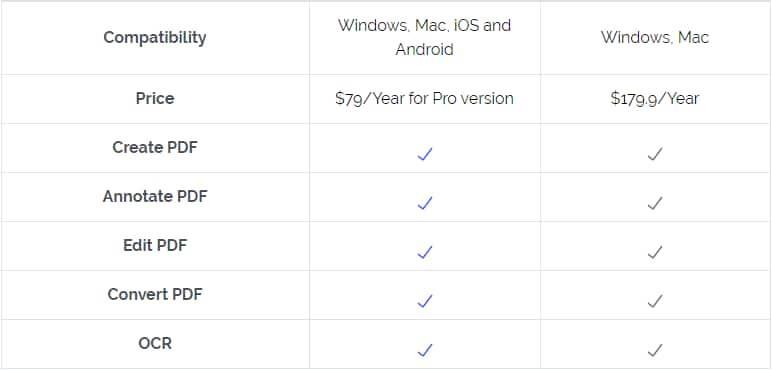
| Annual Individual Price | PDFelement currently lists a $79.99/year standard annual plan; promotions may vary. | $179.88/year at Adobe's current $14.99/month annual-billed-monthly rate. |
| Perpetual License Option | Yes. PDFelement currently lists a perpetual individual option. | No perpetual Standard subscription license; Adobe's separate Acrobat Pro 2024 uses a three-year term. |
| Edit & Convert PDFs | Yes. | Yes. |
| OCR Scanned PDFs | Yes. | Not listed as a core Standard advanced feature. |
| Redaction | Yes, including manual and AI-assisted redaction workflows. | Not included in the Standard feature set. |
| Compare PDFs | Yes. | Not included in the Standard feature set. |
| AI Document Tools | Includes PDFelement 13 AI workflows such as Knowledge Space and Agreement Copilot, plus summarizing, translating, rewriting, explaining, and document chat; plan or credit limits apply. | Adobe AI Assistant is a separate add-on or part of higher-tier AI offerings rather than the main Standard vs Pro differentiator. |
Which PDF Editor Fits Your Workflow?
The best choice is not automatically the plan with the longest feature list. Start with the tasks you perform repeatedly, then choose the least expensive option that covers those tasks without forcing workarounds.
G2 Rating: 4.5/5 |100% SecureChoose Acrobat Standard If Your PDF Work Is Mostly Routine
Acrobat Standard is a sensible choice if your day-to-day work centers on editing text and images, creating or converting PDFs, organizing pages, protecting files with passwords, and collecting occasional signatures. In that scenario, paying for Pro simply to access features you rarely use may not deliver much extra value.
Choose Acrobat Pro If Advanced Document Work Is Part of Your Job
Acrobat Pro is the stronger fit when scanned documents, confidential information, contract revisions, or higher-volume signature workflows are routine rather than occasional.
- Scanned paperwork: use OCR to turn scans into searchable, editable documents instead of retyping content manually.
- Sensitive or regulated files: permanently remove confidential information with a dedicated redaction workflow rather than covering text visually.
- Contracts and revisions: compare two PDFs to identify changes more reliably than checking pages side by side.
For legal, finance, HR, compliance, and document-review teams, these workflows are often the real reason to pay for Pro—not simply because it has more features.
Consider PDFelement If You Want Advanced PDF Tools with More Licensing Flexibility
PDFelement is most relevant when you need capabilities closer to an advanced PDF editor—such as OCR, redaction, comparison, forms, batch processing, and AI-assisted document work—but also want to compare annual and perpetual licensing options. In PDFelement 13, AI Knowledge Space supports questions across multiple files with source-backed answers, while Agreement Copilot supports contract risk review, revision comparison, and bilingual contract workflows. Users focused on redaction can review Smart Redact, while teams that regularly work with scanned files can start with the OCR feature.
G2 Rating: 4.5/5 |100% SecureFor a purchase decision, compare the exact workflows you need rather than assuming one product is universally better. Acrobat Standard is strong for routine PDF work, Acrobat Pro is better suited to Adobe-centric advanced workflows, and PDFelement may be attractive when licensing flexibility and a broad mix of PDF and AI features matter more.
Whichever option you choose, re-check current pricing and plan limits before purchase. Adobe and Wondershare can change prices, promotions, AI entitlements, and e-signature limits over time, so this article uses September 2026 information as a decision baseline rather than treating pricing as permanent.
Try for Free right now!
Try for Free right now!
Free Download or Buy PDFelement right now!
Free Download or Buy PDFelement right now!
Try for Free right now!
Try for Free right now!
Elise Williams
chief Editor