
Half-read books often pile up when busy schedules leave little time to finish them. Audio can help, but an audiobook only exists when a publisher releases one. A book to podcast conversion offers another option, turning a book you already own into a conversational discussion of its ideas rather than simply reading every page aloud.
This guide explains how book-to-podcast conversion differs from narration, which types of books work best, and how to create an episode using PDFelement. It also covers the legal considerations surrounding book conversion, an important issue when transforming copyrighted material into a different audio format.


 G2 Rating: 4.5/5 |
 100% Secure
In this article
Part 1. What a Book-to-Podcast Converter Does
An AI book-to-podcast converter analyzes a book file, identifies its main ideas and structure, then reshapes that material into a spoken discussion. Since the process works from an uploaded file rather than an existing audio edition, it can cover books never released as audiobooks.
Copyright still matters, especially when generated audio is shared or published. The U.S. Copyright Office’s 2025 AI and Copyright report outlines current guidance on AI-generated material and copyrightability.
How This Differs from an Audiobook
Listening instead of reading may be the common ground, but the two formats serve different purposes. An audiobook presents the original text as a narrated performance, whereas tools that convert book to podcast reshape its central ideas into a shorter, conversational discussion. The table below highlights the practical differences between them:
| Aspect | Audiobook | AI Book-to-Podcast |
| Coverage | Every word of the original text | Main arguments with supporting detail |
| Length | Commonly eight to twenty hours | Usually minutes per chapter |
| Production | Recorded by a narrator or the author | Generated from the file you provide |
| Availability | Only titles a publisher has released | Any book you already hold digitally |
| Purpose | Experiencing the work as written | Extracting what the book argues |

Note: Neither format makes the other unnecessary; each fits a different listening goal.
Part 2. Why People Convert Books to Podcasts
The appeal of book to podcast conversion is largely practical: listening can fit into parts of the day when sitting down with a book cannot. The Audio Publishers Association’s 2026 survey found multitasking and on-the-go access remain key reasons people choose audio.
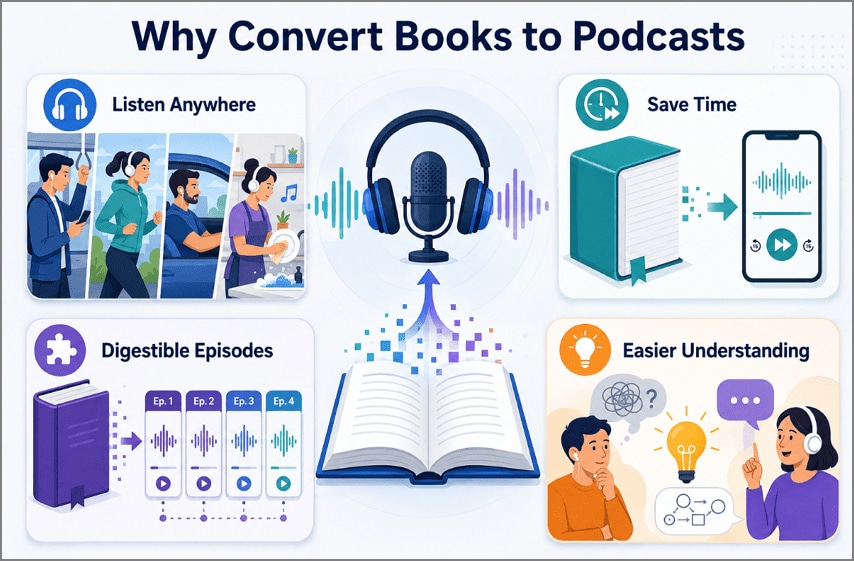
- Listening Anywhere: Commutes, exercise, walks, and household tasks create opportunities to absorb a book’s ideas without setting aside dedicated reading time.
- Saving Time: A 400-page book condensed into a focused discussion can communicate its central arguments in a fraction of the time required to read the complete text.
- Digestible Episodes: Dividing a long book into chapter-sized episodes makes the material easier to approach, pause, and revisit without losing your place.
- Easier Comprehension: A conversational format can break difficult concepts into questions, explanations, and examples, making dense material easier to follow.
Part 3. The Book Types That Convert Best
Some books adapt to podcast discussions much better than others because their value comes from different elements. Before you convert book to podcast, consider whether its value lies mainly in information or writing style.
| Book Type | Suitability | What to Expect |
| Nonfiction | Strong | Argument-led writing compresses cleanly into discussion |
| Textbooks and Study Material | Good, with limits | Definitions and examples carry over, while formulas and diagrams do not |
| Novels and Fiction | Weak | Plot survives, though the prose that makes it worth reading disappears |
The final category needs extra attention because fiction depends heavily on language, pacing, and narrative voice. A podcast can explain important events, character decisions, central conflicts, and themes without reproducing the complete story. However, it cannot fully preserve the author’s sentence-level style or the original rhythm of the narrative. The result therefore feels closer to a book-club discussion than experiencing the complete novel firsthand.
Part 4. Converting a Book with Wondershare PDFelement
Most audio tools simply read uploaded text aloud, which can make a full book difficult to follow. An AI book to podcast feature takes a different approach by turning key ideas into a conversation. Instead of reciting every page, it identifies important points and presents them through a podcast-style exchange. PDFelement brings this approach directly into its AI-powered PDF workspace.
With PDFelement, users can generate a podcast from uploaded source material and review it within Space. This makes it easier to revisit the original pages whenever an explanation needs more context. Podcast settings also let you adjust the output before generation, helping longer books remain manageable. The following steps show how to turn a book file into podcast-style audio using PDFelement:
Step 1. Create a New Space
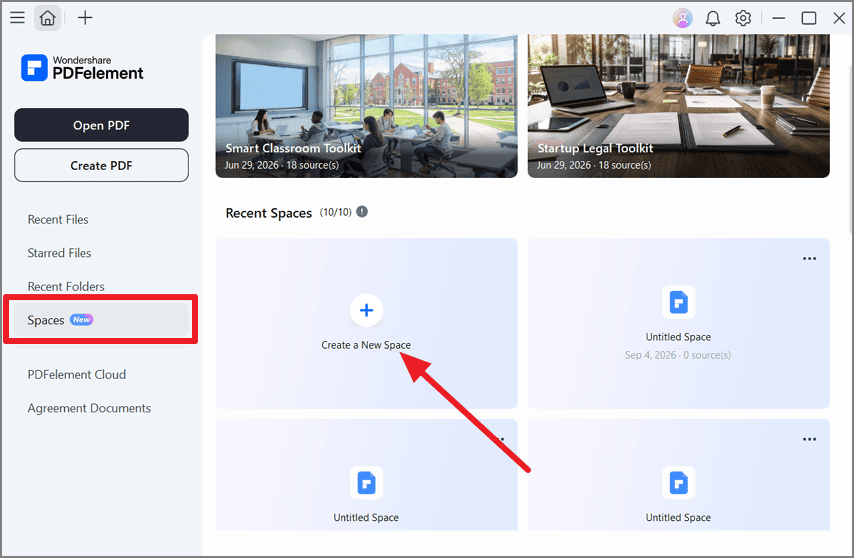
Open PDFelement and select "Spaces" from the left sidebar. Click "Create a New Space" to start a workspace for your book.
Step 2. Upload Your Book
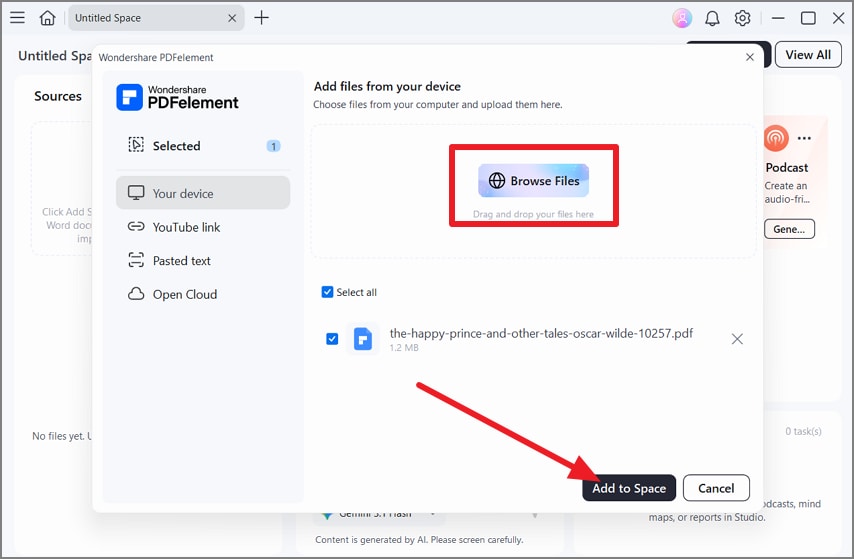
In the new Space, click "Add Sources" or "Browse Files." Select the PDF version of your book from your computer, then press "Add to Space" to upload it.
Step 3. Customize and Generate the Podcast
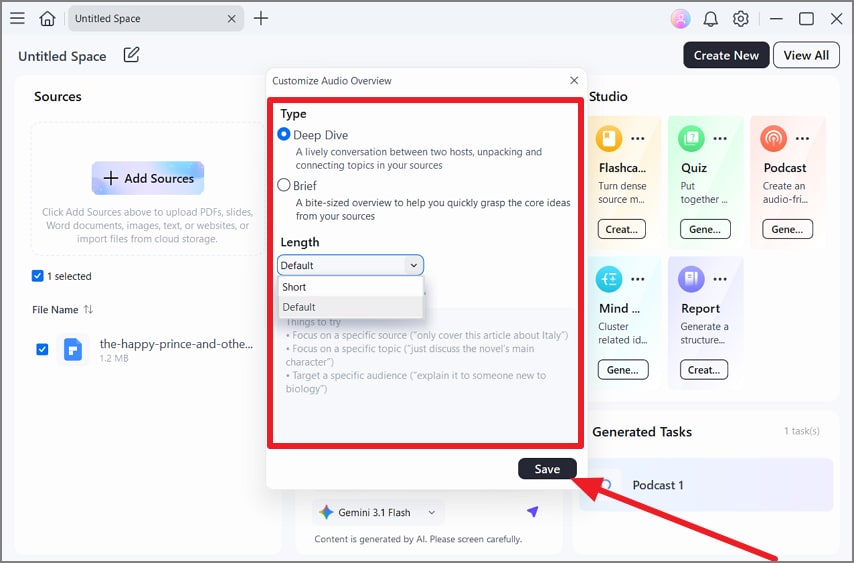
From the "Studio" section, choose "Podcast," and press "Generate." Customize the podcast by selecting a format such as "Deep Dive" or "Brief," choose the preferred duration, review the available settings in Spaces, and click "Save" to generate the audio podcast.
Step 4. Listen to or Download the Podcast
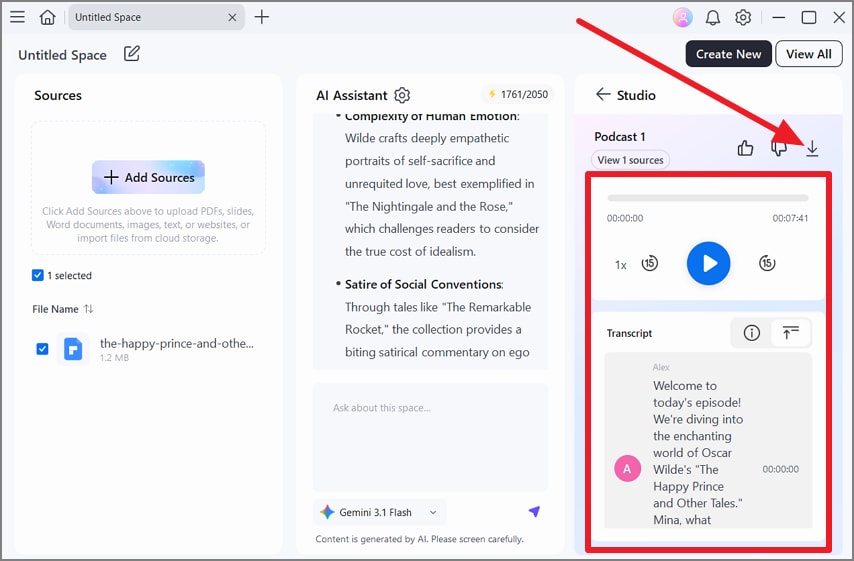
Once the podcast is generated, open it from "Generated Tasks." Use the built-in player to listen, follow along with the transcript, adjust playback controls, or choose the "Download" icon to save the finished audio.
Why PDFelement Suits Book Conversion
A useful book to podcast conversion depends on more than turning written pages into spoken audio. These 5 PDFelement features help keep longer book discussions focused, clear, and easier to follow:
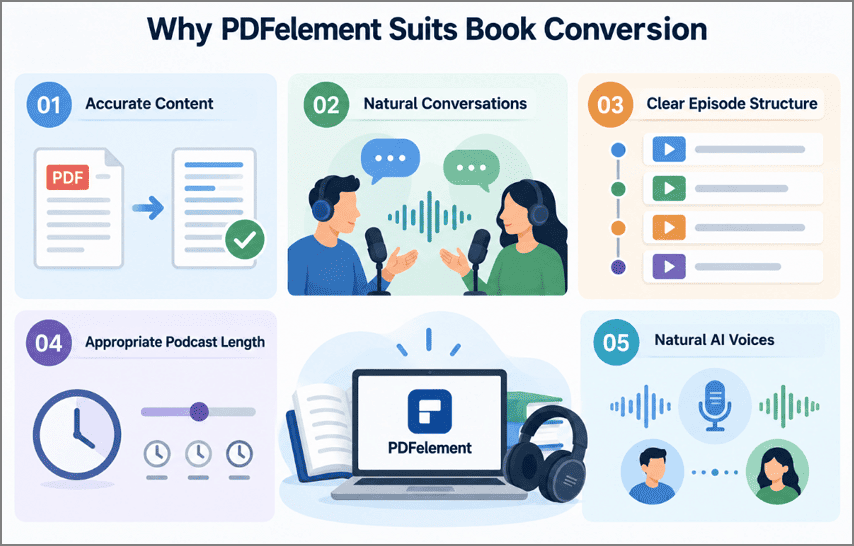
- Source-Based Content: Generated podcast discussions are created from the uploaded source material, helping keep the conversation focused on the book.
- Natural Conversations: Podcast generation presents book content in a spoken discussion format instead of simply reading the source sentence by sentence.
- Clear Episode Structure: Script and section navigation makes it easier to move through different parts of the generated podcast.
- Appropriate Podcast Length: Length controls help keep the generated discussion suitable for the source material and intended listening time.
- Flexible Playback: Users can adjust playback speed, navigate the timeline, move through script sections, and download the finished podcast as an MP3.
G2 Rating: 4.5/5 |100% Secure
Frequently Asked Questions
Can I convert any book to a podcast?
Books available as readable, supported digital files can be converted, while scanned books require OCR first. Results also depend on the book type, source quality, and how clearly its content can be interpreted.
Is AI book to podcast conversion legal?
Copyright rules depend on the book, intended use, and applicable jurisdiction. Personal conversion and public distribution raise different legal considerations, while sharing copyrighted material may require permission. Public-domain works generally provide considerably more freedom for reuse.
What is the best format for conversion?
A text-based PDF is generally the safest choice because its content is already machine-readable. Scanned PDFs can also work after OCR, although recognition errors may affect the generated discussion.
Can I convert scanned books to podcasts?
Yes, once OCR converts the scanned page images into machine-readable text. Clear scans usually produce better results, while faint text, unusual layouts, or handwriting can introduce recognition errors.
Final Takeaway
An AI book-to-podcast conversion works best when you want key ideas without reading every page. Nonfiction and study materials generally suit conversational summaries better, while novels can lose important style and atmosphere. Copyright permissions also deserve attention before sharing generated audio publicly. For a convenient workflow that combines source documents, podcast generation, and review, PDFelement offers a practical option.
G2 Rating: 4.5/5 |100% Secure