
Table of Contents
- What to Know Before Converting PDF to EPUB in Calibre
- How to Convert PDF to EPUB with Calibre
- Best Calibre Settings for PDF to EPUB Conversion
- Why PDF to EPUB Conversion in Calibre Can Look Messy
- How to Prepare a PDF Before Converting It to EPUB
- Where PDFelement Fits in the PDF to EPUB Workflow
- Calibre vs. PDFelement: Which Tool Should You Use?
- Troubleshooting: Common Calibre PDF to EPUB Problems
- Tips for Better EPUB Files After Conversion
- FAQ
- Conclusion
Converting a PDF into EPUB can make a document much easier to read on an eReader, tablet, or phone. EPUB files are reflowable, which means the text can adapt to different screen sizes, fonts, and reading apps. If you are searching for pdf to epub calibre, Calibre is one of the most popular free tools to try because it can manage eBooks, edit metadata, and convert between many eBook formats.
However, PDF to EPUB conversion is not always perfect. PDFs are designed to preserve page layout, while EPUB is designed for flexible reading. That difference is why a converted EPUB may have broken lines, missing images, strange spacing, or poor chapter structure. This guide explains how to convert PDF to EPUB with Calibre, which settings matter, when Calibre works well, and how to prepare your PDF for a cleaner result.


 G2 Rating: 4.5/5 |
 100% Secure
What to Know Before Converting PDF to EPUB in Calibre
Calibre is a free, open-source eBook management program available for Windows, macOS, and Linux. According to the official Calibre website, it supports eBook library management, format conversion, metadata editing, and eReader transfer.
As a PDF to EPUB converter, Calibre is useful when you have a text-based PDF and want a quick way to create an EPUB file. It is especially helpful for:
- Simple PDF documents with mostly selectable text
- eBooks exported from word processors
- Manuals with basic formatting
- Documents with clear headings and minimal complex layout
- PDFs you want to organize in an eBook library
Calibre is less reliable for:
- Scanned PDFs without OCR
- Academic papers with columns, footnotes, and equations
- Magazines or brochures with complex layouts
- PDFs with heavy tables, charts, or image-based text
- Documents where exact visual layout must be preserved
The key point is this: Calibre can convert PDF to EPUB, but the quality depends heavily on the PDF source file. If the PDF is clean, text-based, and logically structured, the EPUB result is usually better. If the PDF is scanned, image-heavy, or visually complex, you may need to prepare it first.
How to Convert PDF to EPUB with Calibre
The basic Calibre PDF to EPUB workflow is straightforward: add the PDF, choose EPUB as the output format, adjust settings if needed, and run the conversion.
Step 1Install and Open Calibre
Download Calibre from the official Calibre download page. Choose the version for your operating system and complete the installation.
Once installed, open Calibre. The main interface shows your library, toolbar, book list, and format information.
Step 2Add Your PDF File
Click Add books in the top toolbar. Select the PDF file you want to convert and import it into your Calibre library.
You can also drag and drop the PDF directly into the Calibre window.
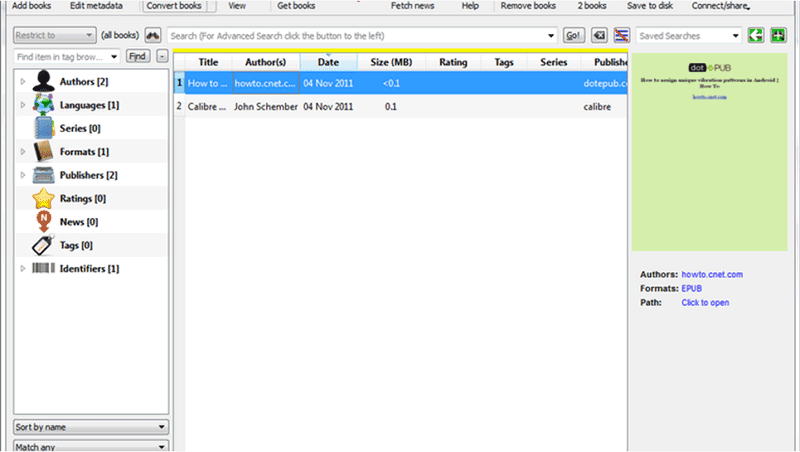
After the PDF is added, select it in your library. Calibre will display available metadata such as title, author, file format, and cover if available.
Step 3Edit Metadata Before Conversion
Before converting PDF to EPUB in Calibre, it is a good idea to clean up the metadata. This helps your eReader or reading app display the book correctly.
Select the PDF and click Edit metadata. You can update:
- Title
- Author
- Publisher
- Tags
- Series information
- Cover image
- Comments or description
This step is optional, but it improves library organization, especially if you plan to manage many converted EPUB files.
Step 4Choose EPUB as the Output Format
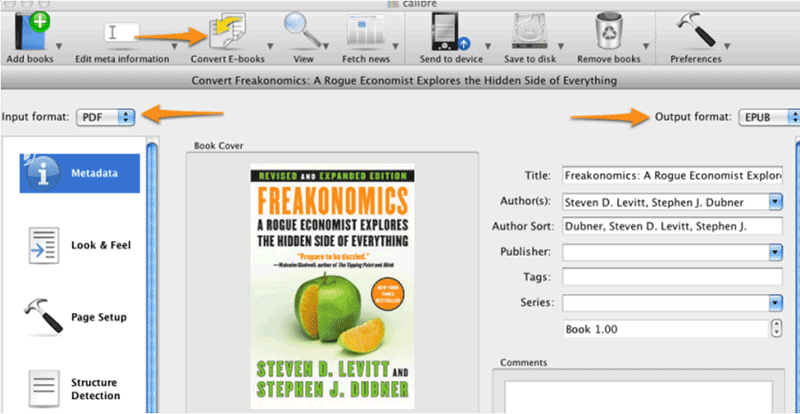
With the PDF selected, click Convert books.
In the conversion window, look at the upper-right corner and choose EPUB as the output format. The input format should show as PDF.
This is the central step where Calibre converts PDF to EPUB.
Step 5Adjust Conversion Settings
Calibre offers many conversion settings. You do not need to change all of them, but a few can affect the quality of your EPUB.
Important sections include:
- Metadata: Confirm title, author, and cover.
- Look & feel: Adjust spacing, fonts, and text formatting.
- Heuristic processing: Try to detect and fix common formatting issues.
- Page setup: Choose an output profile for your device if needed.
- Structure detection: Help Calibre identify chapters and page breaks.
- Table of Contents: Generate or adjust a TOC if headings are detected.
- PDF input: Control how Calibre interprets the source PDF.
For a simple PDF, you can start with the default settings. If the result looks messy, return to these settings and try the adjustments discussed later in this guide.
Step 6Convert and Check the EPUB
Click OK to begin conversion. Calibre will show a job indicator in the lower-right corner. When the job finishes, the book record should show both PDF and EPUB formats.
Click EPUB in the book details panel or use Calibre’s built-in viewer to open the converted file.
Check for:
- Broken paragraphs
- Missing images
- Incorrect chapter breaks
- Strange line spacing
- Headers or footers mixed into body text
- Page numbers appearing in the middle of paragraphs
- Poor table formatting
If the EPUB looks acceptable, you can use it immediately. If not, you may need to adjust conversion settings or prepare the PDF first.
Step 7Send the EPUB to Your eReader
If your eReader is connected to your computer, Calibre can transfer the EPUB file directly.
Connect your device with a USB cable. Once Calibre detects it, select the converted book and click Send to device.
You can also locate the EPUB file on your computer and manually copy it to your device or reading app.
Best Calibre Settings for PDF to EPUB Conversion
When using Calibre to convert PDF to EPUB, default settings may be enough for simple files. For more difficult PDFs, these settings are worth checking.
Enable Heuristic Processing
In the conversion window, go to Heuristic processing and enable it.
This feature tries to fix common conversion issues, such as:
- Unwanted line breaks
- Poor paragraph detection
- Repeated headers and footers
- Inconsistent spacing
It can improve some PDFs, but it may also change formatting unexpectedly. If your first result is poor, try a second conversion with heuristic processing enabled.
Adjust Line Unwrapping
PDFs often store text line by line. When converted to EPUB, this may create awkward line breaks. Calibre’s line unwrapping options can help merge broken lines into normal paragraphs.
If your EPUB has one short line after another, line unwrapping may improve readability.
Check Structure Detection
Structure detection helps Calibre identify chapters, page breaks, and headings. This can affect navigation and table of contents generation.
If your PDF has clear chapter headings, experiment with structure detection settings to improve EPUB navigation.
Generate a Table of Contents
A good EPUB should be easy to navigate. If Calibre can detect headings, it may generate a table of contents automatically.
In the Table of Contents section, you can control how Calibre creates TOC entries. If the PDF is poorly structured, Calibre may not generate a useful TOC without manual cleanup.
Choose the Right Output Profile
In Page setup, select an output profile that matches your reading device if applicable. For many EPUB files, the default output profile is fine. However, choosing a device profile can sometimes improve compatibility.
Why PDF to EPUB Conversion in Calibre Can Look Messy
Many users assume that if a tool can convert a file, the output should look identical. With PDF to EPUB, that is not always realistic.
PDF and EPUB are fundamentally different.
A PDF is page-based. It preserves a fixed layout, including margins, page numbers, columns, headers, footers, and exact object placement. You can learn more about PDF from the Adobe PDF overview.
An EPUB is flow-based. It is built with HTML and CSS so text can resize and reflow across different screens. You can learn more about the EPUB format from the W3C EPUB overview.
Because of this difference, converting PDF to EPUB in Calibre requires the software to interpret the PDF structure and rebuild it as reflowable content. This can cause problems.
Common causes of poor conversion include:
- Scanned pages: If the PDF is just images, Calibre cannot extract real text unless OCR has already been applied.
- Multiple columns: Calibre may read across columns incorrectly.
- Headers and footers: Repeated page elements may become part of the EPUB body.
- Page numbers: Page numbers may appear inside paragraphs.
- Tables: Complex tables may lose alignment.
- Footnotes: Footnotes may move to the wrong location.
- Images: Image placement may change.
- Hyphenated words: Words split at line endings may remain broken.
This does not mean Calibre is bad. It means PDF is one of the hardest formats to convert into a clean EPUB.
How to Prepare a PDF Before Converting It to EPUB
If you want better results from a Calibre PDF to EPUB conversion, prepare the PDF first. A cleaner PDF gives Calibre better source material.
Before conversion, consider these steps:
G2 Rating: 4.5/5 |100% Secure
1. Run OCR on Scanned PDFs
If the PDF contains scanned pages, Calibre may treat them as images. In that case, the EPUB may contain images instead of selectable, reflowable text.
Use OCR to recognize the text first. After OCR, check whether you can select and copy text from the PDF. If you can, Calibre has a better chance of converting it into readable EPUB text. For background on the technology, see this overview of optical character recognition.
2. Remove Unnecessary Pages
Delete blank pages, cover duplicates, ads, or irrelevant front matter before conversion. Extra pages can confuse conversion and make the final EPUB harder to navigate.
3. Crop Wide Margins
Large margins, headers, and footers may affect text extraction. Cropping unnecessary white space can sometimes help conversion tools focus on the main content.
4. Fix Page Order
Make sure pages are in the correct order before converting. If the source PDF is disorganized, the EPUB will also be disorganized.
5. Simplify the PDF When Possible
If you have access to the original document, exporting a cleaner PDF or converting from DOCX to EPUB may produce better results than converting from PDF.
PDF should often be treated as a final presentation format, not an ideal source format for eBook conversion.
Where PDFelement Fits in the PDF to EPUB Workflow
Calibre is a strong choice for eBook management and format conversion, but it is not designed as a full PDF editing and repair tool. This is where PDFelement can support the workflow before you use Calibre.
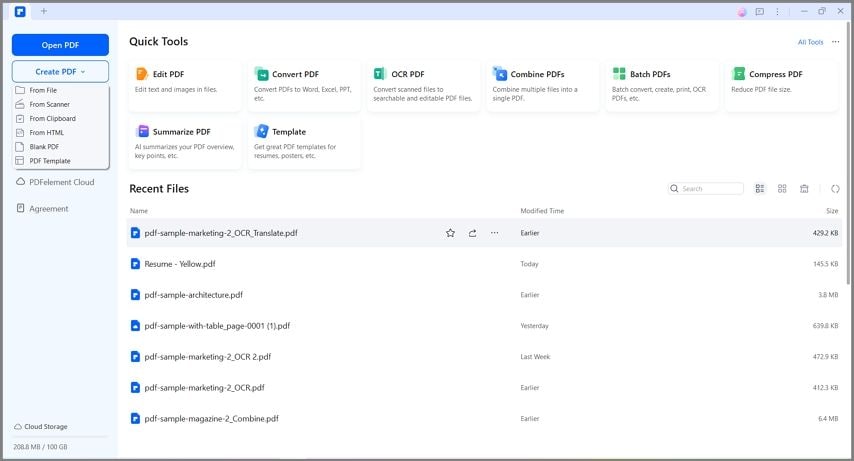
If your PDF is scanned, cluttered, too large, or poorly organized, you can use PDFelement to prepare it first. For example, you can:
- Run OCR on scanned PDFs to make text selectable.
- Edit text errors before conversion.
- Delete unnecessary pages.
- Reorder pages into the correct reading sequence.
- Crop margins or remove distracting page areas.
- Compress large PDFs before processing.
- Annotate or review the document before creating an eBook version.
- Export or convert PDFs using available format options in supported versions.
G2 Rating: 4.5/5 |100% Secure
A practical workflow looks like this:
- Open the PDF in PDFelement.
- Use OCR if the PDF is scanned.
- Remove unwanted pages and fix page order.
- Edit obvious text or layout issues.
- Save the cleaned PDF.
- Import the cleaned PDF into Calibre.
- Convert the PDF to EPUB in Calibre.
- Review the EPUB on your target device.
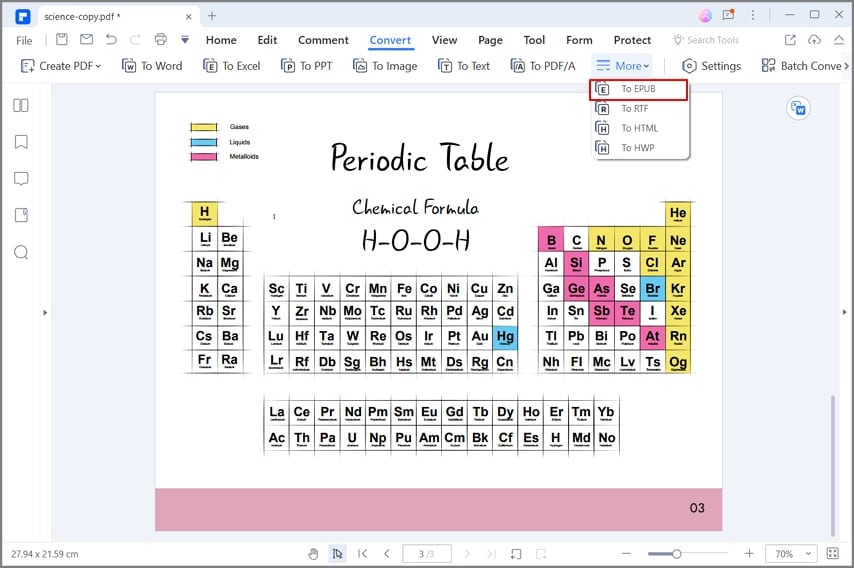
This approach is useful because many PDF-to-EPUB problems begin before the conversion step. If the source PDF is cleaner, Calibre usually has a better chance of producing a readable EPUB.
Calibre vs. PDFelement: Which Tool Should You Use?
Calibre and PDFelement serve different purposes, so the best choice depends on what you need to do.
| Need | Better Tool |
|---|---|
| Manage an eBook library | Calibre |
| Convert PDF to EPUB for free | Calibre |
| Edit PDF text before conversion | PDFelement |
| OCR scanned PDFs | PDFelement |
| Organize, delete, or reorder PDF pages | PDFelement |
| Transfer EPUB files to an eReader | Calibre |
| Fix PDF content before eBook conversion | PDFelement |
| Adjust eBook metadata | Calibre |
If your source PDF is already clean and text-based, Calibre may be all you need. If the PDF is scanned, messy, or requires editing, use PDFelement first and then convert with Calibre.
In other words, Calibre is the converter and eBook manager, while PDFelement is the PDF preparation tool that can help improve the source file before conversion.
G2 Rating: 4.5/5 |100% Secure
Troubleshooting: Common Calibre PDF to EPUB Problems
Even with the right steps, converting PDF to EPUB with Calibre can produce imperfect results. Here are common problems and possible fixes.
Problem 1: The EPUB Has Broken Lines
This happens when Calibre preserves line breaks from the PDF.
Try this:
- Enable heuristic processing.
- Adjust line unwrapping settings.
- Use a cleaner source PDF.
- If available, convert from the original DOCX instead of PDF.
Problem 2: The EPUB Contains Page Numbers in the Text
PDF page numbers may be extracted as body text.
Try this:
- Crop headers and footers before conversion.
- Use find-and-replace in an EPUB editor after conversion.
- Remove page numbers from the source document if possible.
Problem 3: The Text Is Not Selectable After Conversion
If the source PDF is scanned, the EPUB may not contain real text.
Try this:
- Run OCR on the PDF before importing it into Calibre.
- Confirm that text can be selected and copied in the PDF.
- Reconvert after OCR.
Problem 4: Images Are Missing or in the Wrong Place
PDF image placement does not always translate cleanly into EPUB.
Try this:
- Check Calibre’s PDF input settings.
- Use a simpler source file if possible.
- Consider whether EPUB is the right output format for image-heavy content.
Problem 5: Tables Look Bad
Tables are difficult to convert from fixed PDF pages into reflowable EPUB.
Try this:
- Simplify tables before conversion.
- Convert the table pages separately if needed.
- Use PDF format instead of EPUB if preserving table layout is essential.
Problem 6: The Table of Contents Is Missing
Calibre may not detect chapter headings automatically.
Try this:
- Edit metadata and structure settings.
- Use structure detection in the conversion window.
- Add or edit the table of contents after conversion with an EPUB editing tool.
Problem 7: The EPUB Looks Different on Different Devices
EPUB rendering depends on the reading app or device.
Try this:
- Test the file in multiple readers.
- Use a standard EPUB reader for preview.
- Avoid complex formatting that may not be supported everywhere.
Tips for Better EPUB Files After Conversion
To get the best results from Calibre convert PDF to EPUB workflows, keep these tips in mind.
Start With the Best Source File
If you have a DOCX, HTML, RTF, or original manuscript file, convert from that instead of PDF. These formats usually contain more meaningful structure than PDF.
Use PDF Only When Necessary
PDF is convenient for sharing, printing, and preserving layout. It is not always ideal for creating reflowable eBooks. If PDF is the only file you have, Calibre can help, but expect to review the output.
Keep Formatting Simple
Simple headings, paragraphs, and images convert more reliably than complex multi-column layouts.
Review the EPUB Before Sharing
Always open the converted EPUB before sending it to an eReader or publishing it. Check chapter breaks, paragraph flow, images, and metadata.
Consider the Reading Experience
An EPUB does not need to look exactly like the PDF. In many cases, the goal is readability: adjustable fonts, clean paragraphs, and easy navigation.
Keep the Original PDF
Do not delete your original PDF after conversion. If the EPUB has problems, you may need to return to the source file, clean it, and convert again.
People Also As
-
Is Calibre a good PDF to EPUB converter?
Calibre is a good free tool for basic PDF to EPUB conversion, especially when the PDF is text-based and has a simple layout. However, it may struggle with scanned PDFs, tables, multi-column pages, and complex formatting.
-
How do I convert PDF to EPUB in Calibre?
Open Calibre, click Add books, import your PDF, select it, click Convert books, choose EPUB as the output format, adjust settings if needed, and click OK. After conversion, review the EPUB in Calibre’s viewer or on your eReader.
-
Why does my Calibre PDF to EPUB conversion look bad?
PDF is a fixed-layout format, while EPUB is reflowable. During conversion, Calibre has to interpret the PDF’s text, images, spacing, and structure. If the PDF has columns, page numbers, headers, footers, or scanned images, the EPUB may have formatting problems.
-
Can Calibre convert scanned PDF to EPUB?
Calibre can import scanned PDFs, but if the pages are just images, it cannot create clean reflowable text unless OCR has been performed first. Use an OCR tool such as PDFelement to recognize the text, then import the searchable PDF into Calibre.
-
Is EPUB better than PDF for eReaders?
EPUB is usually better for eReaders because it supports reflowable text, adjustable font size, and flexible screen layouts. PDF is better when you need to preserve exact page design, such as forms, brochures, academic papers, or print-ready documents.
-
Can I use PDFelement instead of Calibre?
Use Calibre if your main goal is eBook conversion and library management. Use PDFelement if you need to edit, OCR, crop, organize, or clean up the PDF before conversion. A strong workflow is to prepare the PDF in PDFelement and then convert it to EPUB in Calibre.
-
How do I improve PDF to EPUB quality in Calibre?
Start with a clean, text-based PDF. Edit metadata, enable heuristic processing, adjust line unwrapping, check structure detection, and review the EPUB after conversion. If the PDF is scanned or messy, run OCR and clean it up before importing it into Calibre.
-
Can Calibre preserve the original PDF layout in EPUB?
Not exactly. EPUB is designed to reflow text across different screens, so it will not always preserve the exact page layout of the PDF. If exact layout matters, keeping the document as a PDF may be better.
Conclusion
Calibre is one of the best free tools for converting PDF to EPUB, especially if your PDF is clean, text-based, and simple. The basic process is easy: add the PDF, choose EPUB as the output format, adjust settings, convert, and review the result.
The challenge is that PDF and EPUB are built for different purposes. PDF preserves fixed pages, while EPUB is designed for flexible reading. That is why some conversions need extra cleanup.
For the best results, prepare your PDF before conversion. Use PDFelement when you need to OCR scanned pages, edit text, remove unwanted pages, crop margins, or organize the document. Then use Calibre to convert the cleaned PDF into EPUB and transfer it to your eReader. This combined workflow gives you a better chance of creating an EPUB that is not just converted, but genuinely readable.
![All the Methods to Convert a PDF to Black and White [2026]](https://images.wondershare.com/pdfelement/images2026/pdf-like-article-3.png)