
Table of Contents
- What Counts as a PDF Comment?
- Before You Remove Comments from a PDF
- Method 1: How to Remove Comments from PDF with PDFelement
- Method 2: How to Delete Comments in PDF One by One
- Method 3: Batch Remove Comments from PDF Files on Mac
- Method 4: Remove Comments from PDF with Adobe Acrobat
- Method 5: How to Remove Comments from PDF for Free
- Method 6: How to Remove Comments in PDF Online
- Remove Comments vs. Remove Markups from PDF: What’s the Difference?
- Troubleshooting: Why PDF Comments Still Appear After Deleting Them
- Best Practices Before Sharing a PDF Without Comments
- Why PDFelement Is Useful for a Clean PDF Workflow
- FAQ
- Conclusion
PDF comments are useful during review, but they can become a problem when the document is ready to send, print, publish, or archive. Sticky notes, highlights, text callouts, drawing marks, stamps, and other annotations may reveal internal feedback or make the final file look unfinished. If you need to remove comments from PDF files, the right method depends on whether you want to delete one note, delete all comments in a PDF, remove markups, or permanently flatten the visible changes.
This guide walks through the most practical ways to clean up PDF comments on Windows, Mac, online, and with free tools. You’ll also learn the difference between deleting comments and flattening them, so you can choose the safest option for your document.


 G2 Rating: 4.5/5 |
 100% Secure
What Counts as a PDF Comment?
In a PDF, “comments” often means more than just sticky notes. Depending on the PDF editor or reader, comments may also be called annotations or markups.
Common PDF comment types include:
- Sticky notes or pop-up notes
- Highlight, underline, and strikethrough annotations
- Text boxes and typewriter notes
- Drawing tools, arrows, lines, circles, and rectangles
- Stamps such as “Approved,” “Draft,” or “Confidential”
- File attachments added as annotations
- Review comments from collaborators
- Pencil marks or freehand drawings
So, when people search for how to remove comments in PDF, they may actually want to remove any of these annotation-layer elements.
It is also important to understand that comments are usually separate from the main PDF content. Deleting a comment typically removes only the annotation, not the original text or images in the PDF. However, if a PDF has been flattened, the visual appearance of some annotations may become part of the page content, making them harder to remove.
Before You Remove Comments from a PDF
Before deleting annotations, take a moment to protect your original document. Removing comments is often permanent once the file is saved.
Use this quick checklist:
- Save a copy first. Keep an original version with comments in case you need to review feedback later.
- Check whether comments contain important decisions. Comments may include approval notes, legal review feedback, or revision instructions.
- Decide whether to delete or flatten. If you delete comments, they disappear. If you flatten them, they may remain visible but become part of the page.
- Inspect the file after saving. Reopen the PDF in another viewer to confirm the comments are gone.
- Be careful with online tools. Avoid uploading sensitive contracts, financial files, HR records, or legal documents to unknown online services.
For background on the PDF format and annotation behavior, you can refer to the PDF Association’s overview of PDF technology.
Method 1: How to Remove Comments from PDF with PDFelement
If your PDF contains many review notes, highlights, or markups, deleting each one manually can take too long. A desktop PDF editor such as PDFelement is useful when you need a cleaner workflow to view all comments, select them, remove them, and save a polished copy.
PDFelement is especially practical when your PDF review process includes more than just deleting comments. After you remove markups from PDF files, you can continue with related tasks such as editing text, adding new annotations, organizing pages, compressing the PDF, converting it to Word or Excel, applying OCR to scanned pages, or preparing the document for signing.
G2 Rating: 4.5/5 |100% Secure
Step 1Open the PDF in PDFelement
Launch PDFelement and open the PDF that contains comments or annotations. You can usually open the file from the home screen or drag and drop it into the application.
Step 2Open the Comment Panel
Go to the Comment area. The comment panel lets you see the annotations in the document in one place, which is helpful when the PDF has comments spread across multiple pages.

Step 3Select All Comments
To delete all comments in PDF at once, select all items in the comments list. On Windows, you can commonly use Ctrl + A after clicking inside the comment list. On Mac, the equivalent shortcut is usually Command + A.
This is the fastest answer if you are looking for how to delete all comments in PDF without removing them one by one.
Step 4Delete the Selected Comments
After selecting the comments, press the Delete key or right-click and choose Delete. The selected annotations should be removed from the document.

Step 5Save a Clean Copy
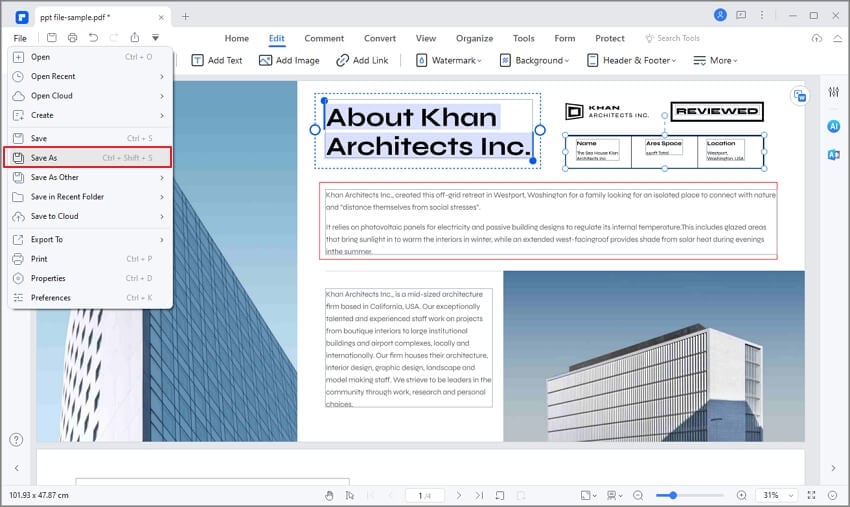
Use File > Save As to create a clean version of the PDF. Saving as a new file is safer than overwriting the original because it preserves the commented version for your records.

This workflow is a good fit when you need to remove comments before sending a final proposal, submitting a school assignment, delivering a client report, or archiving an approved document.
Method 2: How to Delete Comments in PDF One by One
Sometimes you do not need to delete every annotation. You may want to remove only one outdated note while keeping other highlights or reviewer comments.
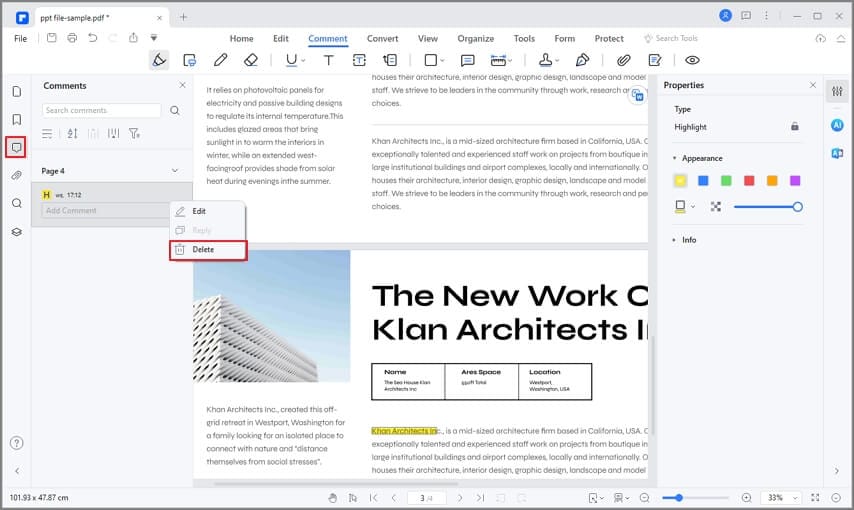
Here is how to delete a single comment in a PDF:
- Open the PDF in your PDF editor.
- Go to the page that contains the comment.
- Click the sticky note, highlight, text box, drawing mark, or other annotation.
- Press Delete, or right-click the comment and choose Delete.
- Save the PDF.
This method works best when:
- You only need to remove a few comments
- You want to keep important highlights
- You are cleaning up one reviewer’s feedback
- You need to remove accidental or duplicate annotations
After deleting the selected comments, save your document.
If the PDF is part of a formal review process, consider saving the final file with a clear name, such as Project-Proposal-Clean-Version.pdf or Contract-No-Comments.pdf.
Method 3: Batch Remove Comments from PDF Files on Mac
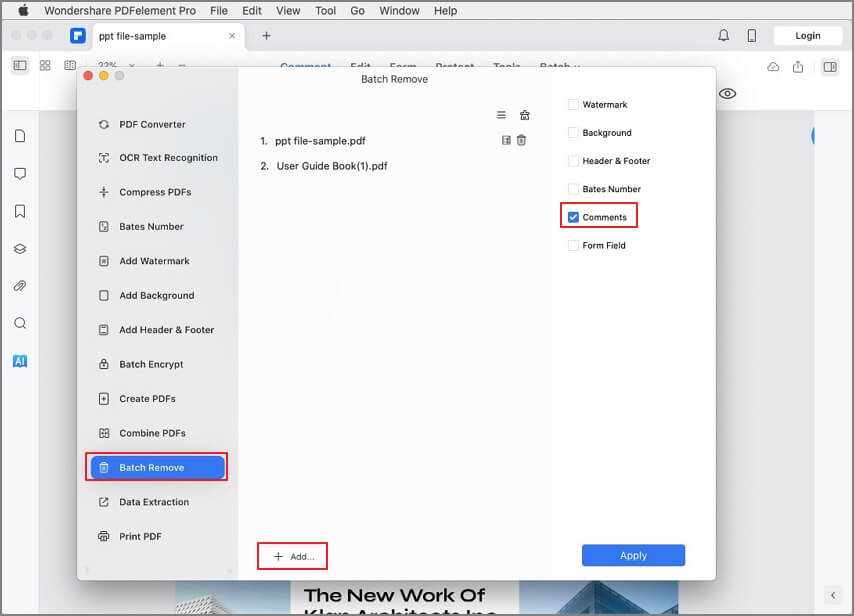
If you have multiple PDFs with review notes, deleting comments file by file is inefficient. A batch workflow lets you remove comments from several PDFs at once.
In PDFelement for Mac, the batch remove feature is useful when you need to clean up a folder of documents before sending them to a client, professor, manager, or external partner.
G2 Rating: 4.5/5 |100% Secure
Step 1Open the Batch Tool
Launch PDFelement for Mac and choose the batch processing option. In the old workflow, this appears as Batch > Batch Remove.

Step 2Add PDF Files
Drag your PDFs into the batch window or use the add-file button to import them.
Step 3Choose Comments for Removal
Select the option to remove comments or annotations. Confirm the files you want to process.
Step 4Apply the Batch Removal
Click Apply to remove comments from the selected PDFs. Save the cleaned files to a separate output folder so you can compare them with the originals if needed.
Batch removal is especially useful for:
- Legal document bundles
- Research paper collections
- Client deliverable packages
- Training materials
- Internal review drafts
- PDF forms with reviewer notes
Method 4: Remove Comments from PDF with Adobe Acrobat
Adobe Acrobat is another common option for removing PDF comments. If you already have Acrobat installed, you can use the Comment tools to delete annotations.
A typical Acrobat workflow looks like this:
- Open the PDF in Adobe Acrobat.
- Select Comment from the tools panel.
- Open the comments list.
- Select one comment, multiple comments, or all comments.
- Press Delete or choose the delete option from the context menu.
- Save the file as a new copy.
If you are using Adobe Acrobat and want official reference material, Adobe provides documentation on commenting in PDFs.
This method is reliable, but it may require a paid Acrobat plan depending on your version and the exact editing features you need.
Method 5: How to Remove Comments from PDF for Free
If you do not have a paid PDF editor, you may still have a few free options. However, free methods can be limited depending on the type of comment and whether the PDF is locked, flattened, or scanned.
Option 1: Use a Free PDF Reader That Supports Comment Deletion
Some free PDF readers allow you to delete annotations, especially if the comments were added in the same application and the file is not restricted.
General steps:
- Open the PDF in the free PDF reader.
- Find the comments or annotations panel.
- Select the comment you want to remove.
- Press Delete.
- Save a copy of the PDF.
This can work for simple notes and highlights, but not all free readers allow full annotation management.
Option 2: Print to PDF
Another workaround is to “print” the PDF to a new PDF file. This may remove interactive comment objects, depending on your print settings. On Windows, you may see options such as Microsoft Print to PDF.
General steps:
- Open the PDF.
- Choose Print.
- Select a PDF printer, such as Microsoft Print to PDF on Windows.
- Look for a setting related to printing document only, document and markups, or comments.
- Create a new PDF.
Be careful: print-to-PDF can change file structure, remove form fields, reduce accessibility tags, alter bookmarks, or flatten content. It is not the best option for professional documents that must preserve metadata, links, form fields, or accessibility.
Option 3: Use Preview on Mac for Basic Annotations
Mac Preview can handle some PDF annotations. To delete a visible annotation:
- Open the PDF in Preview.
- Show the markup toolbar if needed.
- Click the annotation.
- Press Delete.
- Save the file.
Preview is convenient for simple markups, but it may not provide the same full comment-list management as a dedicated PDF editor.
Apple provides general information about Preview features in its Preview User Guide.
Method 6: How to Remove Comments in PDF Online
Online PDF tools can be useful when you need a quick fix and the document is not confidential. The appeal is simple: upload the PDF, choose an annotation or cleanup option, process the file, and download the cleaned version.
A typical online process is:
- Open a trusted online PDF tool.
- Upload the PDF.
- Choose a feature such as remove annotations, flatten PDF, or clean PDF.
- Process the file.
- Download and inspect the new PDF.
Online tools are convenient for low-risk documents, but they are not ideal for sensitive files. Avoid using them for:
- Contracts
- Tax documents
- Medical records
- HR files
- Confidential business reports
- Unpublished research
- Client data
- Government or legal documents
If privacy matters, use an offline desktop PDF editor instead.
Remove Comments vs. Remove Markups from PDF: What’s the Difference?
The terms are often used together, but they are not always identical.
Removing Comments
When you remove comments, you delete annotation objects from the PDF. This can include sticky notes, review comments, and sometimes highlights or drawings if they are stored as annotations.
Choose this when:
- You want a clean final PDF
- You do not want comments visible or accessible
- You want to reduce clutter
- You want to remove internal review notes
Removing Markups
Markups are visual annotation elements such as highlights, underlines, drawing shapes, arrows, stamps, or text boxes. If you want to remove markups from PDF files, you may need to delete these annotation objects from the comment panel or select them directly on the page.
Choose this when:
- You want to remove highlights or drawing marks
- You need to clean a document that was reviewed heavily
- You want the original page content without reviewer markings
Flattening a PDF
Flattening is different. It merges annotations into the page content or removes their interactivity. Depending on the tool and settings, flattening may keep the visual appearance of comments while making them no longer editable.
Choose flattening when:
- You want annotations to remain visible but not editable
- You want to lock in approval stamps or filled form entries
- You are preparing a PDF for printing
Do not choose flattening if your goal is to make comments disappear. If the markups are flattened into the page, they may become much harder to remove.
Troubleshooting: Why PDF Comments Still Appear After Deleting Them
If you followed the steps but comments still appear, one of these issues may be the cause.
1. You Deleted Only One Type of Annotation
A PDF can contain multiple types of comments. For example, you may delete sticky notes but leave highlights, stamps, or drawing marks. Check the full comment list and page view.
2. The Comments Were Flattened
If the comments were flattened before you received the PDF, they may no longer be true comments. They may now be part of the page content. In that case, you may need editing, redaction, or content removal tools instead of comment deletion.
3. You Did Not Save the File
After deleting comments, save the file. Better yet, use Save As to create a new clean version.
4. You Are Viewing a Cached or Old Version
Make sure you are opening the newly saved file, not the original. If the PDF is stored in cloud storage, give it time to sync.
5. The PDF Has Restrictions
Some PDFs are protected against editing. You may need the correct password or permission to remove annotations.
6. Comments Are Hidden, Not Deleted
Some PDF tools allow you to hide comments without removing them. Hidden comments may reappear in another viewer. If you need a clean final file, delete the comments rather than merely hiding them.
7. Markups Are Actually Page Content
Sometimes what looks like a highlight or text box is not a comment at all. It may be part of a scanned image or the original PDF page. In that case, you need PDF editing or redaction tools.
Best Practices Before Sharing a PDF Without Comments
Once you know how to delete comments in PDF files, it is worth building a simple cleanup routine.
Before sharing the final version:
- Create a clean copy instead of overwriting the reviewed version.
- Open the comment panel and confirm there are no remaining annotations.
- Check visible markups page by page.
- Inspect metadata if the document is sensitive.
- Use redaction for confidential content, not comment deletion.
- Test the PDF in another viewer to make sure comments do not reappear.
- Rename the final file clearly, such as Final-No-Comments.pdf.
Comment deletion is not the same as redaction. If a comment contains confidential information, deleting it may be enough for the annotation itself. But if confidential text appears in the PDF body, use a proper redaction tool.
For general digital document security principles, the U.S. National Institute of Standards and Technology offers many resources through its Computer Security Resource Center.
Why PDFelement Is Useful for a Clean PDF Workflow
Removing comments is often just one step in preparing a final PDF. After review notes are removed, you may still need to fix text, replace pages, add page numbers, compress a large file, convert the PDF to Word, apply OCR to scanned content, or send the file for signature.
That is where PDFelement fits naturally into the workflow. It gives you a dedicated place to manage PDF comments and continue editing the same document without switching between multiple tools. For example, you can remove reviewer markups, update a paragraph, reorganize pages, compress the file for email, and then export a final copy.
This is especially useful for users who regularly work with:
- Business proposals
- Contracts and agreements
- Academic papers
- Client reports
- Training manuals
- Forms and applications
- Scanned documents
- Collaborative review drafts
G2 Rating: 4.5/5 |100% Secure
If you only need to remove one comment once, a free method may be enough. But if you often handle reviewed PDFs, a full PDF editor saves time and reduces the risk of sending a document with leftover internal notes.
People Also Ask
-
How do I remove comments from PDF files?
Open the PDF in a PDF editor, go to the comment or annotation panel, select the comments you want to remove, press Delete, and save the file. For many comments, use the comments list to select all annotations and delete them together.
-
How do I delete all comments in PDF at once?
Open the comment panel, click inside the comments list, select all comments with Ctrl + A on Windows or Command + A on Mac, then press Delete. Save the document as a new clean copy.
-
How do I remove markups from PDF files?
Markups such as highlights, text boxes, stamps, arrows, and drawings are usually annotation objects. Select them on the page or from the comments list, then delete them. If the markups were flattened into the PDF, you may need content editing or redaction tools instead.
-
Can I remove comments from a PDF for free?
Yes, sometimes. Free PDF readers, Mac Preview, or print-to-PDF workflows may remove simple annotations. However, free tools may not support bulk deletion, batch processing, protected PDFs, or all annotation types.
-
Are comments permanently removed after I delete them?
They are generally removed from the saved copy, but you should verify by reopening the file and checking the comments panel. Keep a backup of the original PDF in case you need the comments later.
-
Why can I still see highlights after deleting comments?
The highlights may not have been selected, or they may have been flattened into the page content. Check the full annotation list. If they are part of the page content, comment deletion will not remove them.
-
Is hiding comments the same as deleting comments?
No. Hiding comments only changes whether they are visible in your current view. The comments may still exist in the PDF and appear in another reader. To create a clean final file, delete the comments and save the PDF.
-
Can I remove comments from a locked PDF?
Only if you have permission to edit the PDF. If the file is password-protected or restricted, you may need the correct password or an unrestricted copy.
-
Should I flatten a PDF to remove comments?
Not if you want the comments to disappear. Flattening may make annotations non-editable while keeping them visible. Delete comments when you want them gone; flatten only when you want visible annotations locked into the page.
-
What is the safest way to remove comments from confidential PDFs?
Use an offline desktop PDF editor, save a copy, delete all comments, inspect the file, and avoid uploading confidential documents to online tools. For sensitive visible content, use redaction rather than simple deletion.
Conclusion
The best way to remove comments from PDF files depends on your goal. If you only need to remove one note, select it and delete it. If the document is full of review feedback, use the comments panel to select and delete all annotations at once. If you have many files, use a batch workflow. For sensitive documents, choose an offline PDF editor rather than an online tool.
For a complete cleanup process, PDFelement is a practical choice because it lets you delete comments, remove markups, edit content, organize pages, convert files, and save a polished final PDF in one workflow.