
Table of Contents
A 100KB PDF limit feels small until you hit it at the worst possible moment: a job portal rejects your resume, a government form will not upload, or an email system refuses the attachment. The fastest answer is usually a PDF compressor, but there is a catch. A file can often be reduced, but forcing every PDF down to exactly 100KB is not always realistic without making images blurry, flattening text, or removing content.
The better approach is to use the right compression method for the type of PDF you have. A one-page text document may shrink to under 100KB in seconds. A scanned certificate with a high-resolution image may need image optimization, OCR, or page cleanup before compression works well. This guide explains practical ways to reduce PDF size to 100KB online and offline, plus what to do when a normal compressor is not enough.
Why Reducing a PDF to 100KB Can Be Tricky
A PDF is not just “one file.” It can contain text, fonts, images, scanned pages, form fields, annotations, signatures, bookmarks, metadata, and hidden editing data. Two PDFs that look almost identical on screen can have completely different file sizes.
For example, a digitally created one-page PDF made from Word may already be under 100KB because the text is stored efficiently. A one-page scanned PDF, however, is often just a large image placed inside a PDF wrapper. If that scan was saved at 300 DPI or 600 DPI, the file may be several megabytes even before you add signatures or stamps.
What usually makes a PDF too large?
Large PDFs are commonly caused by high-resolution images, embedded fonts, scanned pages, and unoptimized graphics. If you inserted a photo from a phone into a PDF, the image may be much larger than needed for a form upload. If the PDF was exported from design software, it may include print-quality assets that are unnecessary for online submission.
Scanned documents are another common reason. A scanner may save each page as a full-color image, even if the document is only black text on white paper. That extra color and resolution can make a simple document huge.
A few file elements often cause the biggest size problems:
- High-resolution photos or scanned pages
- Full embedded font sets instead of only used characters
- Uncompressed or poorly compressed images
- Extra pages, comments, layers, attachments, or metadata
- PDFs exported for print instead of screen or web use
Can every PDF be compressed to 100KB?
No. A pdf size reducer less than 100kb can only work within the limits of the file content. If a PDF has many image-heavy pages, reducing it to 100KB may require severe quality loss or splitting the document. A clean one-page resume, invoice, certificate, or form is much more likely to reach 100KB than a 20-page scanned report.
That does not mean you are stuck. It means you may need more than one step: compress the PDF, remove unnecessary content, downsample images, convert scanned text with OCR, or split the file if the receiving website allows it.
Quick Method: Reduce PDF Size to 100KB Online
If your PDF does not contain sensitive information, an online compressor is usually the quickest way to reduce PDF size to 100KB online free. Most online tools work the same way: upload the file, choose a compression level, wait for processing, then download the smaller PDF.
The advantage is speed. You do not need to install software, and many tools work in any modern browser. The downside is control. Some tools only offer “basic” or “strong” compression, while others let you choose a target size. Also, if your PDF contains private data, tax information, IDs, contracts, or medical records, an offline tool is usually safer.
Method 1: Use PDFelement Online to reduce PDF size online below 100KB
PDFelement Online is useful when you want a browser-based compressor with simple compression settings. It is especially suitable for common upload tasks such as reducing a resume, school form, application document, or scanned file before submission.
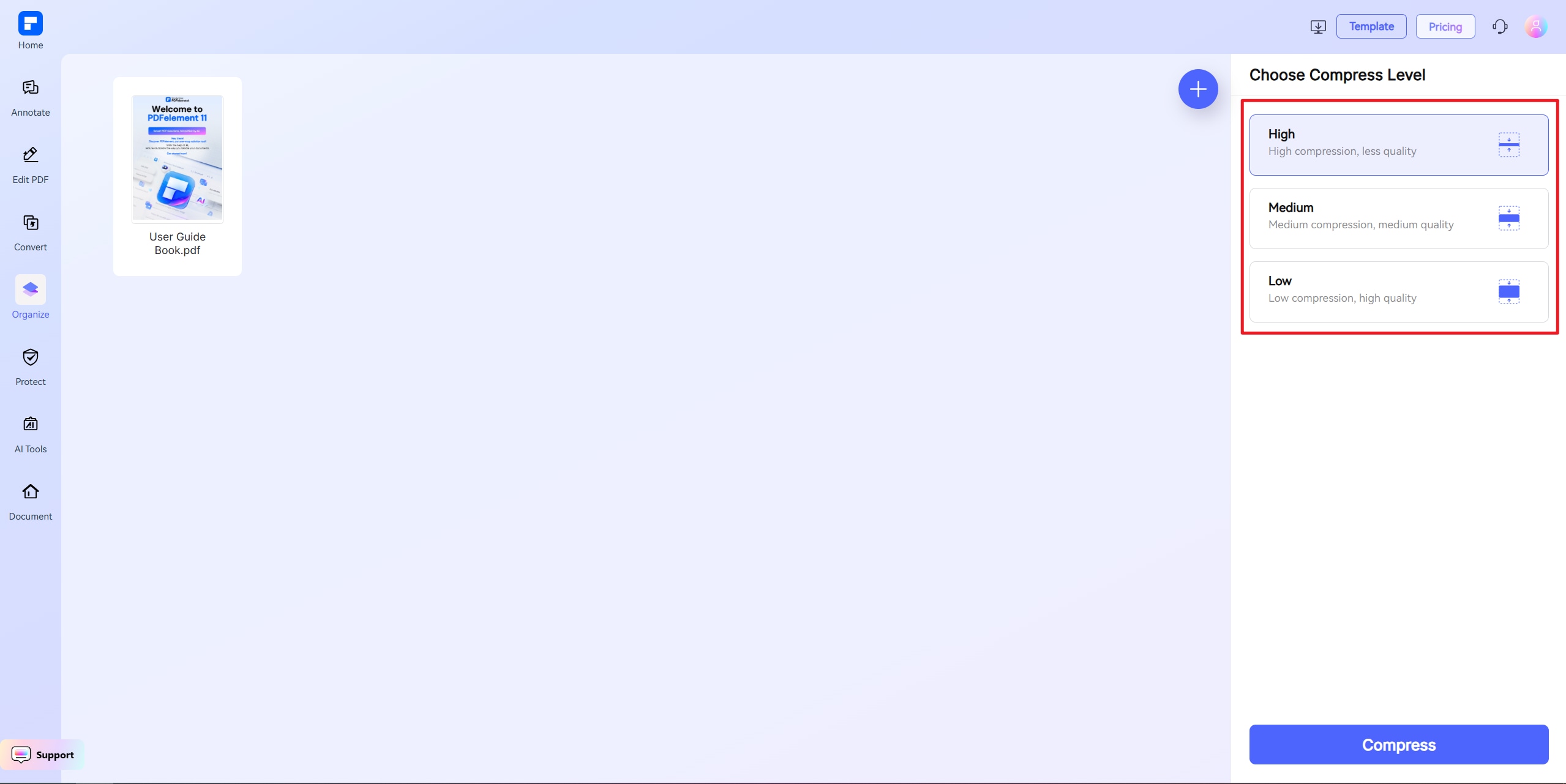
To reduce a PDF with PDFelement Online, open the online compression tool, upload your PDF, and choose the compression level that best matches your goal. If you need the smallest possible output, choose a stronger compression setting. If the first result is still above 100KB, try a higher compression level or use the cleanup tips later in this article.
A practical workflow is to download the compressed file, check the file size, then open it and zoom in to inspect the text. Do not judge quality only from the thumbnail. Small text, stamps, signatures, and ID numbers should still be readable after compression.
PDFelement is also helpful beyond basic compression. If the PDF is too large because it contains unnecessary pages, comments, or images, you can use the desktop version of PDFelement to remove, organize, edit, OCR, or convert the file before compressing again. That makes it a good fit for users who need more than a one-click compressor.
Method 2: Use Adobe Acrobat Online
Adobe Acrobat Online offers a familiar PDF compression workflow. It is a good option if you prefer Adobe tools or already use an Adobe account. The online compressor typically lets you upload a PDF, choose a compression level, and download the optimized file.
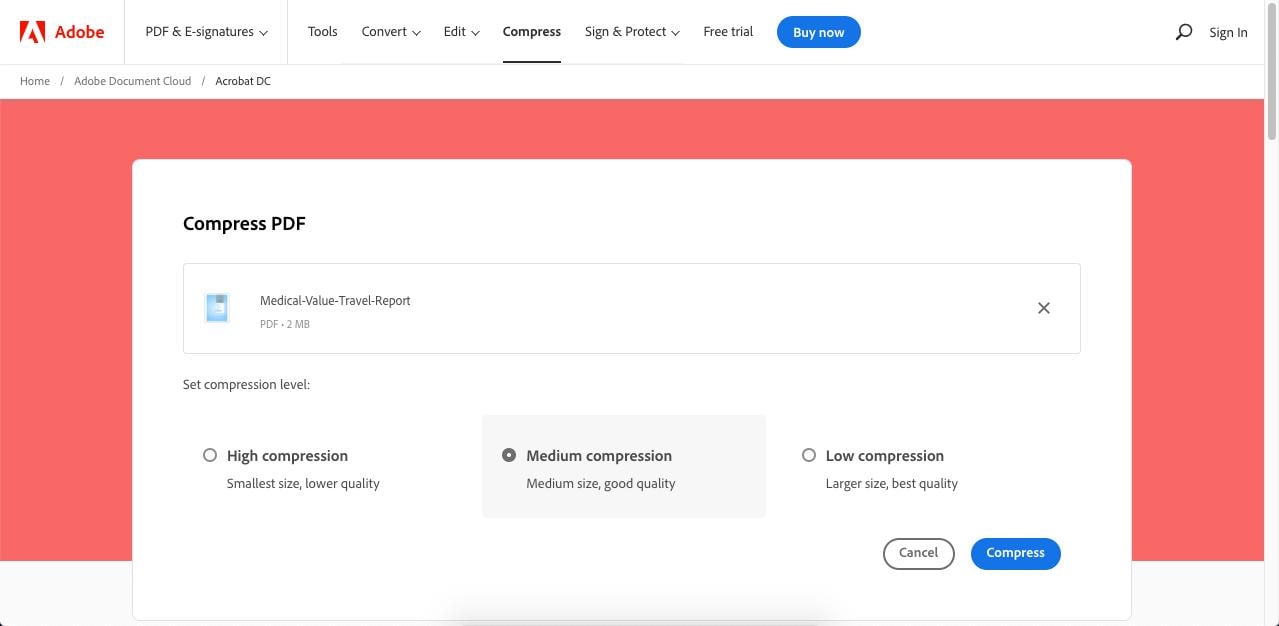
The steps are straightforward. Go to Adobe’s online PDF compressor, select your file, choose the compression strength, and start the compression. If prompted, sign in to download or manage the finished file. Adobe’s own help resources also explain PDF compression and optimization options for Acrobat users on its official support site: Adobe Acrobat Help.
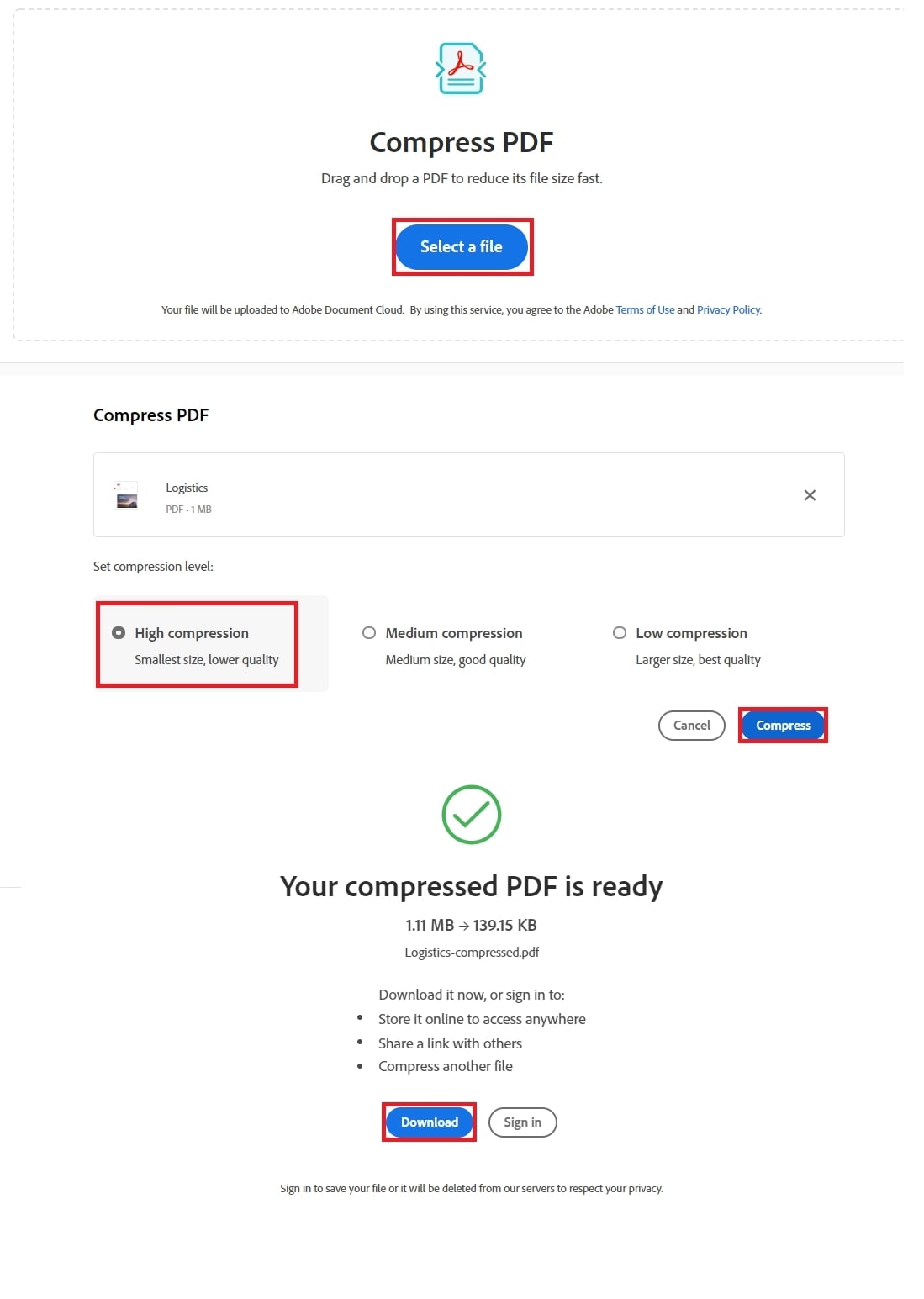
Adobe is a strong option for users already working inside the Acrobat ecosystem. For occasional use, check whether the online result reaches your target before considering a paid desktop workflow.
Method 3: Use Smallpdf
Smallpdf is another popular online option for reducing PDF file size. It is designed for quick browser use and usually offers basic compression for free, with stronger compression or larger usage limits available in paid plans.
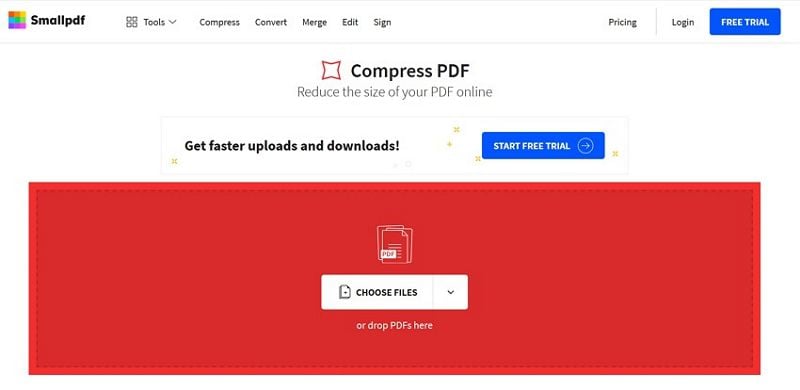
To use it, open the Smallpdf Compress PDF tool, upload or drag your PDF into the browser window, choose the available compression option, and download the smaller file. If you need to reduce PDF to 100KB, check the downloaded file size before submitting it to your portal or email system.
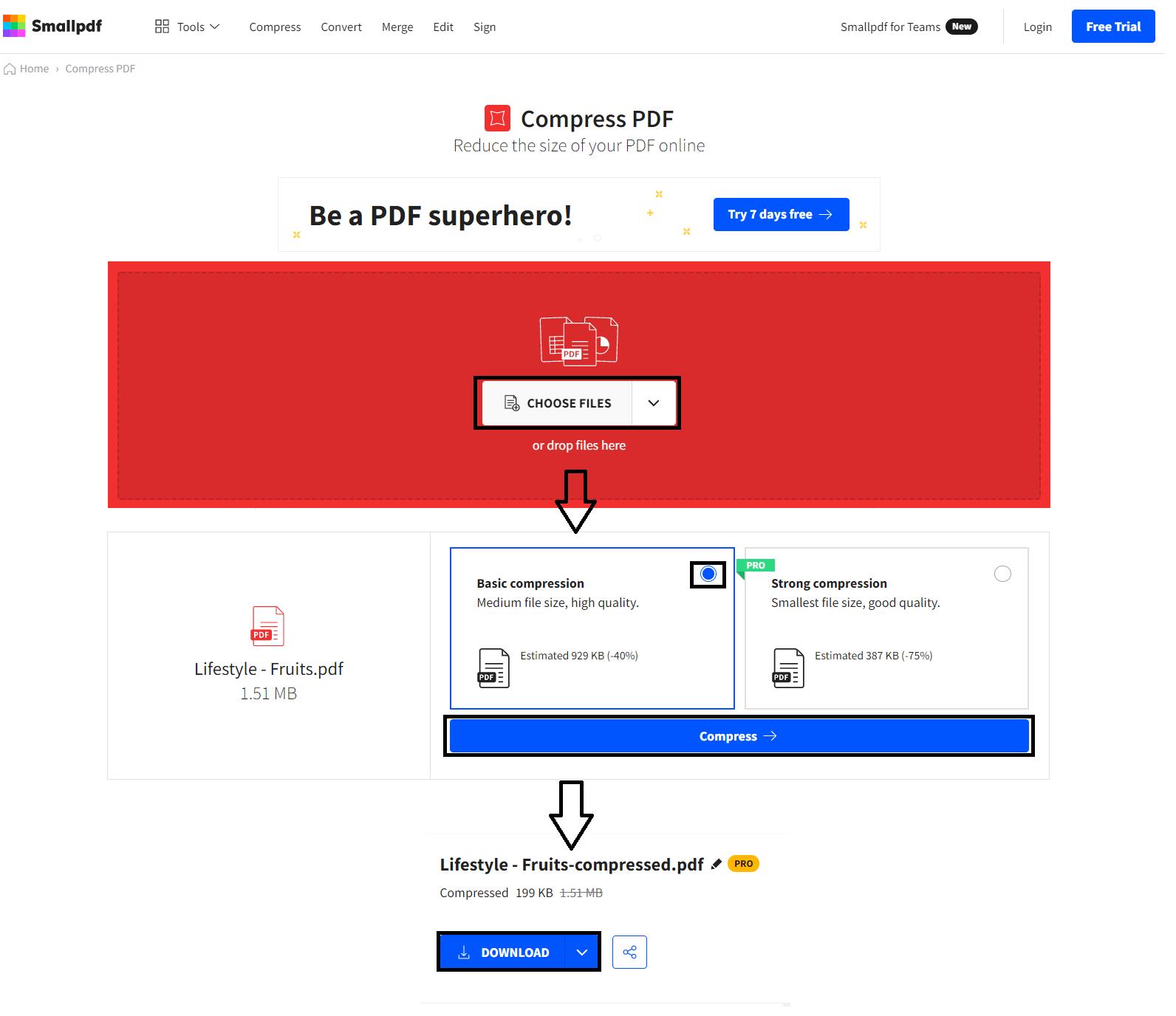
Smallpdf is convenient for everyday documents, but as with any online tool, be careful with confidential files. For privacy-sensitive documents, a desktop compressor gives you more control because the file stays on your computer.
A quick privacy note before using online compressors
Online compression means uploading your file to a third-party server. That may be fine for a public brochure or a non-sensitive school assignment, but it is worth pausing before uploading passports, bank statements, contracts, medical documents, or documents with personal identification numbers.
For sensitive files, use offline PDF software instead. If you must use an online tool, read the tool’s privacy policy and file deletion policy first. For general privacy awareness, resources such as the FTC’s guidance on protecting personal information are useful for understanding what kinds of data deserve extra care.
Best Offline Way to Reduce PDF File Size to 100KB
An offline PDF compressor is usually the better choice when the file contains private information or when you need more control over the result. Desktop tools can also do the extra work that online compressors often cannot: delete pages, replace oversized images, run OCR, flatten comments, or convert the PDF to another format before recreating a smaller PDF.
Why use a desktop PDF size reducer under 100KB?
A browser tool is fast, but it is usually built around one task. Desktop software gives you more room to solve the actual cause of the large file. If a scanned PDF is too heavy, you can OCR it. If one image is oversized, you can replace or compress it. If the file contains unnecessary pages, you can remove them before trying to compress again.
Offline tools are also more suitable when you handle repeated PDF work. If you often prepare forms, contracts, proposals, certificates, or academic documents, installing a desktop PDF editor can save time because you can compress and fix documents in the same workspace.
Method 1: Compress PDF offline with PDFelement
PDFelement is a practical choice if you need to reduce file size and still keep editing options close by. Instead of treating compression as a separate task, you can open the PDF, inspect the pages, remove unnecessary content, apply OCR if needed, and then compress the final file.
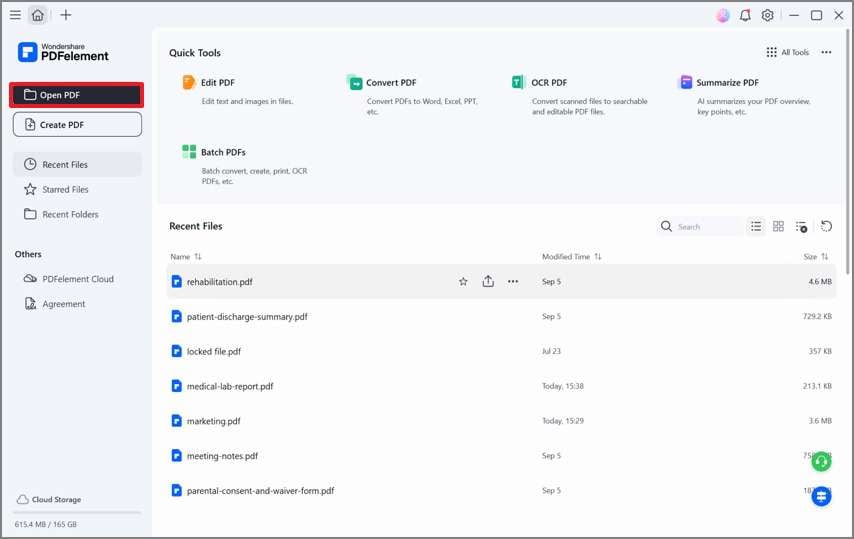
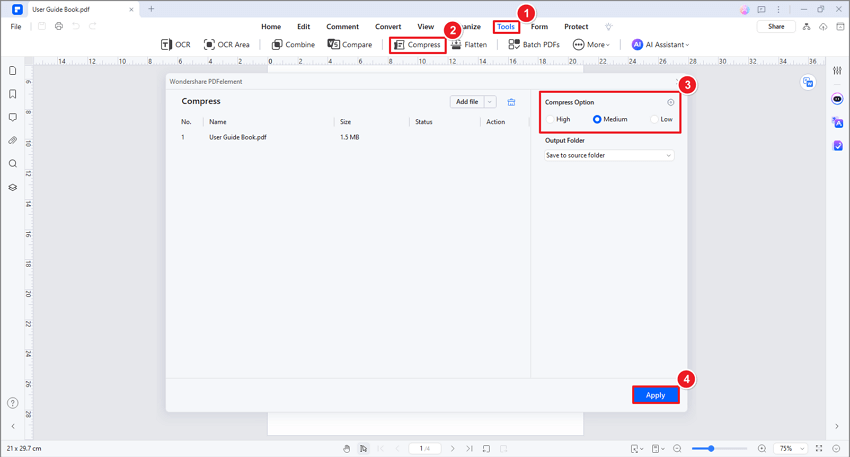
A typical workflow looks like this: open the PDF in PDFelement, go to the compression tool, choose an output quality or compression level, and save the smaller version as a new file. Saving as a new copy is important. It lets you compare the compressed PDF with the original and prevents accidental quality loss if you need to revise the document later.
PDFelement becomes especially useful when a simple compressor cannot reach 100KB. You can remove blank pages, crop oversized margins, convert scanned pages into searchable text with OCR, edit or delete heavy images, and organize the document before compressing again. For a resume, application form, signed agreement, or scanned certificate, this kind of cleanup often matters more than repeatedly running the same compressor.
Another good habit is to keep two versions: one high-quality original for your records and one compressed upload copy. The upload copy can be optimized for a strict 100KB limit, while the original remains clear enough for printing or future editing.
Method 2: Compress PDF offline with Foxit
Foxit is another desktop PDF tool that can reduce file size and optimize PDFs. It is commonly used for viewing, annotating, creating, and managing PDF files, with optimization options available depending on the version.
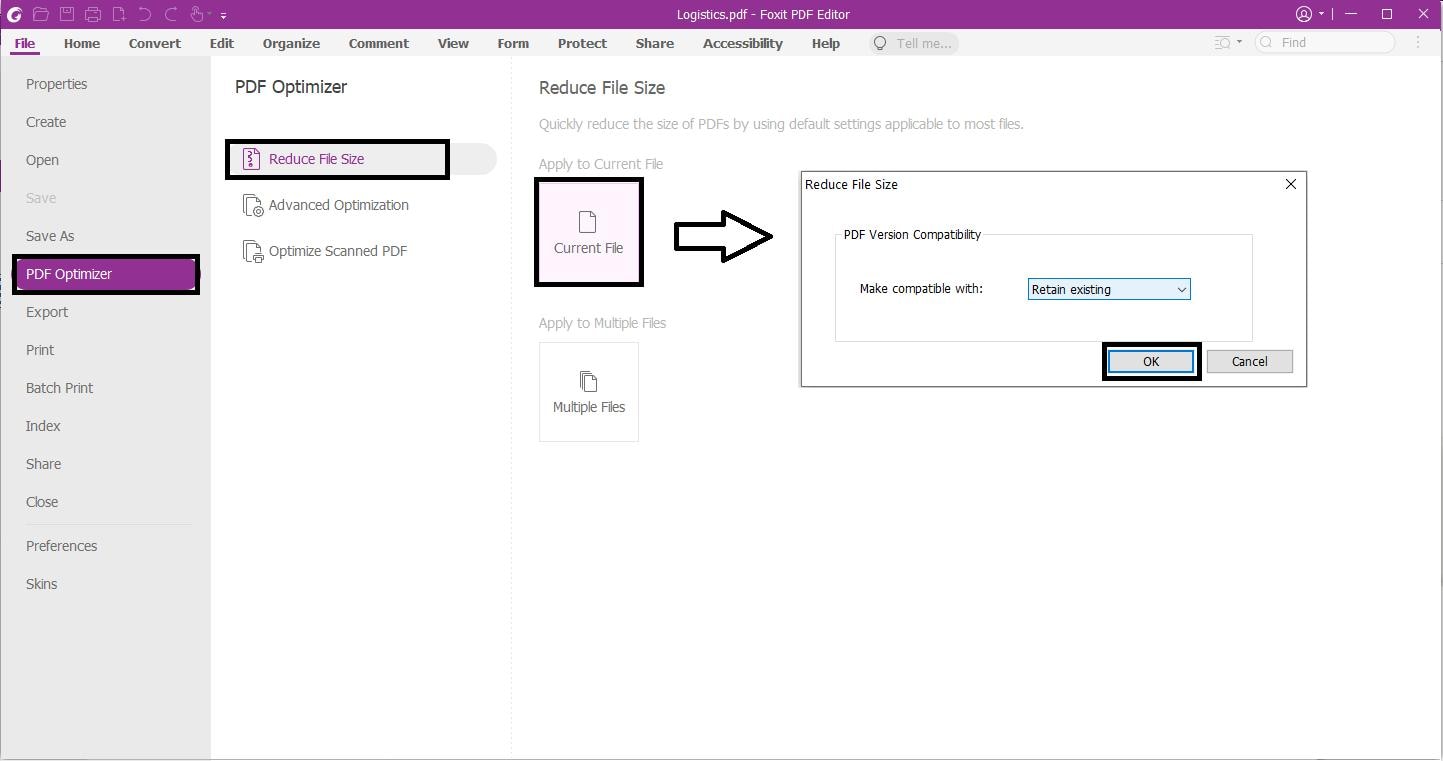
To compress a PDF in Foxit, open the file, look for the file optimization or “reduce file size” option, choose the relevant settings, and save a compressed copy. The exact menu names may vary by version, so check the tool’s current documentation if your interface looks different.
Foxit is a reasonable option for users who already have it installed. If you are choosing a tool specifically for repeated compression and editing, compare whether the version you plan to use includes the optimization settings you need.
How to Get a PDF Below 100KB When Compression Is Not Enough
Sometimes the first compression attempt fails. Maybe your file drops from 2MB to 350KB, but the upload system still demands 100KB. That is frustrating, but it usually means the file needs preparation before another compression attempt.
The key is to reduce the amount of data inside the PDF, not just run the same tool again and again.
Resize images before creating the PDF
If your PDF contains photos, screenshots, ID scans, or certificates, image size is probably the biggest issue. Before inserting images into a document, resize them to match the actual display need. A photo taken on a modern phone can be several thousand pixels wide. A form upload rarely needs that much detail.
For documents that only need to be viewed on screen, a moderate image resolution is usually enough. If the document contains tiny text, stamps, or official marks, be careful not to over-compress the image before converting it to PDF. The goal is to remove unnecessary pixels, not destroy legibility.
If you are starting from images, compress the images first, then create the PDF. This often produces a smaller file than creating a large PDF first and trying to compress it afterward.
Remove pages and objects you do not need
A strict 100KB limit usually means you cannot keep extras. Blank pages, cover pages, duplicated scans, unused attachments, and high-resolution logos can all push the file over the limit.
Open the file and check what is actually required. If the upload portal asks for a one-page certificate, do not upload the full packet. If a resume must be under 100KB, remove decorative background graphics and use standard fonts. If a form has unnecessary instruction pages attached, delete them from the upload version if the portal allows it.
This is where a PDF editor such as PDFelement is more useful than a basic compressor. You can delete pages, crop margins, edit text, remove images, and then compress the file again.
Use OCR for scanned text documents
A scan of a text page is often much larger than real PDF text. OCR, or optical character recognition, can convert scanned text into searchable and selectable text. Depending on how the file is rebuilt, this can sometimes reduce size while making the document easier to search and copy.
OCR is not magic, though. If the scan quality is poor or the page contains handwritten notes, stamps, or complex layouts, check the result carefully. Government and academic documents may need to preserve the original appearance, so do not rely on OCR unless the final PDF still meets the submission requirements.
For general background on OCR technology, the Library of Congress OCR overview provides a useful explanation of how text recognition works in digitized documents.
Split the PDF if the receiving system allows it
If a multi-page PDF cannot be reduced to 100KB without becoming unreadable, check whether the website allows multiple uploads. Some systems let you upload separate files for identity proof, address proof, certificates, or supporting documents. In that case, splitting a PDF into smaller parts may be better than crushing the whole document into one unreadable file.
If the system requires one single PDF under 100KB, prioritize only the required pages and remove everything else. If the document must include many pages, you may need to contact the receiving organization and ask whether a larger file can be accepted by email or another upload channel.
Print to PDF carefully
“Print to PDF” can sometimes reduce file size by flattening complex elements, but it can also make the file larger or turn selectable text into less efficient graphics, depending on the settings. Use it as a last resort and always compare the result.
If you try this method, choose lower image quality or screen-optimized settings where available. Then open the new PDF and confirm that the text, signatures, checkboxes, and page order are still correct.
Online vs Offline PDF Size Reducer Under 100KB: Which Should You Use?
The best tool depends on the document and the risk level. If the PDF is simple and not sensitive, an online compressor is usually the fastest path. If the file contains private information or needs editing before compression, use desktop software.
For a one-page resume, an online pdf size reducer under 100kb may be enough. For a scanned ID, legal agreement, bank statement, or signed form, an offline workflow is safer. For a large scanned document, you may need a desktop editor to remove pages, OCR text, and compress images before you can reach the target size.
A simple way to decide:
Use an online compressor for non-sensitive, short PDFs that only need quick size reduction.
Use offline software for private files, repeated work, batch compression, or files that need editing before compression.
Use cleanup steps when the compressed PDF is still above 100KB or the quality becomes unreadable.
There is also a quality trade-off. Strong compression reduces file size by lowering image quality, removing unnecessary data, or simplifying file structure. That is useful for uploads, but not always ideal for archiving. Keep an original copy if the document matters.
Common Mistakes That Make PDFs Larger After Editing
Many people compress a PDF, make a small edit, and then wonder why the file becomes large again. PDF editing can add new data, especially if the software embeds fonts, saves images at high quality, or keeps editing history.
One common mistake is adding a scanned signature as a large image. A transparent PNG signature from a phone or scanner can be far larger than expected. Resize it before inserting it, or use a PDF signing tool that stores the signature efficiently.
Another issue is using decorative fonts. If a PDF embeds several full font files, the size can grow. For upload documents, standard fonts are safer and usually smaller. Complex backgrounds, icons, and high-resolution logos may look nice but can make a 100KB target much harder.
Annotations can also add weight. Comments, sticky notes, stamps, and markups may not look large on the page, but they add PDF objects. If the final file only needs a clean version, flatten or remove unnecessary annotations before compression.
Finally, avoid exporting with print-quality settings unless the receiver specifically needs print production quality. Many upload portals only need a readable screen version. Exporting for web, screen, or reduced size is usually more appropriate for a 100KB limit.
People Also Ask
-
How do I reduce PDF size to 100KB online free?
Use an online PDF compressor, upload your file, choose strong compression if available, and download the compressed version. After downloading, check both the file size and readability. If the PDF is still larger than 100KB, remove extra pages, reduce image resolution, or use an offline editor such as PDFelement to clean up the file before compressing again. -
Why can’t my PDF be compressed to under 100KB?
Your PDF may contain high-resolution scans, large photos, embedded fonts, or too many pages. A compressor can reduce file size, but it cannot always make a large image-heavy document fit under 100KB without serious quality loss. Try resizing images, deleting unnecessary pages, running OCR on scanned text, or splitting the document if allowed. -
What is the best PDF size reducer less than 100KB?
The best choice depends on your file. For quick non-sensitive documents, online tools such as PDFelement Online, Adobe Acrobat Online, or Smallpdf can work well. For private files or PDFs that need editing before compression, a desktop tool such as PDFelement is more practical because you can remove pages, edit images, OCR scans, and then compress. -
Will compressing a PDF to 100KB reduce quality?
Usually, yes, especially if the PDF contains images or scans. Text-based PDFs can often shrink with little visible change, but image-heavy PDFs may become blurry under strong compression. Always open the compressed PDF and zoom in on important details before submitting it. -
Can I reduce a scanned PDF to 100KB?
Yes, sometimes. A one-page black-and-white scan may compress to 100KB if the resolution is reasonable. A full-color high-resolution scan may need extra work. Convert it to grayscale or black and white if acceptable, reduce image resolution, crop blank margins, and consider OCR if the document is mostly text. -
Is it safe to use an online PDF compressor?
It depends on the document and the service. Online tools require you to upload your PDF, so avoid using them for highly sensitive files unless you trust the provider and understand its privacy policy. For IDs, financial records, legal documents, or medical files, offline compression is usually safer. -
How can I reduce PDF file size to 100KB without losing readability?
Start with moderate compression and check the result. If it is still too large, reduce image size, remove unnecessary pages, simplify graphics, and compress again. Do not use the strongest compression blindly. The best result often comes from cleaning the PDF first, then applying compression. -
Should I use “print to PDF” to make the file smaller?
It can help in some cases, but it is unpredictable. Printing to PDF may flatten complex elements, but it can also increase file size or reduce text quality. If you try it, save a copy, choose screen-friendly settings, and compare the final file carefully with the original.