
Table of Contents
A PDF that is just a little too large can stop an entire task: a visa application upload, a job portal submission, an email attachment, a court filing, or a school assignment. The frustrating part is that many tools say “compress PDF,” but they do not always let you compress a PDF to a specific size such as 100KB, 300KB, 1MB, or 2MB.
The short answer is that you can use a PDF compressor to specific size, but the result may be approximate rather than exact. A PDF made mostly of text can shrink dramatically. A scanned PDF full of high-resolution images may need stronger compression, image resizing, OCR cleanup, or even page removal. This guide explains the most reliable ways to compress PDF to specific size online and offline, plus what to do when one-click compression does not quite hit the target.


 G2 Rating: 4.5/5 |
 100% Secure
Why Compressing a PDF to a Specific Size Is Not Always Exact
A PDF file is a container. It can hold text, fonts, images, scanned pages, annotations, form fields, signatures, attachments, layers, metadata, and sometimes hidden editing data. Because of that, two PDFs with the same page count can have completely different file sizes. A 20-page text-based report may be under 1MB, while a two-page scanned passport copy may be 8MB.
That is why a tool may offer compression levels such as “high,” “medium,” and “low” instead of a guaranteed output box. Some tools also provide a slider or target-size option, but even then, the final size depends on what can safely be compressed inside the file.
What “compress PDF to specific size” usually means
In most real workflows, “specific size” means one of these requirements:
The file must be under a platform limit, such as 500KB, 1MB, 2MB, 5MB, or 10MB.
The PDF must be small enough to email. For example, Gmail has attachment size limits explained in Google’s Gmail attachment help.
The PDF must be reduced without making text unreadable or images unusable.
The file must retain its pages, layout, and signatures as much as possible.
If your requirement is “under 2MB,” the practical goal is not exactly 2.000MB. It is better to aim slightly lower, such as 1.8MB or 1.9MB, so the upload system accepts it even if it calculates size differently.
Why scanned PDFs are harder to compress
Scanned PDFs are usually large because every page is stored as an image. If the scan was saved at 300 DPI or 600 DPI in color, even a short file can become oversized. Compressing this type of PDF often requires image downsampling, grayscale conversion, OCR, or removing duplicate pages.
Text-based PDFs are easier. If the PDF was exported from Word, Excel, PowerPoint, Google Docs, or an HTML page, compression may remove redundant fonts, optimize images, and clean internal structure without much visible quality loss.
Best Way To Compress PDF to Specific Size Offline: PDFelement
If your PDF contains personal, legal, financial, academic, or business information, an offline tool is usually the safer and more controllable choice. Wondershare PDFelement is useful here because it combines compression with editing, page management, OCR, conversion, and PDF cleanup. That matters when the first compression attempt does not get the file below your required limit.
For example, if a government portal requires a PDF under 1MB, you can compress the file first. If the result is still too large, you can remove an unnecessary image, delete blank pages, convert scanned pages with OCR, or split the document—all without uploading the file to a web service.
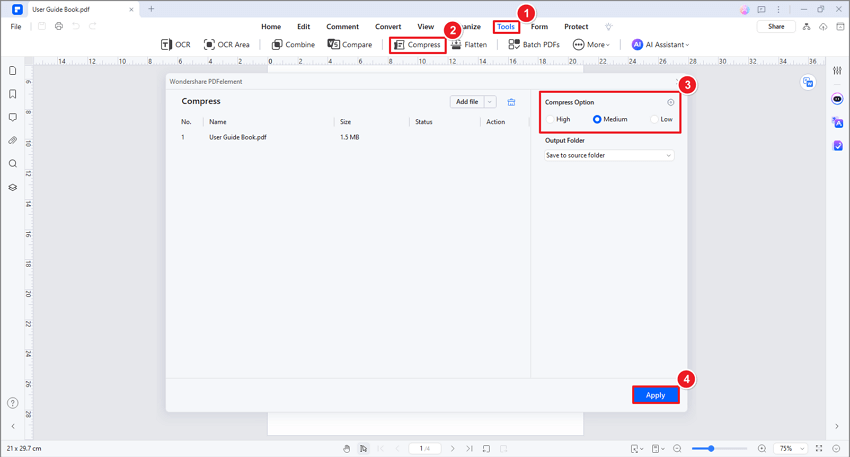
How to compress a PDF with PDFelement
Open PDFelement and import the PDF you want to reduce. From the main toolbar, go to the compression tool. Depending on your version and platform, the option may appear under Tools, Compress, or a similar PDF optimization area.
Choose a compression level. A lighter setting usually keeps images sharper but produces a larger file. A stronger setting gives you a smaller PDF, but image quality may drop. If you need to compress PDF to specific size, start with a medium setting and check the output size. If the file is still too large, run compression again with a stronger level or use manual cleanup.
After compression, save the PDF as a new file instead of overwriting the original. A simple naming system helps: report-original.pdf, report-compressed-2mb.pdf, and report-final.pdf. This gives you a fallback if the compressed version loses too much detail.
How to reduce the file further manually
One advantage of using a desktop PDF editor is that you are not limited to one compression button. You can look inside the PDF and remove the parts that are making it too large.
If the file contains decorative images, large screenshots, scanned blank pages, or duplicate pages, remove them before compressing again. In PDFelement, the edit mode lets you select text, images, and objects. You can delete unnecessary items or replace oversized images with smaller versions.
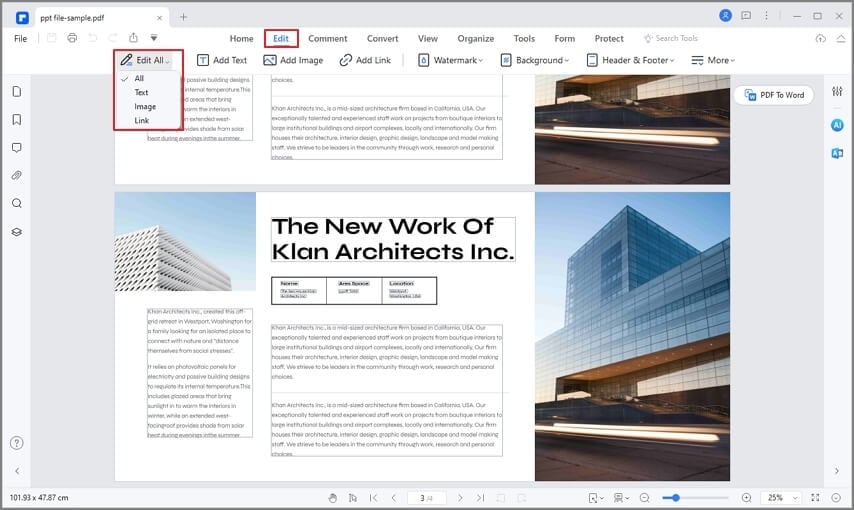
This is especially useful for resumes, forms, business proposals, and application documents. A high-resolution logo, full-page photo, or scanned signature can add more size than the rest of the document combined.
When offline compression is the better choice
Use an offline PDF compressor to specific size when the document is sensitive or when you need more control than an online tool provides. Offline workflows are also better for large batches, unstable internet connections, and files that need editing before compression.
PDFelement is not only a compressor. It can help with the surrounding PDF tasks that often come with size reduction: converting Word or images to PDF, organizing pages, running OCR on scanned documents, adding annotations, signing forms, and protecting final files with passwords. That makes it a practical choice when the goal is not just “make it smaller,” but “make it smaller and still ready to submit.”
How To Compress PDF to Chosen Size Online
Online tools are convenient when the file is not confidential and you need a quick result. They are also useful if you are working on a device where you cannot install software. The main trade-off is control. Some online compressors let you choose a compression level, while others estimate the best reduction automatically.
Before uploading sensitive documents, check the service’s privacy policy and deletion practices. If the PDF includes IDs, contracts, bank statements, medical records, tax files, or confidential business content, an offline method is usually safer.
HiPDF: quick online compression with quality options
HiPDF is a web-based PDF tool from Wondershare. It works in a browser, so you can compress PDF to chosen size online without installing desktop software. It is best for common files such as assignments, brochures, forms, and documents that do not contain highly sensitive information.
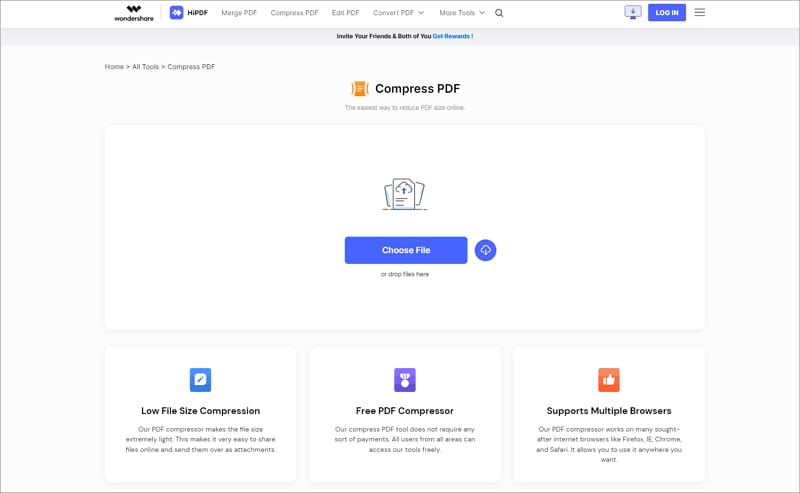
To use it, open the HiPDF PDF compressor page and upload your file. Choose a compression quality level. A higher compression setting creates a smaller PDF, while a lower compression setting preserves more detail. Start with the balanced option if you are unsure.
After the tool processes the file, download the compressed PDF and check the file size. If it is still above your target, run the file again at a stronger setting or use a desktop editor to remove oversized images and pages.
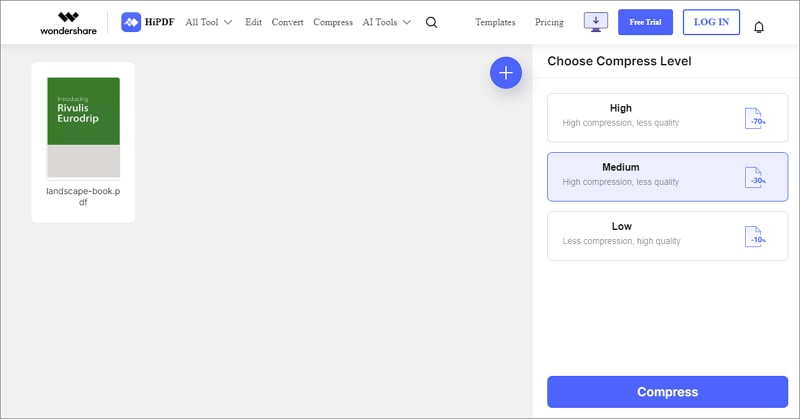
HiPDF is a good fit when speed matters more than advanced editing. If you later need to edit, sign, convert, or reorganize the compressed document, you can move the file into PDFelement for more detailed work.
11zon: target-size style compression in the browser
11zon is another online option for users who want more direct control over the compression level. It is often useful when you need to compress PDF to chosen size and prefer a slider-based workflow rather than selecting only “high,” “medium,” or “low.”
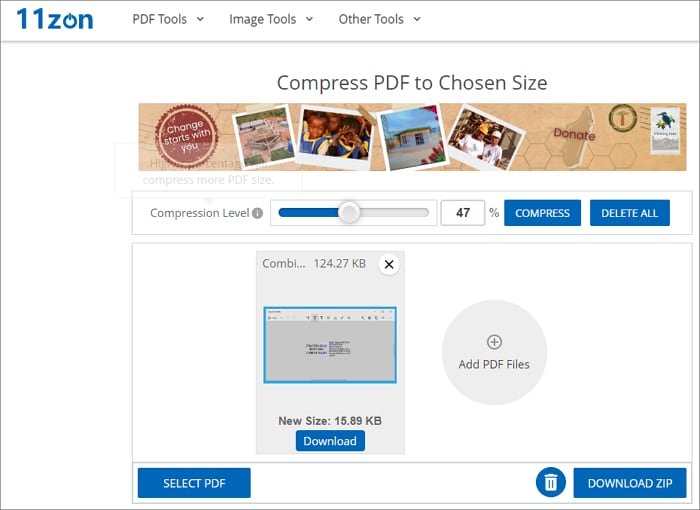
Upload your PDF, adjust the compression slider, and process the file. If the output is too large, increase the compression and try again. If the result looks too blurry, reduce the compression level and consider removing unneeded pages or images instead.
A slider can be helpful, but do not assume the first attempt will hit the exact file size. Always download and check the final size on your device before submitting it.
Adobe Acrobat Online: familiar compression levels
Adobe Acrobat Online is a recognizable option for PDF compression. It lets you upload a file and choose a compression level, which is useful for quick reductions. Adobe also provides general information about PDFs through its own resources, including the Adobe PDF overview.
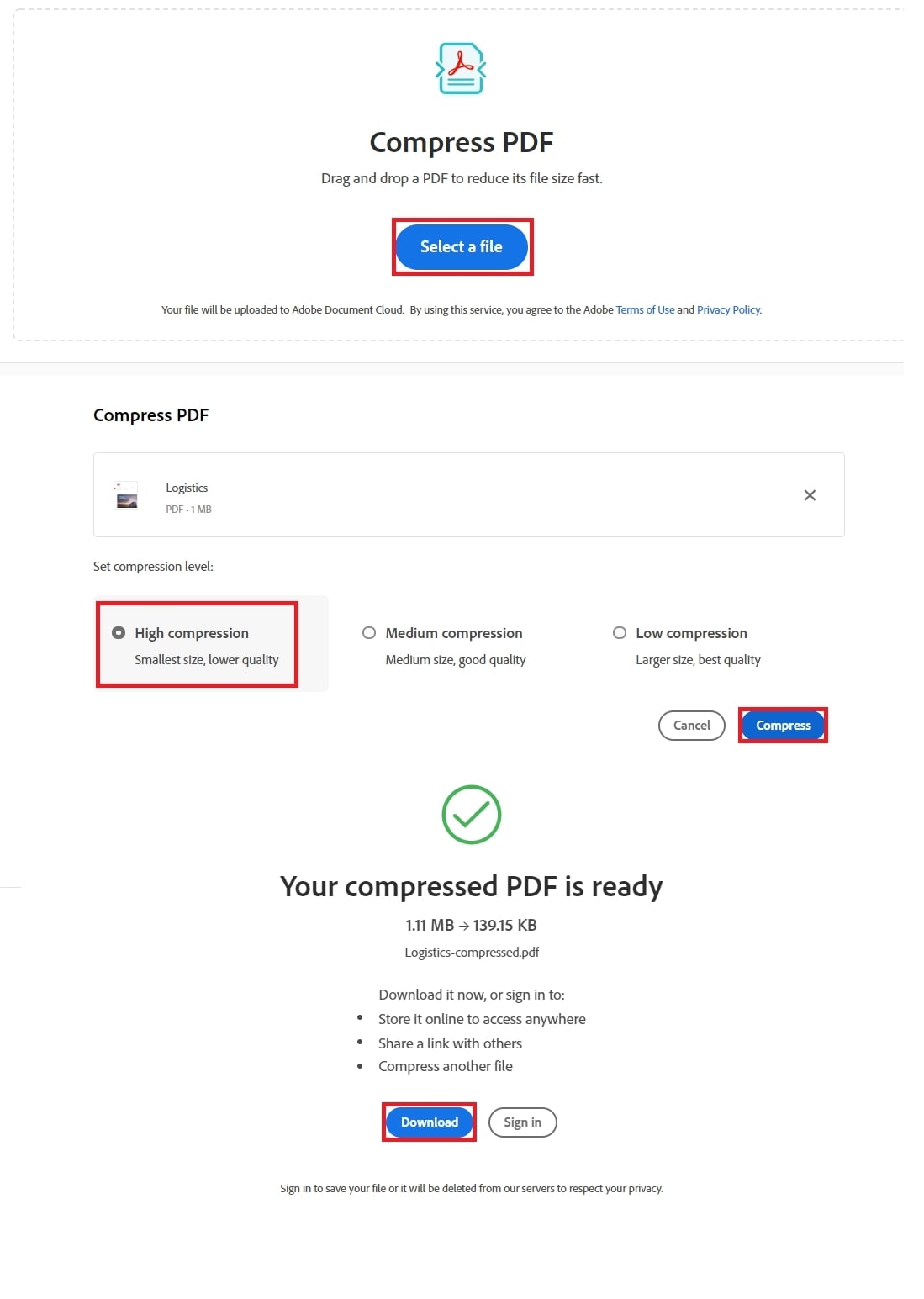
The workflow is straightforward: upload the PDF, choose the compression level, wait for processing, and download the result. If you need repeated use, larger files, or more editing features, check the current Adobe plan details before relying on it as your main tool.
Adobe Acrobat Online is best for quick, occasional compression. If you need to manually edit objects, remove scanned pages, or prepare a file for a strict upload limit, a desktop editor may save time.
What To Do If the PDF Is Still Too Large
Sometimes compression alone is not enough. This is common with scanned forms, image-heavy portfolios, catalogs, manuals, and PDFs created from phone camera scans. If the file is still above your target size, use a cleanup workflow instead of repeatedly compressing until the file becomes unreadable.
Remove unnecessary pages first
The easiest size reduction is deleting pages you do not need. Blank scan pages, duplicate pages, cover sheets, instruction pages, and unused appendices can add unnecessary weight.
If a portal asks for only one document section, do not upload the entire packet. Extract the required pages into a new PDF, then compress that smaller file. This usually preserves quality better than heavy compression on the full document.
Downsample or replace large images
Images are often the main reason a PDF is oversized. A photo inserted directly from a phone may be several megabytes by itself. If the image only needs to be viewed on screen, it usually does not need print-level resolution.
For resumes, forms, and ID uploads, replace huge images with smaller versions before creating the final PDF. If the PDF is already built, use a PDF editor to resize or remove unnecessary images, then compress again.
Use OCR for scanned text when appropriate
If the PDF is a scan of text pages, OCR can help turn the image-based text into searchable text. This does not always make the file smaller by itself, but it can support better document processing and make the file easier to edit or convert.
OCR is also useful when you need to recreate a cleaner, smaller document. For instance, you can run OCR, export the content to Word, clean up the formatting, then save a new PDF with optimized images.
Split the PDF if the upload rules allow it
If a platform allows multiple uploads, splitting the PDF may be better than destroying quality. For example, instead of forcing a 25-page scanned document under 2MB, you might submit it as Part 1 and Part 2 if the system permits.
Do not split a document if the instructions require one combined PDF. In that case, remove nonessential pages and compress images more carefully.
Flatten forms, comments, and layers carefully
PDFs with fillable form fields, comments, stamps, and layers can be larger than expected. Flattening can reduce complexity by turning interactive elements into fixed page content. This may reduce size and prevent formatting changes.
Be careful with signed documents. Flattening or editing a digitally signed PDF can invalidate the signature. If the signature must remain verifiable, make a copy and confirm the submission rules before changing the file.
Online vs Offline PDF Compressor to Specific Size: Which Should You Use?
The best method depends on the document, the size target, and how much control you need. A small school PDF can usually be handled online. A confidential contract or scanned ID should stay offline. A large scanned packet may need editing, OCR, and page cleanup before compression.
| Need | Better Choice | Why |
|---|---|---|
| Quick compression for a non-sensitive PDF | Online compressor | Fast, no installation required |
| Compress PDF to a strict upload limit | Offline editor | Easier to retry, edit, remove pages, and control output |
| Confidential documents | Offline tool | Avoids uploading sensitive files |
| Scanned PDFs | Offline editor with OCR and image tools | More options for reducing image-heavy files |
| Occasional small tasks | Online tool | Convenient for one-off compression |
| Repeated PDF work | Desktop PDF software | Better for editing, converting, signing, and organizing |
G2 Rating: 4.5/5 |100% Secure
Practical recommendations
If you only need to compress PDF to chosen size online once, use a browser tool and check the result carefully. Start with medium compression, then increase only if needed.
If you need to submit an important document under a strict size limit, use PDFelement or another desktop PDF editor. Compress once, inspect the output, then make targeted changes if the file is still too large. This protects readability better than applying maximum compression immediately.
If the PDF is a scan, do not expect miracles from one-click compression. Scanned documents often need image downsampling, grayscale conversion, page removal, or a cleaner rescan at a lower resolution.
Tips for Keeping PDF Quality After Compression
A smaller PDF is only useful if the recipient can still read it. Before you submit, upload, or email the compressed file, open it and inspect the pages that matter most: signatures, ID numbers, fine print, tables, charts, stamps, and photos.
For text-heavy PDFs, you can usually use stronger compression safely. For image-heavy PDFs, strong compression may create blur, color banding, or blocky artifacts. If images become unreadable, undo the compression and reduce size another way.
A good workflow is to aim just below the required limit, not as small as possible. If the portal limit is 2MB, a 1.7MB PDF with readable text is better than a 400KB file that looks damaged. Keep the original file until the compressed version has been accepted.
Also check whether the file still opens in a standard PDF reader. If you edited, flattened, or converted the PDF, review page order and formatting. For official documents, confirm that required signatures, stamps, and form fields are still visible.
People Also Ask
-
Can I compress a PDF to an exact size like 100KB or 1MB?
Sometimes, but not always exactly. Many tools can compress a PDF toward a target size or below a limit, but the final result depends on the PDF’s content. Text-based PDFs are easier to shrink. Scanned PDFs and image-heavy files may require stronger compression or manual cleanup. -
What is the best PDF compressor to specific size?
For sensitive or important files, a desktop tool such as PDFelement is a strong choice because you can compress, edit, remove pages, resize images, and save local copies. For quick non-sensitive files, online tools such as HiPDF, 11zon, or Adobe Acrobat Online can work well. -
How do I compress PDF to chosen size online?
Use an online compressor, upload the PDF, choose a compression level or slider setting, and download the result. Then check the file size on your device. If it is still too large, repeat with stronger compression or remove unnecessary pages and images before trying again. -
Why is my PDF still large after compression?
The PDF may contain high-resolution images, scanned pages, embedded fonts, hidden objects, form fields, comments, or attachments. Scanned PDFs are especially large because each page is stored as an image. Removing pages, resizing images, and optimizing scans can reduce the file further. -
Will compressing a PDF reduce its quality?
Usually, yes to some degree, especially if the PDF contains images. Light compression may have little visible effect. Heavy compression can blur images and make small text harder to read. Always inspect the compressed PDF before submitting it. -
Is it safe to use an online PDF compressor?
It depends on the document and the service. Online tools are convenient for ordinary files, but you should be cautious with IDs, contracts, financial records, medical documents, legal files, or confidential business PDFs. For sensitive files, offline compression is the safer workflow. -
How can I make a scanned PDF smaller?
Rescan at a lower resolution if possible, such as 150 DPI for basic screen reading or 200 DPI when clearer text is needed. Use grayscale instead of color when color is not required. You can also remove blank pages, crop unnecessary margins, run OCR, and use PDF compression after cleanup. -
Should I use maximum compression?
Not immediately. Maximum compression can make images and scanned text unreadable. Start with medium compression, check the file size, and increase only if needed. If the file still exceeds the limit, remove unnecessary content rather than over-compressing the whole document.