
To summarize multiple documents efficiently, use an AI document summarizer that can extract the key points from each file, keep the sources separate, and help you compare information across them. This is especially useful when you are reviewing reports, research papers, contracts, meeting materials, or other PDFs that need to be understood as a group rather than one file at a time.
This guide explains how to summarize multiple PDFs and documents with AI, how a multi-document workflow differs from a basic text summarizer, and which tools fit different use cases. It also shows how PDFelement V13 can move the task beyond one-off summaries by combining document summarization, cross-document questions, and reusable AI knowledge in the same PDF workflow.

In this article
How to Summarize Multiple Documents with AI
AI can summarize multiple documents by identifying the main ideas in each file and then helping you compare themes, findings, differences, risks, or action items across the document set. A useful multi-document summarizer should preserve the context of individual sources instead of blending every file into one vague overview.
This matters because multi-document tasks are different from summarizing a single PDF. A one-file summary answers questions such as “What is this report about?” A multi-document workflow can answer broader questions such as “What findings appear in all three reports?”, “Where do these documents disagree?”, or “Which recommendations should be prioritized across the entire set?”
Students and researchers can use this approach to review several papers before a literature review. Business teams can compare proposals, meeting notes, market reports, or policy documents. Legal and finance professionals can use the same workflow to identify repeated clauses, changes, risks, or figures across related files. In each case, AI works best as a navigation and analysis layer rather than a replacement for checking the original documents.
For reliable results, start by defining the output you need. Ask the AI to summarize each document separately before requesting a combined synthesis. Then use follow-up questions to compare evidence, identify contradictions, and locate details that need manual verification. This source-by-source approach reduces the risk of mixing information from different files and produces a more useful summary for decision-making.
How to Summarize Multiple PDFs with PDFelement V13
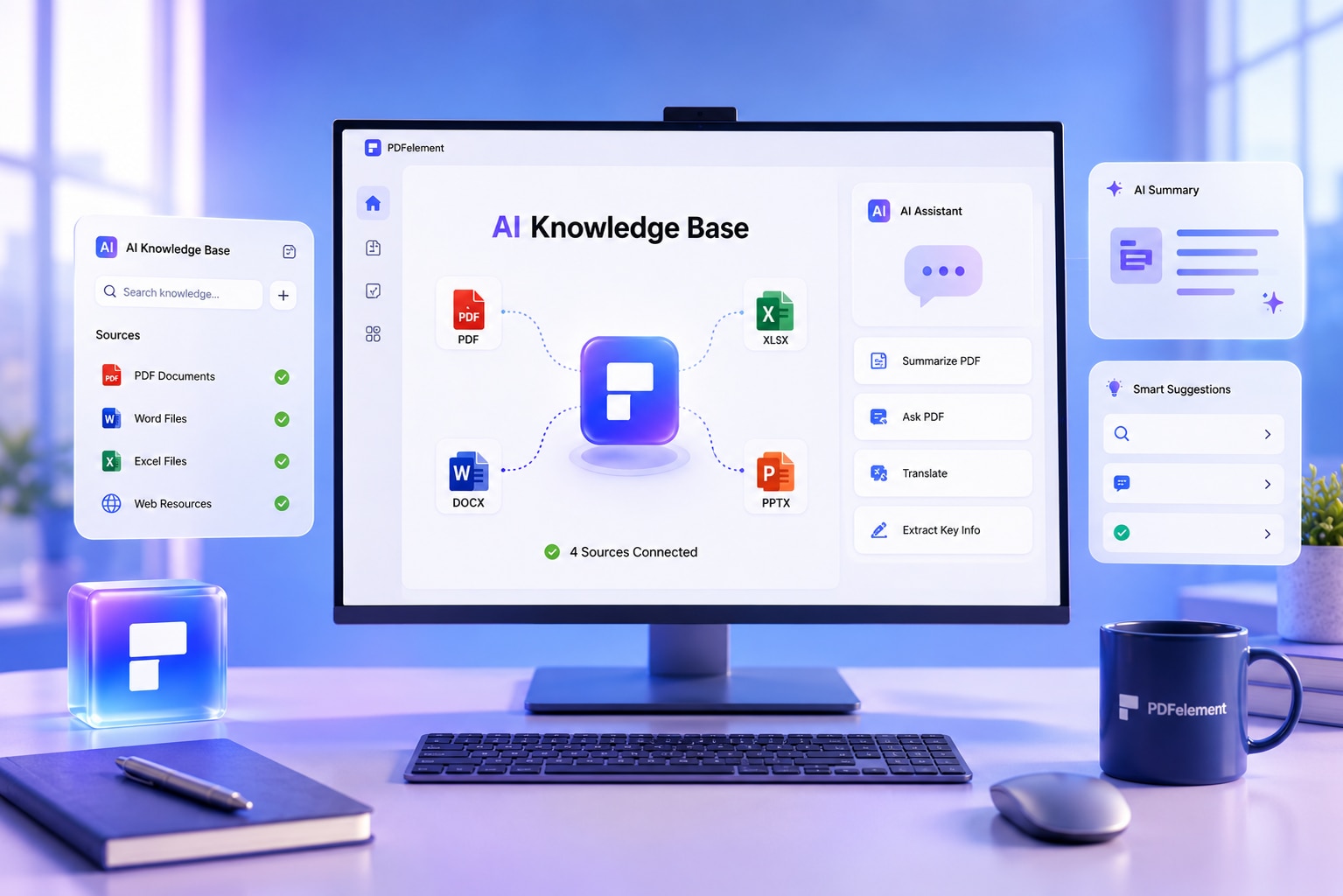
Wondershare PDFelement - PDF Editor Wondershare PDFelement Wondershare PDFelement is designed for document-centered AI workflows. In addition to summarizing a single PDF, its AI PDF tools can work with multiple PDFs, answer questions about document content, and keep the source files available while you review, edit, annotate, or verify the generated insights. In V13, this workflow goes beyond one-off summaries by helping you organize AI-generated overviews and reusable knowledge around related files, making it more suitable for repeated document analysis and an AI Knowledge Base workflow than a basic copy-and-paste summarizer.


 G2 Rating: 4.5/5 |
 100% Secure
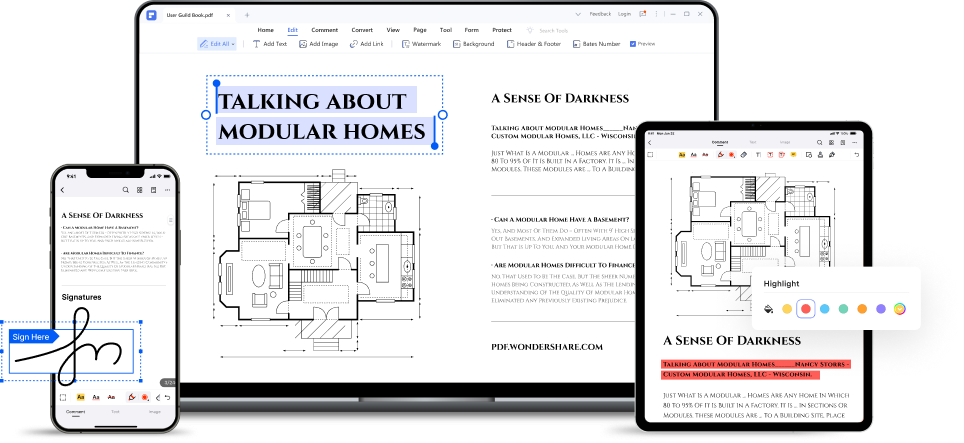
For multi-document work, the main advantage is continuity. You can summarize files, ask cross-document questions, return to the PDFs to check the evidence, and continue editing or annotating without moving the content between unrelated tools. Depending on the task, summaries can also be reused as notes, structured knowledge, or other AI-generated outputs for the next stage of your workflow.
Here is a practical way to summarize and compare multiple PDF documents with PDFelement AI:
Step 1 Open the first PDF in PDFelement and access the AI Sidebar. Before generating a summary, decide what you need from the files—for example, key findings, risks, decisions, action items, or a comparison of several reports.
Step 2 Choose the AI summarization or AI Chat workflow and add the other PDFs you want to analyze. Keeping related documents in the same AI context makes it easier to move from individual summaries to questions that span several files.
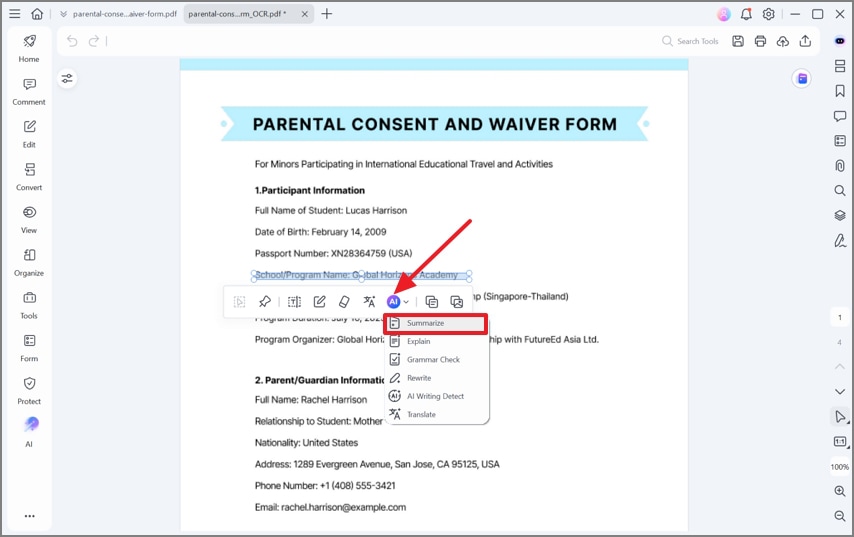
Step 3 Generate a summary for the document set. For clearer results, ask the AI to keep each source separate first—for example: “Summarize each PDF in five bullet points and label the findings by file name.” This gives you a source-aware overview before you combine the information.
Step 4 Ask follow-up questions that require cross-document analysis. Useful prompts include “What themes appear in all documents?”, “Where do the reports disagree?”, “Which recommendations are repeated?”, or “List the numbers and claims I should verify in the original files.”
Step 5 Review the AI output against the original PDFs, then reuse the verified insights in your workflow. You can copy the summary, continue editing or annotating the PDFs, generate structured notes or knowledge assets, and keep important documents connected for later reference in a V13 AI Knowledge Base workflow.
G2 Rating: 4.5/5 |100% Secure
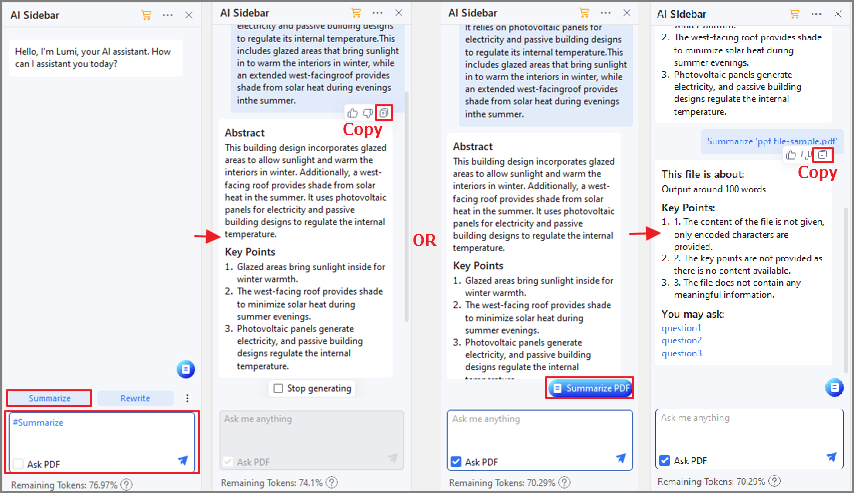
The most useful result is not simply a shorter version of the files. A strong multi-document summary should tell you what each source says, what the sources have in common, where they differ, and which details require further reading. That makes the output more useful for research, meetings, document review, and decision-making.
AI summaries can still omit context or misread important details, so verify names, dates, statistics, quotations, and conclusions in the source PDFs. For sensitive or high-stakes documents, also follow the privacy, compliance, and review requirements that apply to your organization.
Alternative Tools to Summarize Documents Online
If you only need a quick summary of one document or a block of text, an online summarizer may be enough. The tools below are better suited to lightweight, single-document, or text-first tasks than to a full cross-document PDF workflow, so choose based on the type of files you need to process.
1. Text Summarizer by QuillBot AI

QuillBot Summarizer can shorten pasted text and uploaded documents, including PDFs and Word files, into more concise versions. It is useful when you want a quick overview of one document and prefer to control the summary length or output style.
For multi-document analysis, however, treat each file as a separate summarization task and keep your source notes organized manually. QuillBot is a practical option for individual summaries, but it is less focused on cross-document questions and PDF-centered review workflows.
2. Text Summarizer by Paraphraser

Paraphraser.io includes a text summarizer that can turn long text into a shorter paragraph or bullet-style summary. It is suitable for users who already have the important text extracted from a document and want a simple way to condense it.
Because the workflow is primarily text-based, it works best for one-off summaries rather than comparing several PDFs as connected sources. If you are analyzing multiple files, label and save each output separately before combining the findings.
3. Resoomer

Resoomer is a document and text summarization tool that can import formats such as PDF, DOCX, EPUB, ODT, and TXT. It is useful for reducing a long document to its essential ideas and for users who want to continue editing, reading, or reworking the summarized text.
Its strength is processing an individual document in a straightforward reading workflow. If your goal is to compare claims or evidence across several PDFs at once, you will still need to organize the outputs and perform the cross-document synthesis separately.
4. TLDR This

TLDR This is designed mainly for quickly condensing articles, webpages, and pasted text into shorter, easier-to-scan summaries. It is useful when your source material lives online and you want the key ideas without creating a larger document-analysis workspace. For several PDFs or reports, it is better viewed as a quick summarization utility than a multi-document research tool.
5. Editpad

Editpad provides an AI text summarizer that condenses long content into shorter outputs and supports several summary formats. It can be useful for essays, reports, articles, or extracted document text when you need a fast, readable overview. It is less suited to maintaining context across a collection of PDFs.
6. Summarizing Tool: Online Summary Generator

SummarizingTool.io is a lightweight AI summarizer for articles, essays, research papers, and uploaded text documents. It can help you turn long content into shorter notes when you do not need an interactive PDF workspace.
The trade-off is that a basic summary generator usually focuses on the content you provide in one task. If you need to ask questions across multiple reports, preserve source boundaries, or verify findings directly in the PDFs, a multi-document AI workflow is more appropriate.
7. Intellippt

IntelliPPT is known as an AI text and document summarization tool for turning long content into a shorter synopsis. It may suit users who want a lightweight summary from a document, but its role is closer to single-document condensation than to a persistent workspace for comparing multiple PDFs and continuing document analysis.
Comparison of AI Document Summarizing Tools
The best document summarizer depends on whether you need a quick one-file summary or a connected workflow across several documents. The table below compares the tools by the job they are best suited for rather than treating every summarizer as interchangeable.
G2 Rating: 4.5/5 |100% Secure
Summarizing Tool |
Best For |
Multi-Document / PDF Workflow |
Key Limitation |
| PDFelement (AI PDF Editor) | Summarizing, comparing, questioning, and continuing to work with PDFs | Supports multiple PDFs, AI Q&A, document review, and reusable AI knowledge in the same workflow | Full AI access can depend on the plan and usage allowance |
| Text Summarizer by QuillBot AI | Quick summaries of individual text, PDF, or Word documents | Useful for file-by-file summarization with adjustable output styles | Less focused on cross-document analysis |
| Text Summarizer by Paraphraser | Shortening pasted or extracted text | Simple paragraph or bullet summaries for individual inputs | Primarily a text-first workflow |
| Resoomer | Reading and condensing long individual documents | Supports document imports including PDF and DOCX | Cross-document synthesis requires separate organization |
| TLDR This | Articles, webpages, and quick online reading | Fast summaries for web-first content | Not designed as a multi-PDF workspace |
| Editpad | Fast text summaries in different output formats | Good for one-off summaries of text-based content | Limited cross-document context |
| Summarizing Tool | Simple summaries of essays, articles, and text documents | Lightweight upload or text summarization | Limited document comparison and follow-up analysis |
| Intellippt | Condensing long text or documents into a shorter synopsis | Suitable for lightweight document summarization | Less suited to persistent multi-document analysis |
For a single article or short document, a lightweight online summarizer can be the fastest option. QuillBot, Resoomer, Editpad, and similar tools are useful when the task is mainly to shorten one source and you do not need to keep several PDFs connected.
For multiple PDFs, the selection criteria change. Look for a tool that can keep source context, generate separate summaries, support follow-up questions, and let you compare information without losing track of which document contains each claim. These capabilities are more important than simply producing the shortest summary.
PDFelement is a stronger fit when summarization is part of a larger PDF workflow. Its AI features support multiple-document summarization and Q&A, while the PDF workspace lets you return to the sources to edit, annotate, organize, or verify information. In V13, that workflow can extend into reusable AI knowledge rather than ending with a single generated paragraph.
Whichever tool you use, treat AI output as a working summary rather than an authoritative source. Check important numbers, names, dates, quotations, and conclusions in the original documents, and keep each source clearly identified when you combine findings from several files.
Conclusion
The best way to summarize multiple documents with AI is to summarize each source clearly, compare the results across files, and then verify the combined insights against the originals. Basic online summarizers are useful for quick single-document tasks, while PDFelement V13 is better suited to users who want to move from multiple PDF summaries to cross-document questions, source verification, editing, and an ongoing AI Knowledge Base workflow in the same document environment.
G2 Rating: 4.5/5 |100% Secure