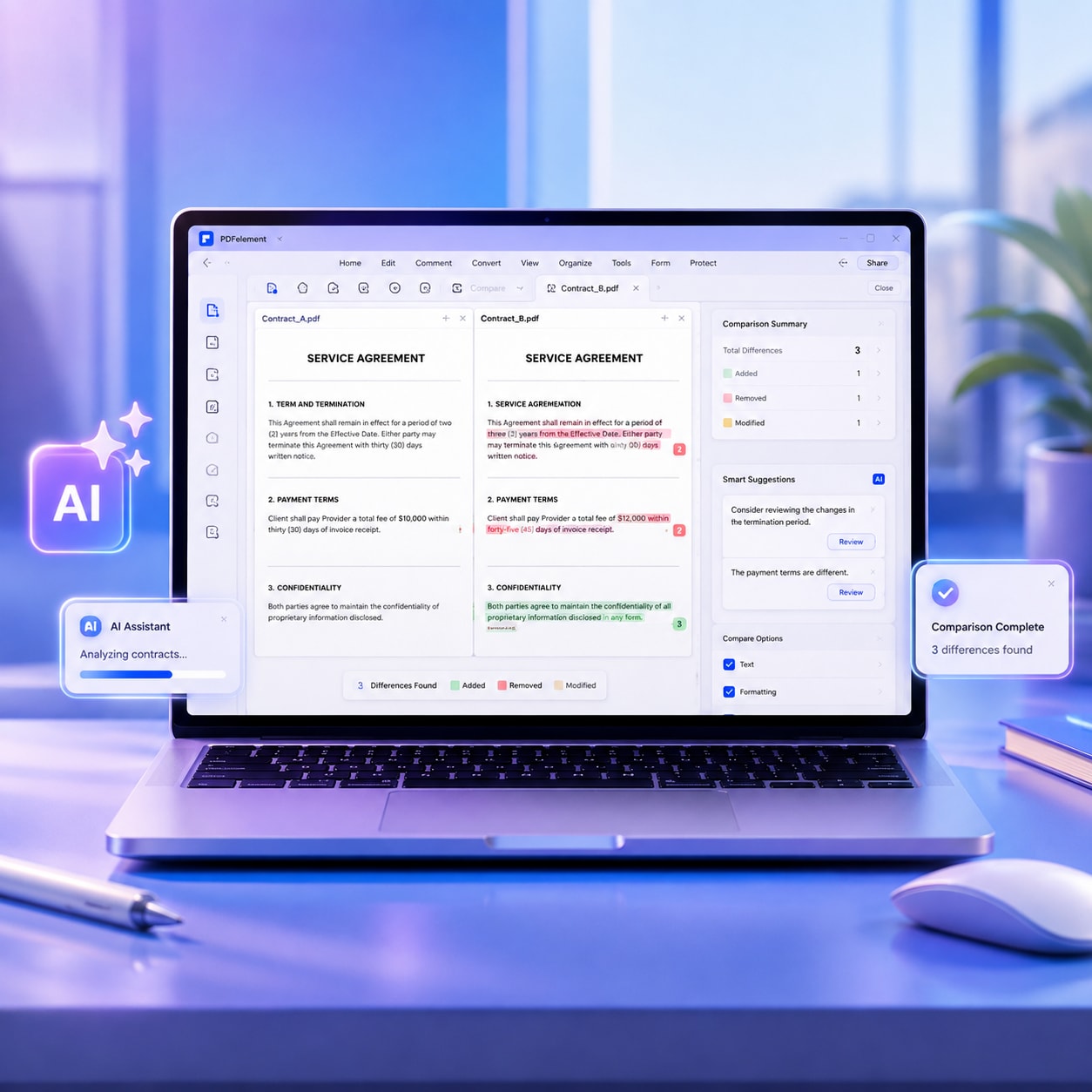

The best AI PDF summarizer for students is not simply the tool that makes a document shorter. A useful study workflow should help you understand the reading, trace important claims back to the source, work with scanned or multi-file material when needed, and turn what you read into something you can actually review before an exam. Depending on the task, that may mean source citations, OCR, flashcards, quizzes, translation, or a PDF-native workspace that lets you continue editing after the AI step is finished.

Quick answer: best AI PDF summarizers for students in 2026
- Best for a PDF-native study workflow: PDFelement V13 - especially when summarization needs to stay connected to OCR, translation, editing, annotations, flashcards, quizzes, mind maps, or other PDF tasks.
- Best for source-grounded study notebooks: NotebookLM - strong for learning across uploaded sources, cited answers, flashcards, quizzes, and study guides.
- Best Acrobat-based student workspace: Adobe Acrobat Student Spaces - combines uploaded study materials, citations, study guides, flashcards, quizzes, and other study tools.
- Best for flexible explanation and drafting: ChatGPT - useful when you want open-ended reasoning, reframing, brainstorming, or writing help from uploaded material.
- Best lightweight PDF chat option: ChatPDF - simple PDF Q&A, summaries, cited sources, and multi-file folders with minimal setup.
- Best for structured academic-paper reading: Scholarcy - designed around research papers, structured summary flashcards, references, findings, and literature-oriented reading.


 G2 Rating: 4.5/5 |
 100% Secure
In This Article
- How we compared these AI PDF summarizers
- What should students look for in an AI PDF summarizer?
- Best AI PDF summarizers for students compared
- Which tool is best for which student workflow?
- Which AI PDF summarizer should you choose?
- A better study loop than “summarize and stop”
- Accuracy, privacy, and academic-integrity checks
- Conclusion
- FAQs about AI PDF summarizers for students
Part 1. How We Compared These AI PDF Summarizers
This article is a feature-verified workflow comparison, not a controlled accuracy benchmark. We reviewed the current student-facing capabilities documented by the six products and compared how well each one fits common PDF study tasks: source-grounded reading, summarization, study-aid generation, scanned-document handling, multi-source work, and what a student can do after the AI response.
Verification standard
- Last verified: August 25, 2026.
- Evidence used: current official product pages, help centers, and first-party documentation.
- What we did not claim: we did not assign an “accuracy winner” because the six tools have not yet been run through the same controlled PDF-and-prompt test in this article.
- Why this matters: feature availability, limits, and plan rules can change, so students should verify any must-have capability before depending on it for an assignment.
A future hands-on version of this comparison should use the same source PDF and the same prompts across all six tools. A useful test set would include one summary task, one source-verification task, one difficult-concept explanation, and one study-output task. Until that controlled test exists, the fairest conclusion is a best-fit recommendation by workflow, not a universal accuracy ranking.
Part 2. What Should Students Look for in an AI PDF Summarizer?
Students often begin with a simple question: “Can this tool summarize my PDF?” But that question is too narrow. The real value appears after the first summary. Can you verify the answer? Can you study from the output instead of copying it into another app? Can the tool handle a scanned handout? Can you work across a folder of readings? Can you keep using the original PDF when the AI step is over?
- Source traceability: important claims should lead back to the original document instead of ending in an uncheckable paragraph.
- Multi-source context: courses, research projects, and exam folders rarely live in one perfectly clean PDF.
- Active-recall outputs: flashcards and quizzes are more useful for exam prep than rereading the same summary repeatedly.
- OCR and document handling: scanned handouts and image-based PDFs need reliable text recognition before any AI summary can be trusted.
- Workflow continuity: the best tool for a one-off question may not be the best tool for a semester-long project or document-heavy class.
- Clear limitations: students should know what the tool does not do well, especially when exact wording, charts, tables, or citations matter.
| A basic PDF summary | A stronger student workflow |
|---|---|
| Shortens the document | Shortens it and keeps a path back to the source |
| Helps you skim | Helps you read, verify, recall, and reuse information |
| Often ends with one output | Can continue into flashcards, quizzes, notes, mind maps, or editing |
| Works best on clean digital text | Accounts for OCR, scans, mixed files, and document structure |

Part 3. Best AI PDF Summarizers for Students: Side-by-Side Comparison
| Tool | Best for | Source grounding | Study outputs | PDF workflow | Main limitation |
|---|---|---|---|---|---|
| PDFelement V13 | PDF-centered study and document work | Source-based AI workflow with the original PDF kept in the same workspace for checking | Flashcards, quizzes, mind maps, podcast-style outputs, reports, summaries, and other Space tasks | Strong: OCR, translate, edit, annotate, convert, organize, and continue working on the PDF | More product than you need if you only want a lightweight browser-based study notebook |
| NotebookLM | Source-grounded learning across a notebook | Strong source-grounded answers and explanations tied back to uploaded material | Native flashcards, quizzes, study guides, reports, audio, and other source-based outputs | Focused on source learning rather than full PDF editing | Not a replacement for a full PDF editor when you need OCR correction, page editing, signing, or document production |
| Adobe Acrobat Student Spaces | Study hubs inside the Acrobat ecosystem | Citations can open the supporting section of uploaded source material | Study guides, study packets, flashcards, quizzes, mind maps, podcasts, presentations, and video summaries | Strong Acrobat ecosystem for PDF work and collaboration | Best value is inside Acrobat; students who only need a simple summarizer may find the workspace broader than necessary |
| ChatGPT | Open-ended explanation, reasoning, and drafting | Can work from uploaded files, but document grounding depends on how the conversation and file workflow are used | Flexible prompt-generated study guides, questions, explanations, and drafts | Not a native PDF editor; PDF visual handling varies by plan and upload method | Embedded PDF visuals are not handled the same way on every plan |
| ChatPDF | Fast PDF Q&A with minimal setup | Built-in citations point answers back to PDF references | Chat, summaries, study interactions, and research-oriented PDF Q&A | Lightweight browser workflow with multi-file folders | Fewer editing, OCR-correction, and document-production functions than a full PDF editor |
| Scholarcy | Academic papers and structured research reading | Structured summaries surface key claims, references, findings, and research details | Summary Flashcards, research comparison, references, exports, and literature-oriented workflows | Research-reading workflow rather than full PDF editing | Scanned PDFs need OCR first because Scholarcy requires extractable text |
Feature note: availability can vary by plan, account, platform, and rollout. The comparison above was verified against current first-party documentation on August 25, 2026. It is not a substitute for testing a must-have feature in your own account before a deadline.
Part 4. Which Tool Is Best for Which Student Workflow?
1. PDFelement V13 - Best for a Full PDF Study Workflow
Choose PDFelement V13 when the PDF itself needs to remain usable after the summary. The current PDFelement AI Help Center lists AI Chat, Summarize, AI Knowledge Card, Space Flashcards, Quiz, Podcast, Mind Map, Report, PDF Translate, and other AI tasks, while the broader editor also supports OCR and document editing. That combination matters when understanding the PDF is only the first step. Wondershare's current AI Help Center documents the supported AI tasks and usage rules.
For example, a student working with a scanned reading can run OCR, summarize the text, move into source-based study outputs, translate a difficult section, annotate the original file, and keep the document in the same PDF workflow. PDFelement's current PDF-to-mind-map workflow also shows Spaces with uploaded sources and Studio outputs such as summaries, notes, flashcards, quizzes, and mind maps. See the current PDFelement Spaces workflow.
Choose PDFelement if...
You want summarization to connect directly to OCR, translation, annotation, editing, conversion, and reusable study outputs.
Skip it if...
You only need a free, lightweight browser notebook and do not need to edit or manage the PDF itself.
G2 Rating: 4.5/5 |100% Secure

2. NotebookLM - Best for Source-Grounded Study Notebooks
Choose NotebookLM when your main job is learning from a collection of sources. NotebookLM can generate flashcards and quizzes from notebook sources, with controls for difficulty and explanations that help you revisit the underlying material. Google's current student guidance also highlights source-grounded flashcards, quizzes, and study-guide/report workflows. Google NotebookLM Help: Flashcards and Quizzes.
Choose NotebookLM if...
Your priority is source-grounded study, synthesis, explanations, and study aids across a notebook of materials.
Skip it if...
You need a full PDF editor for OCR correction, page-level editing, forms, signatures, redaction, or document production.
3. Adobe Acrobat Student Spaces - Best Acrobat-Based Study Hub
Choose Adobe Acrobat Student Spaces when you already work in the Acrobat ecosystem and want a dedicated student workspace. Adobe says Student Spaces can organize up to 100 files, generate study guides, flashcards, quizzes, study packets, mind maps, and multimedia tools, and add citations when responses or study tools are based on uploaded sources. Adobe Student Spaces FAQ.
Adobe also lets students open citation markers and jump back to the supporting section of a source document, which is especially useful when an AI explanation needs to be checked before it is reused in coursework. Adobe: cited AI answers in Student Spaces.
Choose Acrobat Student Spaces if...
You want citation-backed study tools and collaboration inside an established Acrobat workflow.
Skip it if...
Your main need is a simple PDF Q&A tool and you do not need the larger Acrobat environment.
4. ChatGPT - Best for Flexible Reasoning and Drafting
Choose ChatGPT when you want to go beyond a fixed summary format. Uploaded files can be used for synthesis, transformation, and information extraction, making ChatGPT useful for alternative explanations, comparisons, outlines, examples, and drafting. However, PDF behavior is not identical across plans. OpenAI's current File Uploads FAQ says ChatGPT Enterprise supports Visual Retrieval for PDFs, while other plans use text-based retrieval for embedded document content. OpenAI File Uploads FAQ.
Choose ChatGPT if...
You want flexible reasoning, explanation, brainstorming, rewriting, or drafting from uploaded course material.
Skip it if...
Your priority is a predictable PDF-native workflow with editing, OCR correction, and consistent document navigation in the same product.
5. ChatPDF - Best for Quick PDF Questions with Minimal Setup
Choose ChatPDF when you want a focused “upload, ask, verify” workflow. ChatPDF's current site highlights built-in citations that anchor answers to PDF references and multi-file chats through folders. That makes it a practical option when the task is mainly understanding one or a few PDFs rather than editing them. ChatPDF official site.
Choose ChatPDF if...
You want fast PDF Q&A, summaries, citations, and a low-friction browser experience.
Skip it if...
You need a full document editor, advanced OCR correction, or a broader academic research workflow.
6. Scholarcy - Best for Structured Academic-Paper Reading
Choose Scholarcy when dense academic papers are the main problem. Scholarcy turns research papers into structured Summary Flashcards, surfaces key points, references, methods, results, and research comparisons, and supports literature-oriented export workflows. Its current product documentation also notes that scanned PDFs need OCR first because the tool requires extractable text. Scholarcy Article Summarizer.
Choose Scholarcy if...
You read journal articles, research papers, or book chapters and want consistent structured summaries with research details.
Skip it if...
Your material is mainly scanned PDFs or you need full PDF editing rather than a research-reading workflow.
Part 5. Which AI PDF Summarizer Should You Choose?
The best choice depends on what you need to do after the first summary. If you only need a quick answer, a lightweight PDF chat tool can be enough. If you need to verify sources, build study aids, work across a source library, process scanned documents, or edit the original PDF, the workflow around the summary becomes more important than the summary itself.
| If your main job is... | Start with... | Why |
|---|---|---|
| Summarize, OCR, translate, annotate, and keep editing the PDF | PDFelement V13 | The AI task stays connected to a full PDF workflow and reusable Space outputs. |
| Study from a source library with strong grounding | NotebookLM | Source-grounded notebooks and native study aids are central to the experience. |
| Study and collaborate inside Acrobat | Adobe Acrobat Student Spaces | Citations, multi-file study hubs, and student-oriented study tools are built into Acrobat on the web. |
| Reason, explain, brainstorm, or draft from uploaded material | ChatGPT | Flexible model interaction is the primary strength. |
| Ask quick questions about one or a few PDFs | ChatPDF | Low-friction chat, cited sources, and multi-file folders. |
| Screen academic papers and organize research findings | Scholarcy | Structured Summary Flashcards and research-oriented extraction are the core workflow. |
Part 6. A Better Study Loop Than “Summarize and Stop”
Whichever tool you choose, do not treat the summary as the final answer. A stronger student workflow is Read → Verify → Recall → Reuse. The goal is not to make the PDF disappear. The goal is to reduce reading friction while keeping enough connection to the source that you can still study, check, and reuse the material responsibly.
- Read: generate a short overview first so you understand the document structure, main argument, and high-priority sections.
- Verify: open the cited or relevant source location and check any fact, number, quotation, or claim that matters for an essay, assignment, or exam.
- Recall: turn the material into flashcards, short-answer questions, or a quiz and test yourself before rereading the summary.
- Reuse: move verified information into notes, an outline, a mind map, or another document without losing track of where it came from.
A better prompt pattern
“Use only the uploaded source. Give me the five most important ideas, show where each idea appears in the source, then create five review questions. If the document does not support an answer, say so instead of guessing.”
G2 Rating: 4.5/5 |100% Secure
Part 7. Accuracy, Privacy, and Academic-Integrity Checks
AI PDF summarizers are reading assistants, not automatic evidence. A confident answer can still miss context, misunderstand a scan, or over-compress an argument. Before you quote, paraphrase, or submit anything based on an AI summary, go back to the original material.
Check the source before using a claim
If the tool provides citations or source markers, open them. If it does not, search the original PDF for the relevant phrase, number, definition, or section before treating the AI output as reliable.
Run OCR before trusting a scanned PDF
Image-based PDFs can introduce recognition errors in names, dates, formulas, tables, or symbols. If the text layer is poor, the AI output can be poor even when the model itself is capable.
Follow your school's AI rules
Use AI summaries to support reading and review, not to bypass assigned work. When an assignment requires evidence, cite the original source rather than the AI-generated summary, and follow your instructor's or institution's policy for AI-assisted work.
Check privacy before uploading sensitive material
Do not upload confidential research, restricted course materials, unpublished work, personal records, or institution-controlled files unless the service's current privacy terms and your school or organization allow it. Privacy and retention rules vary across products and account types.
Part 8. Conclusion
There is no single AI PDF summarizer that is best for every student. NotebookLM is a strong choice for source-grounded notebook study. Adobe Acrobat Student Spaces is a serious option for citation-backed study tools inside Acrobat. ChatGPT is strongest when the task expands into explanation, reasoning, or drafting. ChatPDF is deliberately simple for PDF Q&A, while Scholarcy is specialized for academic-paper reading.
PDFelement V13 stands out when the PDF itself remains central to the work. Its advantage is not that it is the only product that can summarize a document. The advantage is that summarization can stay connected to OCR, translation, editing, annotations, flashcards, quizzes, mind maps, reports, and other document actions in one PDF-centered workflow. That makes it particularly relevant for students who need to move from reading to verification to study outputs without rebuilding the document in another app.
G2 Rating: 4.5/5 |100% Secure
People Also Ask
-
What is the best AI PDF summarizer for students?
There is no universal winner. PDFelement V13 is a strong fit when students want summarization connected to OCR, translation, editing, and study outputs. NotebookLM is excellent for source-grounded notebook study, Acrobat Student Spaces is strong for citation-backed study tools, ChatGPT is flexible for reasoning, ChatPDF is simple for PDF Q&A, and Scholarcy specializes in academic papers. -
Which AI PDF summarizer has citations?
NotebookLM, Adobe Acrobat Student Spaces, and ChatPDF all provide source-grounded or citation-linked workflows in their current product documentation. PDFelement keeps AI work connected to the source PDF in its Space workflow. Whatever tool you use, open the supporting passage before reusing an important claim in assessed work. -
Can AI turn a PDF into flashcards and quizzes?
Yes. NotebookLM and Adobe Student Spaces provide native flashcard and quiz tools from source material, while PDFelement's current Space workflow includes Flashcards and Quiz tasks. ChatGPT can also generate study questions through prompts, but that is a more manual workflow rather than a dedicated PDF study pipeline. -
What is the best AI PDF summarizer for scanned PDFs?
For scanned PDFs, prioritize a workflow with OCR before summarization. A PDF-native editor such as PDFelement can reduce preprocessing friction because the scan can be recognized and corrected before the AI workflow continues. Scholarcy, for example, states that scanned PDFs need OCR first because it requires extractable text. -
Is there a free AI PDF summarizer for students?
Several tools provide free or limited-access options, but limits can change. ChatPDF promotes free PDF Q&A, Scholarcy currently offers a free summarizer with daily limits, Adobe says Student Spaces is free to use, and other products offer trials or plan-dependent access. Check the current plan page before relying on a free workflow for a large assignment. -
Can I use AI PDF summaries in homework or essays?
Use AI summaries as a reading aid, not as unverified evidence. Check the original source, cite the original material when academic evidence is required, and follow your instructor's or institution's rules for AI-assisted work. -
Is it safe to upload class or research PDFs to an AI summarizer?
It depends on the material and the service. Avoid uploading confidential, unpublished, restricted, or personally sensitive documents unless the product's current privacy terms and your institution's policy permit it. Privacy, retention, and training rules can differ by provider and account type.
Related Reading
- How to Summarize a PDF with Citations for Homework, Essays, and Exam Review
- How to Turn Multiple PDFs into an AI Study Guide for Exams
- How to Summarize Multiple PDFs in PDFelement
- PDFelement vs ChatGPT vs NotebookLM: Which PDF Tool Is Best for Students?
Sources and Verification References
- Wondershare PDFelement AI Help Center
- Wondershare PDFelement Spaces and Mind Map Workflow
- Google NotebookLM - Flashcards and Quizzes
- Google - NotebookLM Student Features
- Adobe Acrobat Student Spaces FAQ
- Adobe - Cited AI Answers in Student Spaces
- OpenAI - File Uploads FAQ
- ChatPDF Official Site
- Scholarcy Article Summarizer