
Table of Contents
Long PDFs are much easier to use when the left-side bookmark panel works like a clickable table of contents. Instead of scrolling through 80 pages to find “Chapter 4,” “Payment Terms,” or “Appendix B,” you can jump straight to the right section. The problem is that adding every bookmark by hand can be slow, especially in reports, manuals, ebooks, policy documents, and legal files.
That is where an auto bookmark PDF workflow helps. With the right PDF editor, you can generate bookmarks from the document’s heading structure, then quickly review and adjust the result. This article explains how automatic PDF bookmarks work, how to create them with Wondershare PDFelement, and what to check when the generated bookmarks are incomplete or messy.



 G2 Rating: 4.5/5 |
 100% Secure
What Does Auto Bookmark PDF Mean?
To auto bookmark a PDF means to let PDF software generate bookmarks for you instead of creating each one manually. The software usually looks for visible structure in the file, such as heading text, title formatting, chapter labels, or existing document tags, and then turns those sections into clickable bookmark entries.
PDF bookmarks are not the same as ordinary web browser bookmarks. In a PDF, bookmarks are navigation items stored inside the file. They usually appear in a side panel and point to a page, a specific location on a page, or sometimes an action. A good bookmark tree lets readers understand the document structure before they even start reading.
For example, a 120-page employee handbook might have bookmarks such as:
- Company Policies
- Benefits
- Leave and Attendance
- Payroll
- Security Guidelines
- Appendix
If the document has sub-sections, the bookmarks can also be nested. “Benefits” might expand to show “Health Insurance,” “Retirement Plan,” and “Paid Time Off.” That hierarchy is what makes bookmarks useful in longer files.
Automatic bookmarks in PDF files are most helpful when the document already has clear headings. If a PDF was created from Word, Google Docs, InDesign, or another structured source, the heading styles often remain visible enough for a PDF editor to detect. If the file is a flat scan or a poorly exported document, auto bookmarking may need extra cleanup.
Manual bookmarks still have a place. They are useful when you want to bookmark only selected pages, create custom navigation that does not match the headings, or add bookmarks to a file with weak structure. But for long documents with predictable headings, auto bookmarking saves a lot of repetitive work.
How to Create Bookmark in PDF Automatically with PDFelement
Wondershare PDFelement is a practical option if you need to create bookmarks, edit the bookmark tree, and continue working on the same PDF afterward. The workflow is especially useful for files that need more than bookmarking, such as OCR, page organization, commenting, form editing, signing, compression, or conversion to Word or Excel.
PDFelement can generate bookmarks based on heading styles in the PDF. If your file already contains bookmarks, you can choose how to handle them instead of accidentally losing existing navigation. That matters when you receive a document from someone else and only want to improve what is already there.
Before You Start
Open the PDF and quickly scan the section headings. Auto bookmarking works best when the document has consistent formatting. For instance, all chapter titles should look similar, and subheadings should use a smaller or clearly different style.
If the PDF is scanned, run OCR first so the text becomes recognizable. Without OCR, the software may see the page as an image rather than real text. You can read more about OCR basics from the Library of Congress digital preservation resources, which explain how searchable text layers are commonly used in digital documents.
G2 Rating: 4.5/5 |100% Secure
Step 1: Open the PDF in PDFelement
Launch PDFelement on your computer, then open the file you want to bookmark. You can use the Open PDF button from the main window and select the document from your local folder.
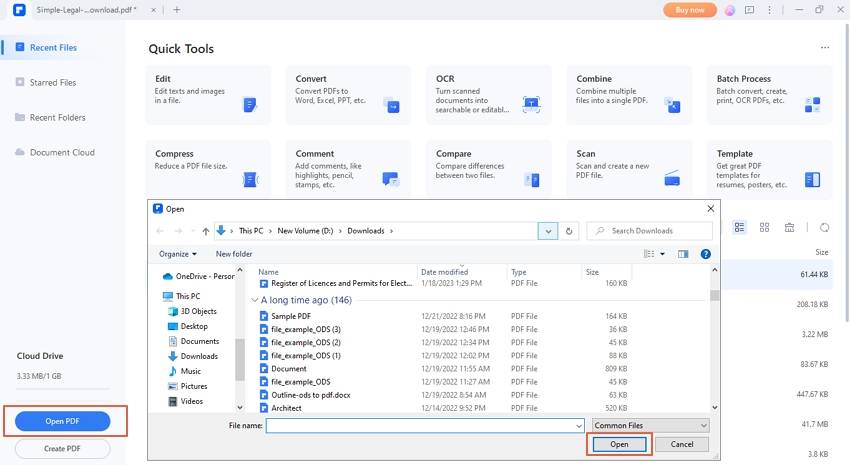
After the file opens, take a moment to check the page order. If the document has cover pages, blank separators, or misplaced pages, organize them first. Bookmarks are more useful when they point to the final page order, not a draft arrangement that will change later.
Step 2: Use the Auto Bookmarks Feature
Go to the View tab and select Auto Bookmarks. PDFelement will analyze the PDF structure and generate bookmark entries from the recognizable headings.
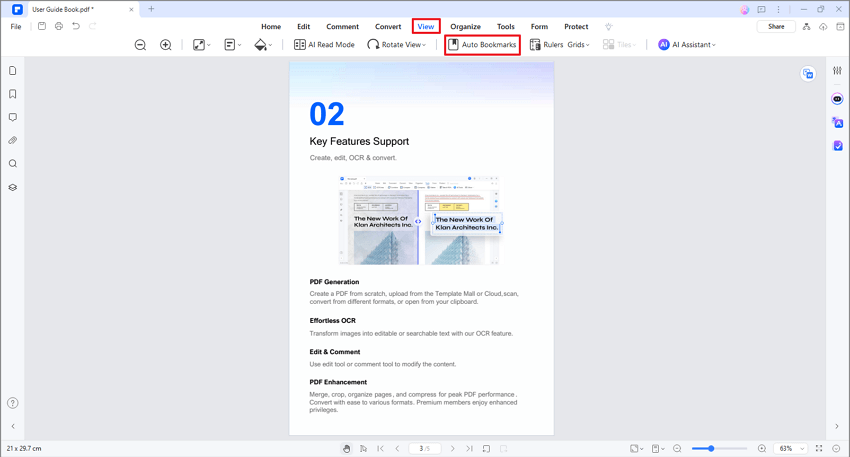
This is the key step for anyone searching for how to create bookmark in PDF automatically. Instead of selecting each page and adding a bookmark one by one, you let the software create the first draft of the bookmark panel.
If the file already has bookmarks, PDFelement may ask whether you want to overwrite the existing bookmarks, add the new ones to the end, or cancel. Choose carefully:
- Use overwrite if the current bookmarks are wrong, outdated, or incomplete.
- Use add to the end if you want to keep the existing bookmark set and compare it with the new one.
- Use cancel if you opened the feature by mistake or need to inspect the current bookmarks first.
Step 3: Review the Bookmark Panel
Open the bookmark panel on the left side of the PDF. You should see the generated bookmark list. Click several entries to confirm they jump to the correct section.
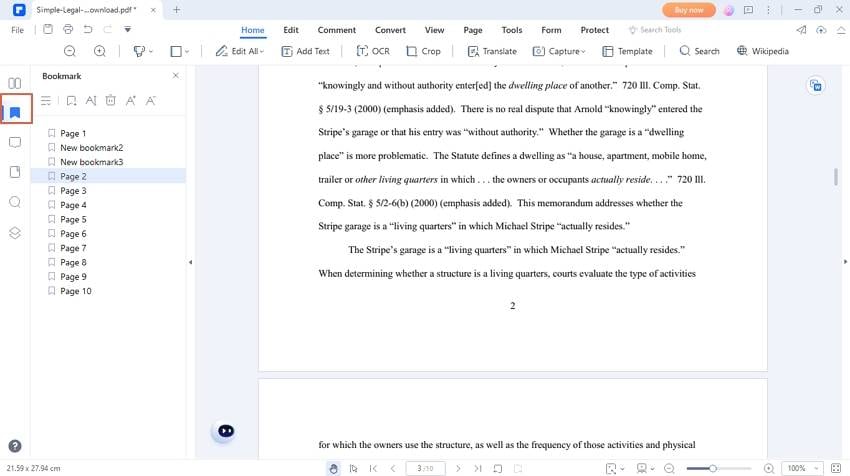
Do not skip this review. Automatic bookmarks are fast, but they are not always perfect. A title may be detected as a top-level bookmark when it should be a sub-bookmark. A bold sentence may be mistaken for a heading. A section may be missing because its formatting differs from the rest of the document.
Think of auto bookmarks as a strong first draft. The final quality still depends on a quick editorial pass.
Step 4: Save the Bookmarked PDF
After reviewing the bookmarks, save the file. Use Save if you want to update the current file, or Save As if you want to keep an original unbookmarked version.
Saving a separate copy is often safer when working with contracts, published manuals, compliance documents, or client files. A clear file name helps too, such as:
Product-Manual-bookmarked.pdfAnnual-Report-2025-with-bookmarks.pdfContract-review-copy-bookmarked.pdf
Once saved, the bookmarks should remain inside the PDF when the file is opened in compatible PDF readers.
How PDF Automatic Bookmarks Are Generated
Most PDF automatic bookmarks are created by detecting patterns in the document. The software is not “reading” the document in the same way a person does. It is looking for signals that suggest certain text should become a navigation item.
The most common signal is heading formatting. Larger font size, bold text, centered titles, chapter numbering, or consistent spacing may help the software identify section titles. If your document uses a clean hierarchy, the generated bookmarks are usually cleaner.
For example, a well-structured source document might use:
- Heading 1 for chapter titles
- Heading 2 for major sections
- Heading 3 for sub-sections
When converted to PDF, that structure can help a PDF editor create a bookmark tree. The more consistent the formatting, the better the result.
Existing bookmarks are another factor. Some PDFs already include bookmarks from the original export process. Microsoft Word, Adobe InDesign, and other publishing tools may export bookmarks if the correct settings are used. If those bookmarks are already present, you may only need to edit or expand them.
Scanned PDFs are more complicated. A scan is often just a series of page images. Before automatic bookmarks can work well, the file may need OCR so the text becomes searchable and selectable. OCR does not always restore heading hierarchy perfectly, but it gives the PDF editor more information to work with.
It also helps to understand the difference between a table of contents and bookmarks. A table of contents is visible on the document page. PDF bookmarks live in the PDF navigation panel. They can point to the same sections, but they are not the same object. You can have a table of contents without bookmarks, bookmarks without a table of contents, or both.
For general information about PDF structure and navigation features, Adobe’s PDF documentation is a useful reference: Adobe PDF overview.
How to Fix or Improve Automatic Bookmarks in PDF
After you create automatic bookmarks in PDF, the next step is cleanup. This is where many articles stop too early. Generated bookmarks are useful only if readers can trust them.
Rename Unclear Bookmarks
Auto-generated bookmark names come from detected text. If a heading in the PDF is too long, duplicated, or badly formatted, the bookmark name may be awkward.
For example, a generated bookmark might say:
“SECTION 2.4.1 The following rules shall apply in circumstances where…”
That is not pleasant in a bookmark panel. Rename it to something shorter, such as:
“2.4.1 Rules and Exceptions”
Good bookmark names are short enough to scan but specific enough to distinguish one section from another.
Reorder and Nest Bookmarks
A clean bookmark hierarchy matters more than the total number of entries. If every bookmark appears at the same level, readers lose the structure of the document.
Top-level bookmarks should usually represent major divisions: chapters, parts, departments, contract sections, or appendices. Sub-bookmarks should sit underneath the right parent bookmark.
For example:
-
- Payment Terms
3.1 Invoice Schedule
3.2 Late Fees
3.3 Taxes
This is easier to use than a flat list of every section. If the auto bookmark tool creates a flat structure, spend a few minutes nesting related items.
G2 Rating: 4.5/5 |100% Secure
Add Missing Bookmarks Manually
Automatic detection can miss sections. In PDFelement, you can add manual bookmarks from the bookmark panel. Go to the page or section you want, open the bookmark panel, and choose the add bookmark option.
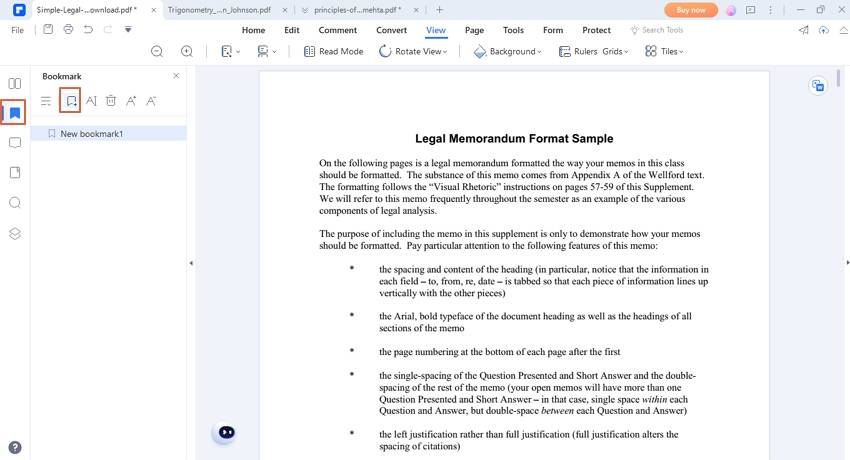
Then rename the bookmark so it matches the style of the rest of the list.
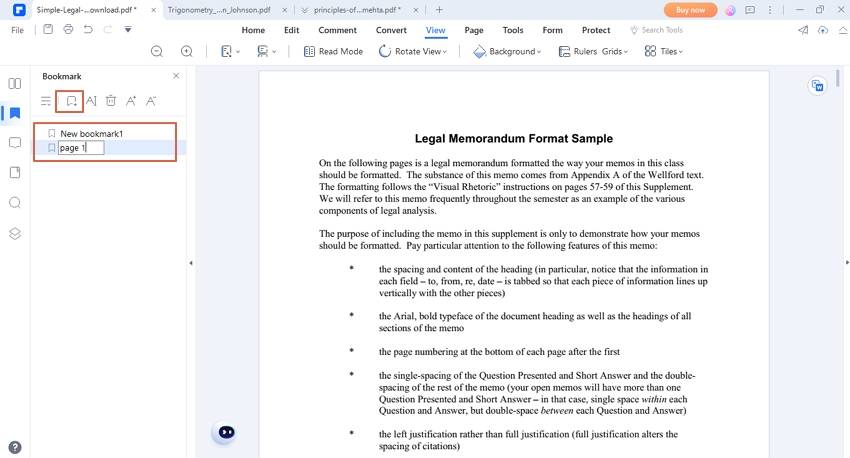
Manual additions are useful for pages that do not have obvious headings, such as a signature page, certification page, index, attachment, exhibit, or reference table.
Remove Extra Bookmarks
Sometimes the software detects text that should not become a bookmark. Common examples include page headers, footers, bold callout text, repeated disclaimers, or table captions.
Remove these entries before sharing the file. Too many bookmarks make the panel noisy. A reader should not have to scroll through dozens of low-value entries to find the main sections.
As a rule, if a bookmark does not help someone make a navigation decision, it probably does not need to be there.
Best Practices for Clean, Professional PDF Bookmarks
A bookmarked PDF feels polished when the navigation matches the way readers think about the document. That does not always mean bookmarking every heading. It means choosing the right level of detail.
For a short 12-page proposal, bookmarks for each main section may be enough. For a 300-page technical manual, you may need chapters, subchapters, appendices, and reference tables. The right structure depends on the document length and how people will use it.
Keep bookmark names concise. Avoid full sentences unless the section title genuinely needs them. Remove decorative numbering if it adds clutter, but keep numbering when it helps readers match the bookmark to the document structure. In legal, academic, and technical documents, section numbers are often useful.
Use consistent capitalization. A bookmark panel that mixes “Payment Terms,” “PAYMENT schedule,” and “late fee policy” looks careless even if the links work. Choose title case or sentence case and apply it consistently.
Also test the bookmarks in a common PDF reader before sending the file. Open the saved PDF, expand and collapse the bookmark panel, click the first few entries, and check a few later entries. If the document will be distributed externally, test it outside the editing software too.

PDFelement can fit naturally into this broader finishing workflow. After you auto bookmark the PDF, you can use the same tool to compress a large file for email, reorder pages, add comments for review, run OCR on scanned sections, convert the PDF to an editable format, or apply signatures before distribution. That is useful because bookmarking often happens near the end of document preparation, when small fixes still appear.
When to Use Manual Bookmarks Instead
Auto bookmarking is efficient, but it is not the best choice for every document. Some files need human judgment from the beginning.
Manual bookmarks are often better for small PDFs. If a file has only five or six important sections, it may be faster to add bookmarks yourself than to generate a full bookmark list and clean it up.
They are also better for documents with weak visual structure. If headings are inconsistent, repeated, or not styled differently from body text, automatic detection may create a messy list. You could still try auto bookmarking, but manual cleanup may take longer than manual creation.
Scanned documents can go either way. If OCR produces clean selectable text and the headings are easy to detect, auto bookmarking may work. If the scan is skewed, blurry, handwritten, or full of stamps and marks, manual bookmarks are more reliable.
Manual bookmarks also make sense when you want a custom reading path. For example, a lawyer might bookmark only the clauses relevant to negotiation. A teacher might bookmark only the pages students need for an assignment. A project manager might bookmark decision points rather than every section heading.
In those cases, the goal is not to recreate the document outline. The goal is to guide a specific reader to specific places.
People Also Ask
-
Can a PDF create bookmarks automatically?
A PDF file itself does not usually create bookmarks on its own. You need a PDF editor with an auto bookmark feature. The editor analyzes the document structure, such as headings or text styles, and generates bookmarks based on those signals. -
Why did my PDF automatic bookmarks miss some sections?
This usually happens because the missed headings are formatted differently from the rest of the document. For example, one chapter title might be bold and large, while another is plain text. Auto bookmark tools rely on patterns, so inconsistent formatting can lead to missing or misplaced bookmarks. -
Can scanned PDFs be auto bookmarked?
Yes, but only if the scanned PDF has usable text recognition. If the file is just page images, run OCR first. After OCR, the software may be able to detect headings and create bookmarks. The quality depends on the scan clarity and how well OCR recognizes the text. -
How do I keep bookmarks after saving a PDF?
After creating or editing bookmarks, save the PDF in a standard PDF format. In PDFelement, use Save or Save As after confirming the bookmark panel looks correct. If you export or print the PDF through another tool, check the settings because some workflows may flatten or remove navigation data. -
Are PDF bookmarks the same as links?
No. PDF bookmarks appear in the bookmark or navigation panel and help users move through the document structure. Links usually appear on the page itself, such as clickable text in a table of contents or a URL. Both can take users to another page or destination, but they are stored and displayed differently. -
Can I add bookmarks without changing the page content?
Yes. PDF bookmarks are navigation elements, so adding them does not change the visible page text or layout. You can create, rename, reorder, or delete bookmarks without rewriting the document content. -
What is the fastest way to add bookmarks to a long PDF?
The fastest method is to use an auto bookmark PDF tool, then review and adjust the generated bookmark tree. This gives you the speed of automation while still allowing you to fix missing, extra, or poorly named entries before sharing the file. -
Should every heading become a PDF bookmark?
Not always. Bookmark the sections readers are likely to navigate to. In a long technical manual, detailed sub-bookmarks may help. In a short proposal, too many bookmarks can feel cluttered. The bookmark panel should make the file easier to use, not simply repeat every styled line.
Auto bookmarking is one of the quickest ways to make a long PDF easier to navigate, but the best results come from pairing automation with a short review. Generate the bookmarks from the document structure, check the bookmark panel, rename unclear entries, add missing destinations, and remove anything that does not help the reader.
If you work with PDFs regularly, PDFelement gives you a practical workflow for creating automatic bookmarks in PDF files and then finishing the document in the same place. You can clean up pages, run OCR, add comments, compress the file, or save a polished bookmarked copy for sharing. For long documents, that saves time and gives readers a PDF that feels organized from the first click.