SIOP Lesson Plan Examples Free PDF Samples
In this article
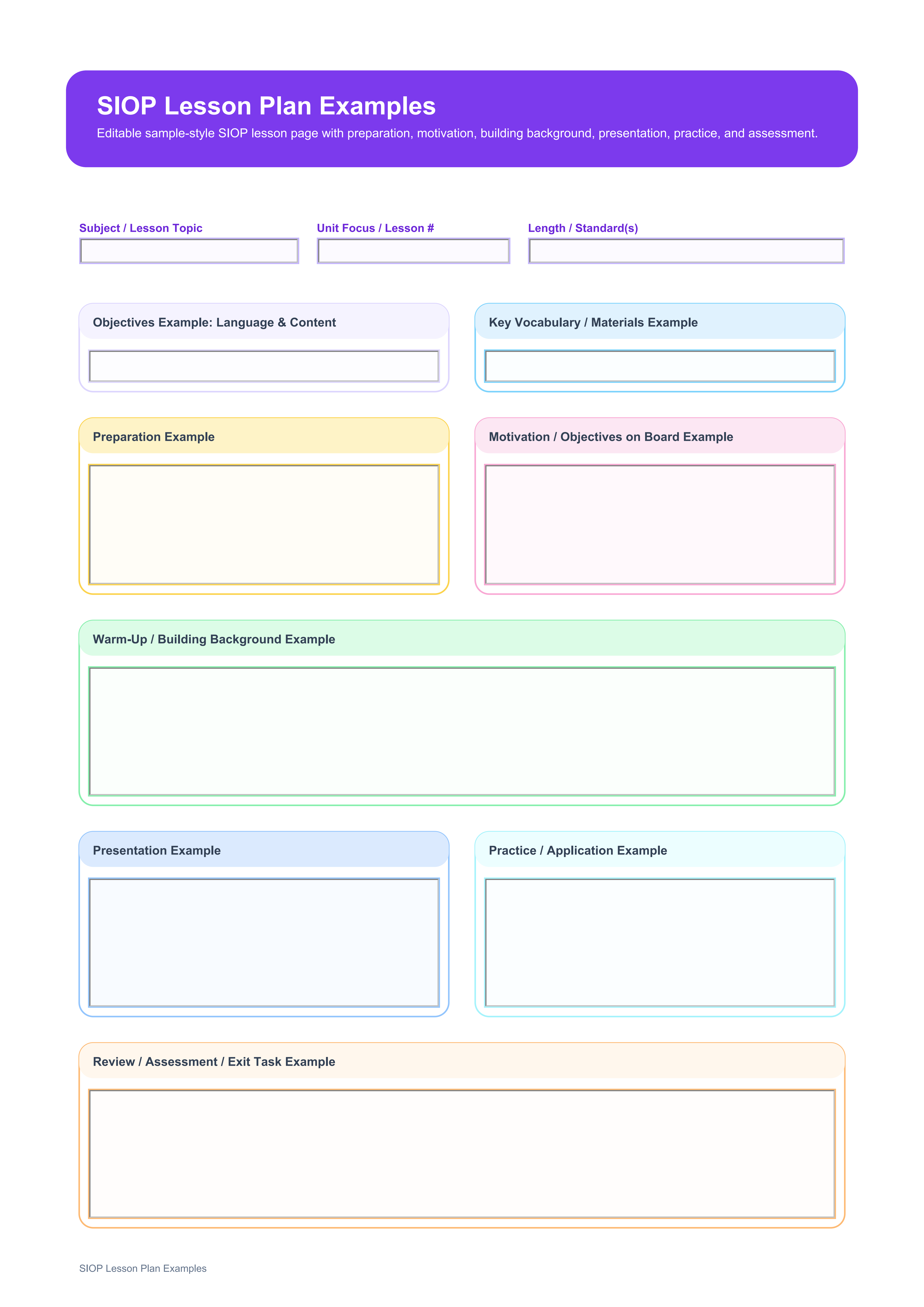
What are SIOP lesson plan examples? SIOP lesson plan examples are sample pages that show how a sheltered lesson can be written in a real classroom sequence rather than as a blank framework. This PDF reflects that sample-style structure with fields for Subject / Lesson Topic, Unit Focus / Lesson #, Length / Standard(s), Objectives Example: Language & Content, Key Vocabulary / Materials Example, Preparation Example, Motivation / Objectives on Board Example, Warm-Up / Building Background Example, Presentation Example, Practice / Application Example, and Review / Assessment / Exit Task Example.
This is why the page feels different from a template. It is organized to show how a lesson moves in practice: what the teacher prepares, how the lesson opens, how background is built, how content is presented, and how understanding is checked at the end. The published sample lesson sequence from CAL follows that kind of progression closely.
Who should study these SIOP examples
This page is most useful for teachers who understand the idea of SIOP in theory but want to see how a finished lesson can sound and flow on paper.
- Teachers looking for a sample SIOP lesson before drafting their own
- Instructional coaches or teacher candidates studying how SIOP components appear in sequence
- Schools that want model SIOP plans for training, calibration, or demonstration purposes
What the sample page contains
This PDF is organized around the real field structure of the page, so the sections below map directly to what appears in the template.
| Field | What to Fill In | Why It Helps |
| Subject / Lesson Topic | The subject area and the lesson topic being modeled | Places the sample in a real classroom context |
| Unit Focus / Lesson # | Where the sample fits inside a unit and lesson sequence | Shows the lesson as part of a larger instructional arc |
| Length / Standard(s) | The time span and content standard reference | Helps the sample feel anchored to teachable conditions |
| Objectives Example: Language & Content | Sample content and language objective wording | Demonstrates how dual objectives can be written clearly |
| Key Vocabulary / Materials Example | The vocabulary and materials included in the sample | Shows what support resources often matter in sheltered instruction |
| Preparation Example | What is prepared in advance before students begin | Models the planning that happens before delivery |
| Motivation / Objectives on Board Example | How the lesson is launched and how objectives are introduced | Shows a practical opening rather than an abstract heading |
| Warm-Up / Building Background Example | A sample activation of prior knowledge and topic entry | Demonstrates how background work can sound in real teaching |
| Presentation Example | The modeled explanation or teaching segment | Shows how core content can be introduced clearly |
| Practice / Application Example | The sample task where students use the content and language | Illustrates how SIOP moves from input to active use |
| Review / Assessment / Exit Task Example | The closing check and summary of learning | Shows how the lesson can end with evidence rather than guesswork |
How to learn from a sample SIOP lesson
The best way to use a sample SIOP lesson is to notice the level of detail, not to imitate every word. A good sample does not just list headings; it shows how preparation, motivation, building background, presentation, practice, and review connect to one another in a believable classroom rhythm.
That is what makes sample plans valuable. They reveal how a teacher can move from posted objectives to actual tasks and then back to assessment at the end. The CAL sample, for example, makes that sequence explicit by moving from objectives into warm-up, presentation, practice, and review with timed sections.
Why do teachers download this siop lesson plan examples?
Teachers often download example pages because a sample is faster to learn from than an empty form. It gives a concrete sense of tone, pacing, and instructional detail that a blank template cannot provide by itself.
Note: This file is example-driven. It is meant to model SIOP lesson wording and sequence rather than serve as a neutral blank planning sheet.
How are SIOP lesson plan examples different from a SIOP lesson plan template?
Examples explain by showing a finished lesson pattern. Templates organize by providing empty fields. If you need to understand what a SIOP lesson may look like in real use, examples help more. If you already know the method and need a clean page to fill, the template is more efficient.
| Format | Best For | Main Difference |
| SIOP Lesson Plan Examples | Studying a modeled sheltered lesson sequence | Shows sample preparation, motivation, presentation, practice, and assessment wording |
| SIOP Lesson Plan Template | Creating a new SIOP lesson on your own | Provides blank sections for the teacher to complete independently |
How to adapt the sample with PDFelement
PDFelement is helpful for sample pages because examples often become working drafts. A teacher can keep the lesson logic, replace the topic, adjust the vocabulary, and convert the example into a classroom-ready plan without recreating the layout.
It also offers AI, Edit, OCR, Convert, Sign, Protect, and Batch Tools, which helps when sample lessons are stored alongside related readings, handouts, or training materials.
Step 1 Open the SIOP examples page in PDFelement
Read the lesson sequence from preparation to review before making changes.
Step 2 Adapt the sample for your own classroom
Replace the subject, standards, objectives, vocabulary, and teaching moves while keeping the useful structure.
Step 3 Save the revised version as a new lesson draft
Keep the original example available so it can still function as a reference model later.
Why is PDFelement practical for SIOP planning?
PDFelement works well here because examples are most valuable when they can be annotated, revised, and gradually turned into original classroom plans.
FAQ
-
Why use SIOP lesson plan examples?
They help teachers see how SIOP components actually appear in order, with realistic detail and classroom pacing.
-
Should I copy a sample SIOP plan exactly?
Usually not. It is better to learn from the structure and level of explanation, then adapt the lesson to your own students and standards.
-
What makes a sample different from a template?
A sample shows completed teaching logic, while a template gives you blank sections to build your own lesson.
-
Is the PDF editable?
Yes. You can revise the sample, save a personalized version, and print it for planning or training use.