ESL TEFL EFL Lesson Plan Examples Free PDF
In this article
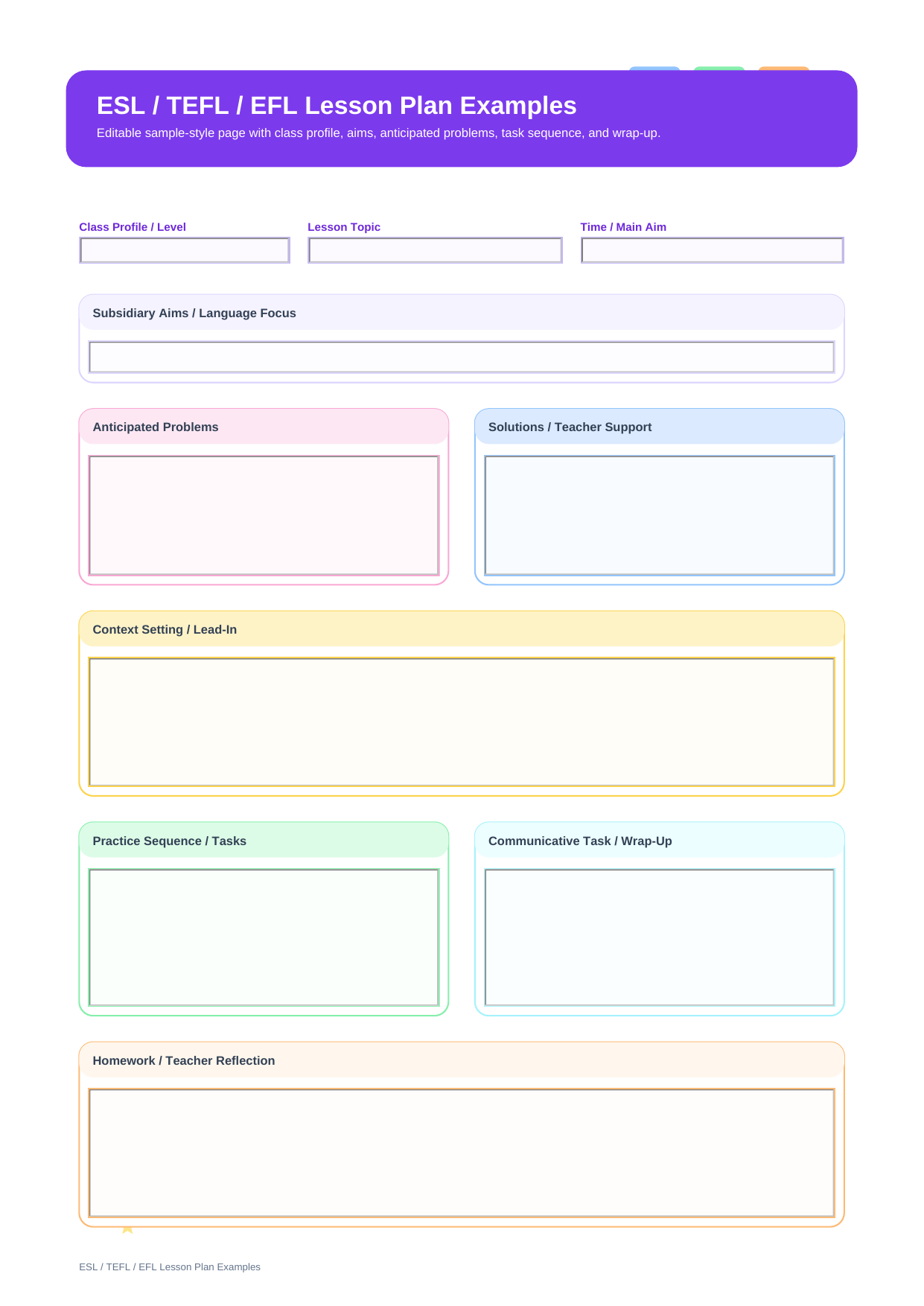
What are ESL / TEFL / EFL lesson plan examples? These ESL / TEFL / EFL lesson plan examples are sample-style planning pages that show how a language lesson can unfold in real classroom conditions. The PDF layout includes Class Profile, Main Aim, Subsidiary Aims, Problems & Solutions, Context, Practice Sequence, Communicative Task, and Homework.
That combination makes the page feel more like a teacher-training example than a plain blank template. It is meant to show decision-making, anticipation, and progression, not just provide empty boxes.
Who benefits from example-based ESL pages
These pages are especially useful for teachers in training, certification courses, and reflective practice, where the reasons behind each lesson stage matter as much as the stages themselves.
- CELTA, TEFL, TESOL, or EFL trainees studying lesson design
- Teachers who want a concrete English lesson plan sample
- Trainers collecting model language-lesson structures for workshops
What sections the sample uses
This PDF is organized so the planning logic is easy to scan. The main fields below reflect the exact structure of the page and show what each part is meant to capture.
| Field | What to Fill In | Why It Helps |
| Class Profile | Who the learners are and what level or needs they have | Keeps the sample grounded in a real teaching context |
| Main Aim | The primary communicative or language goal | Shows the central purpose of the lesson |
| Subsidiary Aims | Supporting aims such as vocabulary, skills, or pronunciation | Adds realistic detail to the planning logic |
| Problems & Solutions | Likely learner difficulties and teacher responses | Demonstrates anticipatory planning |
| Context | Situation, text, topic, or scenario used to introduce the lesson | Gives the language a meaningful setting |
| Practice Sequence | The ordered classroom tasks | Shows how the lesson will build step by step |
| Communicative Task | A freer or more authentic language-use activity | Pushes the lesson toward real communication |
| Homework | A follow-up task after class | Extends learning beyond the lesson |
How to learn from the sample structure
The best way to use these examples is to study the reasoning hidden inside the layout. Notice how the page moves from learner context to aims, then anticipates likely problems before outlining the practice sequence.
That is why example pages are valuable in training. They show not only what happens next, but why a teacher might choose that next step.
Why do teachers download this esl / tefl / efl lesson plan examples?
Teachers often look for an english lesson plan sample when they want something more concrete than a general form. That is exactly where example-style ESL pages help.
Note: This is an example-driven language-teaching format. It is more reflective and more situational than a standard blank ESL template.
How are ESL / TEFL / EFL lesson plan examples different from an ESL template?
Example pages explain a lesson through context and decision-making. A blank template helps you record your own lesson quickly. If you need inspiration or training support, examples do more work.
| Format | Best For | Main Difference |
| ESL / TEFL / EFL Lesson Plan Examples | Studying modeled lessons and teaching choices | Includes class profile, aims, and anticipated problems |
| ESL Lesson Plan Template | Drafting your own lesson efficiently | Uses reusable blank stages with less built-in guidance |
Editing the sample with PDFelement
PDFelement lets you annotate, edit, and adapt the sample into your own classroom version. You can keep the planning logic but replace the learner profile, language target, and tasks.
With AI, Edit, OCR, Convert, Sign, Protect, and Batch Tools, it also becomes easier to maintain a bank of reference lessons for training and teaching practice.
Step 1 Open the ESL example page in PDFelement
Read the lesson logic from class profile to communicative task.
Step 2 Adapt the sample for your learners
Replace the model aims, context, problems, and tasks with details that fit your class.
Step 3 Save the revised file as a new teaching version
Keep the original example available for future comparison or training use.
Why is PDFelement practical for lesson planning?
PDFelement is useful here because example pages often become working drafts, reflection notes, and observation documents all at once.
FAQ
-
Who should use ESL / TEFL / EFL lesson plan examples?
Teacher trainees, trainers, and practicing teachers who want modeled lesson structures.
-
Why include problems and solutions?
Because language teaching improves when likely learner difficulties are anticipated in advance.
-
Can I edit these examples?
Yes. You can adapt the sample to a new class, level, or language focus.
-
Is this the same as a blank template?
No. This page is example-based and includes more contextual teaching guidance.