SIOP Unit Plan Template Free PDF for Teachers
In this article
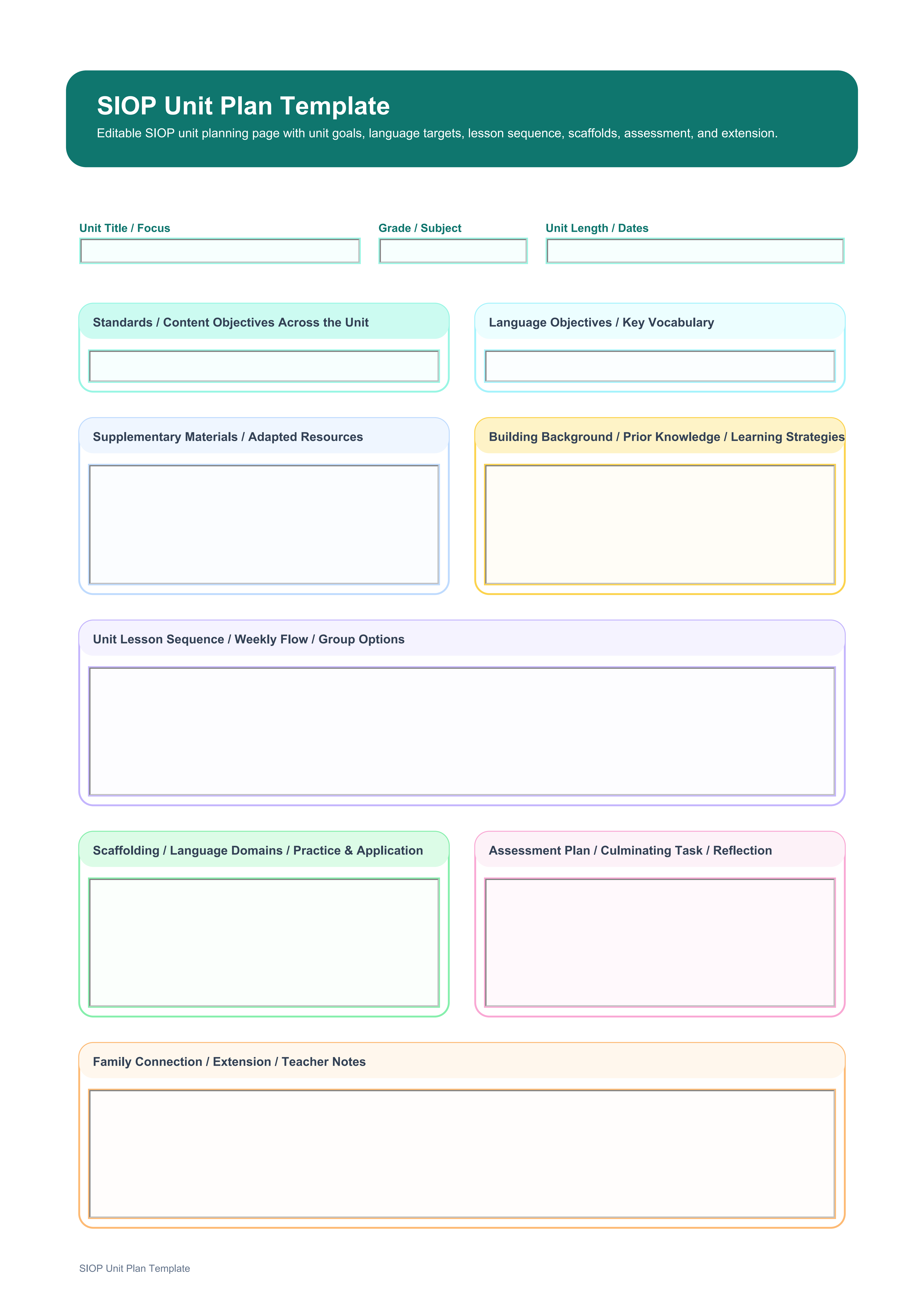
What is a SIOP unit plan template? A SIOP unit plan template is a broader planning page used to map multiple lessons through the lens of sheltered instruction rather than plan a single class period. This PDF follows the actual unit-level structure with Unit Title / Focus, Grade / Subject, and Unit Length / Dates across the top, followed by Standards / Content Objectives Across the Unit, Language Objectives / Key Vocabulary, Supplementary Materials / Adapted Resources, Building Background / Prior Knowledge / Learning Strategies, Unit Lesson Sequence / Weekly Flow / Group Options, Scaffolding / Language Domains / Practice & Application, Assessment Plan / Culminating Task / Reflection, and Family Connection / Extension / Teacher Notes.
The key difference is scale. A lesson template asks what happens in one class. A unit template asks how content objectives, language demands, scaffolds, resources, and assessment fit together across a longer stretch of instruction. Even the few public references to a SIOP unit template frame it as a separate planning format rather than just a larger lesson page.
Who should use this SIOP unit plan page
This page fits teachers who want to organize an entire SIOP-aligned unit before drafting individual daily lessons, especially when language support needs to stay coherent across several days or weeks.
- Teachers planning a multi-lesson SIOP unit rather than a single class period
- Teams mapping shared standards, vocabulary, and scaffolds across a unit
- Instructional leaders who want a higher-level sheltered planning document before daily planning begins
What belongs in a SIOP unit template
This PDF is organized around the real field structure of the page, so the sections below map directly to what appears in the template.
| Field | What to Fill In | Why It Helps |
| Unit Title / Focus | The unit theme, text set, topic, or content focus | Defines the long-range focus of instruction |
| Grade / Subject | The grade band and subject area for the unit | Keeps planning tied to a clear audience and discipline |
| Unit Length / Dates | The unit duration or planned dates | Shows the planning horizon beyond a single lesson |
| Standards / Content Objectives Across the Unit | The core standards and content outcomes for the unit | Keeps the unit academically grounded from the start |
| Language Objectives / Key Vocabulary | The recurring language goals and unit vocabulary | Prevents language support from being treated as an afterthought |
| Supplementary Materials / Adapted Resources | Texts, visuals, adaptations, and support resources used across the unit | Supports consistency in access and comprehension |
| Building Background / Prior Knowledge / Learning Strategies | How prior knowledge and learning strategies will be activated over time | Helps the unit build understanding instead of assuming it |
| Unit Lesson Sequence / Weekly Flow / Group Options | The order of lessons, pacing, and grouping choices across the unit | Shows how the unit unfolds over multiple teaching days |
| Scaffolding / Language Domains / Practice & Application | How scaffolds and language-domain work will recur across lessons | Keeps the sheltered design visible across the whole unit |
| Assessment Plan / Culminating Task / Reflection | Unit assessment, major task, and reflection planning | Links daily instruction to larger evidence of learning |
| Family Connection / Extension / Teacher Notes | Home links, extension opportunities, and planning notes | Adds continuity beyond the classroom and the unit itself |
How to plan a unit with SIOP in mind
A useful unit plan begins with the larger arc, not the first activity. Write the Standards / Content Objectives Across the Unit and the Language Objectives / Key Vocabulary first so the unit has both academic direction and language coherence. After that, identify the Supplementary Materials / Adapted Resources and the prior knowledge work that students will need throughout the unit.
The center of the page should show movement over time. Use Unit Lesson Sequence / Weekly Flow / Group Options to lay out the pacing, then describe how Scaffolding / Language Domains / Practice & Application and the Assessment Plan / Culminating Task / Reflection will stretch across the unit instead of appearing only at the end.
Why do teachers download this siop unit plan template?
Teachers choose this page when they want to plan SIOP at the unit level, not just at the lesson level. It is especially useful when vocabulary, scaffolds, and language domains need to recur in a coordinated way over several lessons.
Note: This is a unit-level planning form. It should guide multiple lessons, not compete with a daily lesson template by trying to capture every move from a single class period.
How is a SIOP unit plan template different from a SIOP lesson plan template?
A lesson template focuses on one teachable period. A unit template focuses on continuity across many periods. The unit page tracks standards, vocabulary, resources, scaffolds, and assessment over time, while the lesson page narrows down to one instructional sequence for a single class.
| Format | Best For | Main Difference |
| SIOP Unit Plan Template | Organizing a multi-lesson sheltered unit | Tracks standards, language goals, pacing, scaffolds, and assessment across several lessons |
| SIOP Lesson Plan Template | Planning one SIOP lesson at a time | Tracks objectives, sequence, interaction, and review for a single class period |
How to maintain it with PDFelement
PDFelement is useful for unit planning because unit documents are revised repeatedly as pacing shifts, assessments change, or resources are updated. A fillable PDF makes those updates easier without breaking the structure of the plan.
It also includes AI, Edit, OCR, Convert, Sign, Protect, and Batch Tools, which can help if the unit plan is linked to multiple texts, adapted resources, or planning documents stored together.
Step 1 Open the SIOP unit plan template in PDFelement
Look over the unit-level sections first so you do not accidentally plan it like a single lesson page.
Step 2 Fill in the unit arc and supports
Type the standards, unit language goals, resources, sequence, scaffolds, and assessment plan into the PDF.
Step 3 Save updated versions as the unit develops
Keep a current working copy and revise it as pacing, vocabulary, or culminating tasks change.
Why is PDFelement practical for SIOP planning?
PDFelement is especially practical for unit work because long-range plans stay useful only when they are easy to revisit, revise, and redistribute.
FAQ
-
What should a SIOP unit plan include?
A SIOP unit plan should include standards, content objectives across the unit, language objectives, vocabulary, resources, sequencing, scaffolds, assessment planning, and extension or reflection notes.
-
Why make a unit plan instead of only daily lesson plans?
Because a unit plan helps keep objectives, vocabulary, scaffolds, and assessment consistent across several lessons instead of rebuilding them from zero every day.
-
Can I still use daily SIOP lesson plans with this?
Yes. The unit plan works best as a high-level guide, while daily lesson templates handle the specific teaching moves for each class.
-
Is the PDF editable?
Yes. You can type into the fields, update the unit as it changes, and print revised versions whenever needed.