SIOP Lesson Plan Template Free PDF for Teachers
In this article
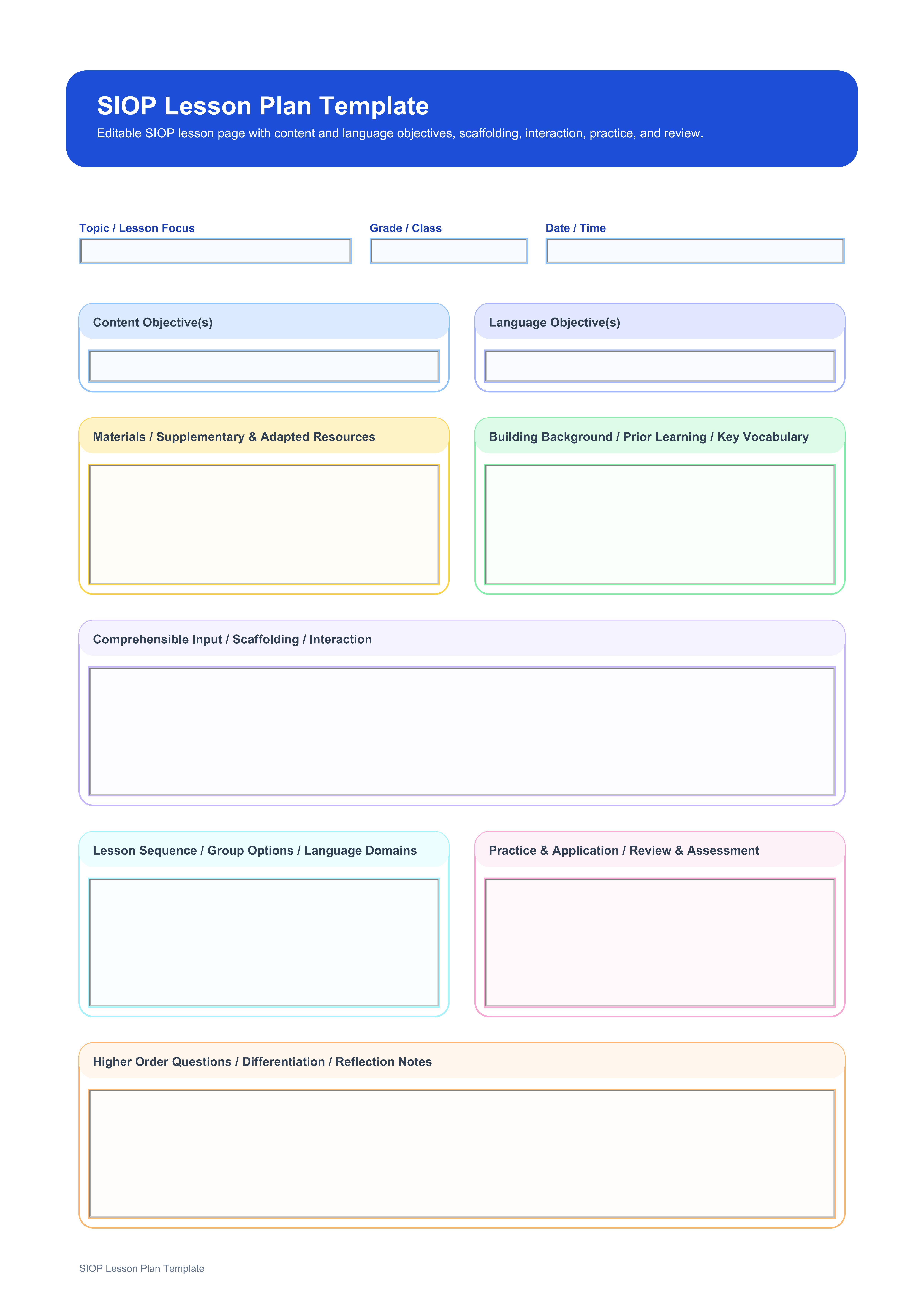
What is a SIOP lesson plan template? A SIOP lesson plan template is a blank planning page built around the Sheltered Instruction Observation Protocol, a framework used to make academic content more accessible to English learners while keeping language development visible inside the lesson. This PDF follows the actual template structure with fields for Topic / Lesson Focus, Grade / Class, and Date / Time, followed by Content Objective(s), Language Objective(s), Materials / Supplementary & Adapted Resources, Building Background / Prior Learning / Key Vocabulary, Comprehensible Input / Scaffolding / Interaction, Lesson Sequence / Group Options / Language Domains, Practice & Application / Review & Assessment, and Higher Order Questions / Differentiation / Reflection Notes.
It is designed for teachers who need a fillable page that keeps the SIOP components in view without turning the lesson into a checklist dump. The structure encourages a teacher to think about academic goals, language goals, scaffolds, grouping, and review as connected parts of the same lesson rather than separate compliance items.
Who should use this SIOP lesson template
This page works best for teachers planning a single sheltered lesson where both content learning and language development need to be visible from the beginning.
- Classroom teachers using SIOP for content-area instruction with multilingual learners
- ESL or EL support teachers who want language and content objectives on the same page
- Coaches or teacher candidates who need a lesson format aligned with SIOP components
What the template includes
This PDF is organized around the real field structure of the page, so the sections below map directly to what appears in the template.
| Field | What to Fill In | Why It Helps |
| Topic / Lesson Focus | The topic, text, concept, or academic skill being taught | Anchors the lesson in one clear instructional focus |
| Grade / Class | The grade level, section, or group receiving instruction | Keeps the plan tied to the actual teaching context |
| Date / Time | The lesson date and class period or teaching block | Helps organize planning and reuse later |
| Content Objective(s) | What students should understand or do academically | Makes the academic target explicit |
| Language Objective(s) | How students will use language during the lesson | Keeps language growth visible, not assumed |
| Materials / Supplementary & Adapted Resources | Texts, visuals, supports, adapted materials, or tools | Prepares the teacher to make input more accessible |
| Building Background / Prior Learning / Key Vocabulary | Prior knowledge links, background connections, and target vocabulary | Helps learners connect new content to what they already know |
| Comprehensible Input / Scaffolding / Interaction | How teacher language, modeling, support, and student interaction will be handled | Captures what makes the lesson sheltered rather than simply well organized |
| Lesson Sequence / Group Options / Language Domains | The teaching order, grouping choices, and language domains used | Shows how the lesson will unfold across listening, speaking, reading, and writing |
| Practice & Application / Review & Assessment | Meaningful practice, application tasks, and checks for understanding | Ensures students use the learning before the lesson closes |
| Higher Order Questions / Differentiation / Reflection Notes | Questions, differentiation moves, and brief reflection notes | Pushes the lesson beyond low-level recall and supports adjustment |
How to fill out a SIOP lesson plan well
Start with the two objectives, not the activity. A strong SIOP lesson becomes easier to plan when the Content Objective(s) and Language Objective(s) are written clearly first. After that, use Building Background / Prior Learning / Key Vocabulary to connect the lesson to what students already know and to surface the language demands early.
The middle of the page matters most. In a true SIOP format, Comprehensible Input / Scaffolding / Interaction should explain how the lesson will be made understandable, while Lesson Sequence / Group Options / Language Domains and Practice & Application / Review & Assessment should show how learners will use both content and language during the lesson.
Why do teachers download this siop lesson plan template?
Teachers download this template when they want a reusable one-page SIOP structure that is specific enough to support sheltered instruction but still flexible enough to work across science, social studies, literacy, and other content areas.
Note: This is a blank SIOP lesson form. It is meant for building a fresh lesson, not for modeling sample wording or demonstrating one completed classroom scenario.
What is the difference between a SIOP lesson plan template and SIOP lesson plan examples?
The template gives you the framework. The examples show how that framework might be used in a real lesson. If you need to create your own objectives, scaffolds, and practice tasks, the blank template is the right starting point. If you want to see what a finished SIOP lesson looks like, examples are more useful.
| Format | Best For | Main Difference |
| SIOP Lesson Plan Template | Planning your own sheltered lesson from scratch | Blank structure with SIOP-aligned sections for objectives, scaffolds, interaction, and assessment |
| SIOP Lesson Plan Examples | Reviewing a sample SIOP lesson in action | Model-based page that shows preparation, motivation, presentation, and review in use |
How to edit and reuse it with PDFelement
PDFelement works well for a SIOP planning page because teachers often reuse the same framework while changing only the objectives, vocabulary, scaffolds, and practice activities. The structure stays stable even when the lesson focus changes.
It also includes AI, Edit, OCR, Convert, Sign, Protect, and Batch Tools, which can help if your SIOP lesson materials include adapted texts, scanned handouts, or multiple versions for different classes.
Step 1 Open the SIOP lesson plan template in PDFelement
Review the objective and scaffold sections first so the lesson logic is clear before you start typing.
Step 2 Fill in the SIOP lesson components
Type the content objective, language objective, vocabulary, sequence, interaction, practice, and assessment details directly into the PDF.
Step 3 Save reusable teaching copies
Keep one blank master version and duplicate it for each new SIOP lesson you build.
Why is PDFelement practical for SIOP planning?
PDFelement is practical here because SIOP teachers usually repeat a planning structure while revising the instructional content, and that kind of editing is faster in a stable fillable PDF.
FAQ
-
What should a SIOP lesson plan include?
A SIOP lesson plan should include content objectives, language objectives, background building, key vocabulary, comprehensible input, scaffolding, interaction, practice, and review or assessment.
-
Why are content and language objectives separated?
Because SIOP expects teachers to make both academic learning and language use visible instead of leaving language demands hidden inside the task.
-
Can this template be used across subjects?
Yes. The format is broad enough for science, social studies, literacy, and other content areas taught with sheltered instruction.
-
Is the PDF editable?
Yes. You can type into the fields, save revised copies, and print the completed lesson plan as needed.